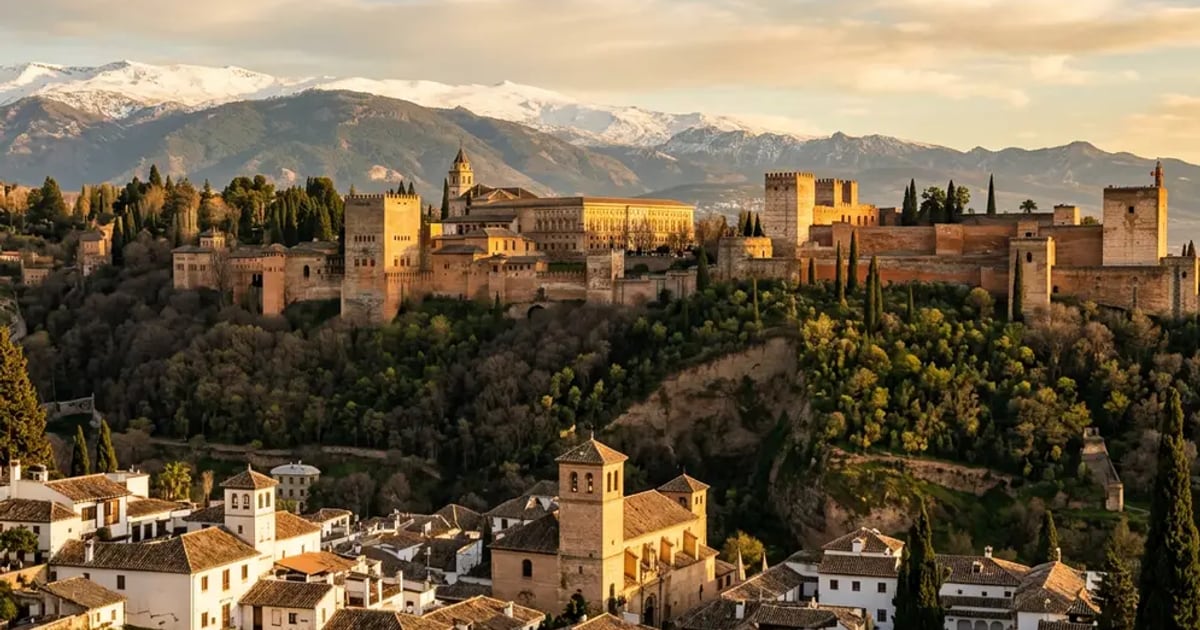
Granada was not always the city you see. Romans built Iliberis here. Berber dynasties fortified the hill above the Darro. The Nasrids spent 250 years building one of the world's great palaces before handing over the keys in 1492. Then the Habsburgs built a Renaissance palace inside it.
Seven years resident in Granada. Specialist in Nasrid architecture, Al-Andalus history, and Andalusian walking routes.
Published
Updated
Walk through the Albaicín and you are on streets that follow the layout of a 10th-century Islamic medina. Look at the foundations of any old building in the city centre and you will likely find Roman stone beneath. The Alhambra stands on a hill where Berber soldiers built the first fortifications around 1013; inside it, a Habsburg emperor planted a circular Renaissance palace in 1527 as if to say the old owners were gone for good. Granada does not wear its history lightly. It is built from it, layer by layer.
This guide runs chronologically: from the Roman settlement of Iliberis through the Zirid and Nasrid dynasties, through the extraordinary compression of 1492 (fall of Granada, expulsion of the Jews, Columbus in the Americas — three world-historical events in nine months), through Habsburg decline and Romantic rediscovery, to Federico García Lorca's assassination in August 1936 and what came after.
Each section points to specific sites you can visit. History here is not abstract. The pomegranate on the city coat of arms, the carved Arabic script on the palace walls, the grave they have never found near Víznar — all of it is still present, accessible, and worth knowing before you arrive.
Before the Moors: Iliberis and Roman Granada
The city the Romans called Iliberis sat roughly where the Albaicín hill stands today. It was a settlement of the Iberian Turduli people before Rome arrived; after conquest it became a prosperous provincial town in the province of Baetica, producing olive oil, metalwork, and the coins that archaeologists still pull out of the ground near Carrera del Darro.
The Roman city matters less for what survives — almost nothing of it is visible above ground — than for what it established: a populated, defended hill with fresh water from the Sierra Nevada rivers, controlling the route south between the mountains and the coast. Every subsequent occupier chose the same location for the same reasons.
The Council of Elvira, 306 AD
One of the earliest Christian church councils in the Western world met at Iliberis (then called Elvira) around 306 AD. The town already had a substantial Christian community. The council's canons dealt with everything from priestly celibacy to whether Christians could hold municipal office in a pagan city — practical questions for a community navigating Roman life. When the Visigoths took over in the 5th century, Granada remained a Christian city. It was that Christian population — never fully absorbed and never fully expelled — that made the first centuries of Islamic rule in the region complicated.
The Visigoths held the territory from the 5th century until 711, when Arab and Berber forces crossed the Strait of Gibraltar under Tariq ibn Ziyad and swept through the peninsula in under three years. What is now Granada fell quickly. For the next three centuries it was a regional centre within the Emirate and later Caliphate of Córdoba — prosperous, multi-religious, and largely unremarkable compared to what came after.
If you want physical evidence of Roman Iliberis, the Museo Arqueológico de Granada on Carrera del Darro holds the best collection: mosaics, Iberian pottery, Roman funerary inscriptions, and coins. The museum is in the Casa de Castril, a 16th-century palace with a carved plateresque doorway that is itself worth stopping for. Free for EU citizens; open Tuesday to Saturday.
The Zirids: Granada's first golden age
In 1013, the Caliphate of Córdoba collapsed. What had been one unified Islamic state in Iberia fractured into a dozen competing petty kingdoms called taifas. Granada fell to a Berber dynasty from North Africa, the Zirids, who made it the capital of their independent emirate. For the first time, Granada was the centre of something rather than a provincial outpost.
The Zirid emir Badis ibn Habus fortified the Sabika hill above the Darro — the same hill where the Alhambra now stands. Those early 11th-century fortifications were the proto-Alhambra, and traces of Zirid stonework lie beneath the Nasrid construction you visit today. The city that grew around them was already substantial, with a population of Jews, Muslims, and Christians living in separate quarters.
Samuel ibn Naghrilla and the Jewish golden age
The most extraordinary figure of Zirid Granada was not the emir but his vizier. Samuel ibn Naghrilla (Samuel HaNagid in Hebrew) was a Jewish scholar, poet, and general who served as prime minister to Badis ibn Habus from around 1020 until his death in 1056. He commanded Muslim armies in battle while also writing some of the finest Hebrew poetry of the medieval period. His son Joseph succeeded him as vizier.
It ended violently. In 1066, a mob killed Joseph ibn Naghrilla and massacred a significant portion of Granada's Jewish population — a pogrom that historians consider one of the earliest in medieval Iberia. The golden age of Jewish Granada effectively ended on that day. The community rebuilt, survived, and then faced the final blow in 1492, when the Alhambra Decree expelled all Jews from Spain who refused conversion.
The Zirid period lasted until 1090, when the Almoravids — a stricter, more orthodox Berber dynasty from Morocco — absorbed Granada into their expanding North African empire. Granada lost its independence but kept its population and its infrastructure. The Almohads replaced the Almoravids in the 1140s. Neither dynasty left much in Granada that is visible today; both were essentially transit rulers.
The Zirid legacy you can visit
Almost nothing of the Zirid period survives above ground in Granada. The best approach is the Museo Arqueológico, which holds artefacts from the Islamic period including 11th-century ceramics and metalwork. The Alhambra's own archaeological survey has identified Zirid foundations beneath the Alcazaba — these are not visible to visitors but are referenced in the museum's permanent collection.
The Nasrid dynasty: 250 years at the edge of Europe
In 1238, a minor Granadan noble named Muhammad I ibn al-Ahmar founded the Nasrid emirate and declared Granada its capital. He did so from a position of weakness: Córdoba had just fallen to Ferdinand III of Castile; Seville would follow in 1248. The Nasrid state existed because Muhammad I reached an accommodation with the Castilian crown, paying tribute and occasionally sending troops to fight alongside Christian armies. It was an arrangement that lasted, on and off, for 250 years.
The Nasrid Palaces were built mainly in the 14th century, under Yusuf I (1333–1354) and his son Muhammad V (1354–1391). The Comares Palace, the Court of the Myrtles, the Court of the Lions — all date from this period. Granada at its height had a population of around 100,000, making it one of the largest cities in medieval Europe. The silk trade funded everything: the city's souks, its palaces, the water systems that brought snow-melt from the Sierra Nevada through the Alhambra's fountains and pools. For a close reading of the visual language behind the palace walls — the muqarnas vaulting, arabesque carving, and hydraulic engineering — the Alhambra architecture guide explains what you are looking at and why it was built the way it was.
What the Nasrids built
The Alhambra complex on the Sabika hill, including the Alcazaba fortress
The Nasrid Palaces — Comares, Court of the Lions, and the private royal apartments
The Generalife summer palace and gardens above the Alhambra
The Madraza (Islamic university) in the city centre, fragments of which survive inside a later building on Calle Zacatín
How the emirate survived
Tribute payments to Castile, sometimes amounting to a third of tax revenues
Playing Christian kingdoms against each other (Castile vs Aragon)
Calling in North African allies (Marinids) when military pressure became critical
A geography that made conquest expensive: mountain passes, fortified hilltops, the Sierra Nevada at its back
The last decades of the Nasrid sultanate were consumed by dynastic civil war. Muhammad XII — known in Spain as Boabdil — and his father fought a succession dispute in the 1480s that left the emirate divided and exposed. Ferdinand and Isabella, newly unified through their 1469 marriage and flush with the revenue of a united Castile and Aragon, began systematically taking the Nasrid towns: Alhama in 1482, Ronda in 1485, Loja in 1486, Málaga in 1487, Almería in 1489. By 1491, Granada itself was under siege. The city held for months. Then it did not.
Boabdil surrendered on 2 January 1492. The terms were relatively generous: Muslims could keep their religion, their property, their mosques. Within a decade, most of those terms had been broken. The full guide to Moorish Granada covers what you can see today of the Nasrid city.
1492 and its three revolutions
No single year in Spanish history carries more weight. Three events, each world-historical on its own, occurred within nine months of each other — all connected to the same monarchs, the same treasury, and in two cases the same city.
2 January: the fall of Granada
Boabdil handed the keys of the Alhambra to Ferdinand and Isabella at Armilla, just south of the city, then rode towards exile. The Royal Chapel where Ferdinand and Isabella are buried was built on the site of the main Nasrid mosque; the Cathedral rose over it. The terms of surrender promised religious tolerance. The promise did not last. For a deeper portrait of Boabdil, the last Moorish king of Granada — his reign, his surrender, and what became of him — read the full article.
31 March: the Alhambra Decree
Signed in the Alcázar of Granada, the same palace complex, the Alhambra Decree ordered the expulsion of all Jews from Spain within four months unless they converted to Christianity. The document was signed by the same monarchs who had accepted Boabdil's surrender twelve weeks earlier. Historians estimate between 100,000 and 200,000 Jews left, taking what they could carry. Their property was forfeit. The decree would not be formally revoked until 1968.
October: Columbus lands in the Americas
Columbus's expedition was approved and funded by Ferdinand and Isabella from the Santa Fe camp outside Granada during the final months of the siege. He had been refused by Portugal; he came to the Catholic Monarchs at the moment when their treasury was fully committed to the conquest of Granada. They said yes anyway. He reached the Caribbean on 12 October 1492. The colonisation of the Americas, the Atlantic slave trade, the destruction of indigenous civilisations — all of it traces back to that approval, in that camp, outside this city.
What came after 1492
The promises made to Granada's Muslims on surrender were broken systematically. In 1502, Muslims in Castile were ordered to convert or leave. Those who converted — the Moriscos — faced a century of suspicion, forced assimilation, and ultimately expulsion: Philip III ordered the final removal of Moriscos from Spain between 1609 and 1614. Granada's silk trade, which had depended almost entirely on Morisco labour and expertise, collapsed. The city never fully recovered its medieval population levels.
The 1568–1571 War of the Alpujarras — a Morisco uprising in the mountain villages south of Granada — was suppressed with particular brutality. The survivors were forcibly dispersed across Castile. The Alpujarran villages were repopulated by settlers from northern Spain who had never grown silk and did not know the land. You can read about Boabdil's route south and the legend of the last sigh in the pomegranate history guide, which traces the city's symbol back through the Nasrid period.
Habsburg Granada: the city the Christians built
Ferdinand and Isabella did not demolish the Alhambra. They moved into it. Isabella used the Nasrid apartments; Ferdinand held court in the same halls where Nasrid sultans had received ambassadors. The palaces were too beautiful to destroy and too useful to ignore. But the city below was systematically transformed.
The Granada Cathedral was begun in 1523 on the site of the main Friday mosque. Its design shifted from Gothic to Renaissance partway through construction — you can see both impulses in the nave. The Royal Chapel, attached to the Cathedral, was built to house the tombs of the Catholic Monarchs and was completed in 1521. Isabella's crown, Ferdinand's sword, and the paintings from her personal collection are still there.
Charles V's palace inside the Alhambra (1527)
In 1527, Charles V commissioned a new palace inside the Alhambra — a circular courtyard building in the Italian Renaissance style, designed by Pedro Machuca, who had worked with Michelangelo. The Nasrid palaces were partly demolished to make space for it. Work continued for over a century but the building was never fully finished; Charles himself barely used it. It sat as a roofless shell for nearly 400 years.
Today the Palace of Charles V holds the Museo de la Alhambra on the ground floor and the Museo de Bellas Artes above. Both are included with a general Alhambra ticket. The circular courtyard — 30 metres in diameter — has a geometric perfection that is genuinely impressive, even if it has no business being inside a Nasrid palace complex. That incongruity, in a way, is the whole story of 16th-century Granada. See the Dobla de Oro guide for the combined ticket covering the Alhambra and eight Nasrid-era monuments in the Albaicín.
By the end of the 16th century, Granada's trajectory was clear. The expulsion of the Moriscos had gutted the silk trade. The city's population fell. New investment went north to Seville, which controlled the monopoly on Atlantic trade. Granada became a university city and a religious centre — the Monastery of San Jerónimo, the first Renaissance church in Spain, dates from this period — but it was no longer at the centre of anything.
Washington Irving and the romantic rediscovery
By the early 19th century, the Alhambra was in a state of managed decay. The French had occupied it during the Napoleonic Wars (1808–1812) and partially blown up some of the towers on withdrawal. Gypsies, itinerant workers, and a small garrison of Spanish soldiers were living inside the palace complex. The gardens were overgrown. The plasterwork was deteriorating.
In 1829, the American writer Washington Irving arrived in Granada with a letter of introduction to the Spanish governor. He was given rooms inside the Alhambra itself and spent three months living in the Nasrid apartments, writing by candlelight in rooms where Nasrid sultans had received ambassadors four centuries earlier. His Tales of the Alhambra, published in 1832, combined historical research, local legend, and Romantic embellishment into a portrait of a lost civilisation that captivated European and American readers.
What Irving actually did for Granada
The practical consequence of the book's success was real. European travellers arrived in numbers — Théophile Gautier in 1840, Richard Ford throughout the 1830s (whose Handbook for Travellers in Spain remains the most detailed 19th-century account of the country). The Spanish government began systematic restoration of the Alhambra in the 1840s. The architect Rafael Contreras devoted his career to it. Without Irving's book and the tourist revenue it generated, the deterioration might have continued to the point of irreversible loss.
Irving's room in the Alhambra — the Washington Irving Room in the Hall of Ambassadors — is not generally open to visitors, but there is a plaque. His account of the Alhambra in winter, candlelit and half-ruined, is more evocative than most contemporary writing about the place.
The 19th century also brought a railway to Granada (1874), connecting it to the national network and making mass tourism possible for the first time. By 1900, the Alhambra was already the most visited monument in Spain. The tension between preservation and visitation that the Patronato de la Alhambra manages today — timed tickets, strict visitor limits in the Nasrid Palaces — has its origins in those first Romantic-era crowds.
García Lorca and the 20th century
Federico García Lorca was born on 5 June 1898 in Fuente Vaqueros, a village about 17 km west of Granada. His family moved to the city when he was a child; he studied law at the University of Granada and music with Manuel de Falla, who also lived in the city. By the 1920s he was already publishing poetry and plays that drew on the traditions of Andalusian folk culture — the deep song, the Gypsy ballads of Sacromonte — while placing them inside a theatrical modernism unlike anything else being written in Spain. The Granada Lorca guide maps the sites connected to his life in detail: the Centro Federico García Lorca, the Huerta de San Vicente, and the literary trail through the city.
The family's summer house, the Huerta de San Vicente, is now a museum in the Parque Federico García Lorca, about 15 minutes' walk from the Cathedral. Lorca wrote Blood Wedding, Yerma, and Doña Rosita the Spinster there. The house is almost exactly as it was in his lifetime: the piano he played with De Falla, the desk where he worked, the garden where he sat in the evenings.
August 1936
The Spanish Civil War began on 17 July 1936. Granada was taken by Nationalist forces within days. Lorca, whose Republican sympathies were well-known and whose sexuality made him additionally vulnerable, took refuge with friends and then with the family of the Falangist poet Luis Rosales. He was arrested at the Rosales house on 16 August 1936, taken to the Nationalist civil government headquarters, and shot by Falangist militia on the night of 18–19 August, somewhere on the road between Víznar and Alfacar, about 10 km north of Granada.
His body was thrown into a mass grave. Despite several archaeological excavations — the most recent in 2009 — his remains have never been definitively identified. He was 38 years old. The order for his arrest came from the civil governor of Granada; who gave that order has been debated for 90 years without final resolution. His murder was not an accident or an administrative error. It was a deliberate killing of a man who was already internationally famous.
Granada under Franco was a quiet city. The repression in Andalusia after the Civil War was severe, and Granada, which had fallen to the Nationalists so quickly and completely, was not a place where resistance had room to organise. The University continued; the Alhambra continued to be visited. Tourism became the city's main economic engine in the 1960s and 1970s. The Patronato de la Alhambra was established in 1914 and expanded its remit steadily through the 20th century.
The contemporary city — liberal, university-dominated, with one of the densest bar and tapas cultures in Andalusia — lives at some distance from that history while remaining shaped by it. Lorca's name is on streets, theatres, and airport terminals. The Sacromonte cave district, which Lorca wrote about and collected folk songs from, is still inhabited and still has active flamenco performance spaces. The Huerta de San Vicente requires timed entry and sells out in advance — book online before you visit.
Frequently asked questions
Frequently asked questions
How long was Granada under Moorish rule?
Arab and Berber forces entered the region in 711. Granada finally fell to Ferdinand and Isabella on 2 January 1492. That is 781 years of Muslim rule in some form, though the city was not always an independent capital — for much of that time it was a provincial town within a larger Islamic state. The Nasrid Sultanate of Granada, the final independent Muslim kingdom in Iberia, lasted from 1238 to 1492, a period of 254 years. The Alhambra was built almost entirely during those Nasrid decades. The full guide to Moorish Granada covers what survives from those eight centuries.
Who was Boabdil and what is the 'Moor's last sigh'?
Muhammad XII, known to the Spanish as Boabdil, was the last Nasrid sultan. He surrendered Granada to Ferdinand and Isabella on 2 January 1492 after a siege that had left the city isolated and its treasury exhausted. The legend says that as he rode south into exile, he stopped at a mountain pass — the Puerto del Suspiro del Moro — and looked back at Granada for the last time, weeping. His mother, the story goes, said to him: "You weep like a woman for what you could not defend as a man." The pass exists; the inscription is real. Whether the dialogue happened is a different question. Boabdil was given a small estate in the Alpujarras mountains, then left Spain for Morocco, where he died in exile.
What was the Alhambra Decree and what happened to the Jews of Granada?
The Alhambra Decree (Edict of Expulsion) was signed on 31 March 1492 — twelve weeks after the fall of Granada. It ordered the expulsion of all Jews from Spain who refused to convert to Christianity. Historians estimate between 100,000 and 200,000 Jews left. The decree was signed in the Alcázar of Granada, in the very city where Jewish viziers had served the Zirid emirs four centuries earlier. Samuel ibn Naghrilla (Samuel HaNagid) had built a synagogue in Granada in the 11th century; by 1492 every synagogue in the city was gone. The decree was not officially revoked until 1968.
What did Charles V build inside the Alhambra, and why?
In 1527, the Holy Roman Emperor Charles V (Carlos I of Spain) commissioned a new Renaissance palace inside the Alhambra complex — a circular courtyard building in the Italian style, designed by Pedro Machuca. It was never fully completed and Charles himself rarely visited Granada. The palace was largely abandoned for centuries. Today it holds the Museo de la Alhambra and the Museo de Bellas Artes. As a piece of architecture it is arresting; it sits awkwardly among the Nasrid buildings, which is partly the point — a deliberate assertion of Christian imperial authority over the Moorish past.
Where was Federico García Lorca killed and is he buried in Granada?
Lorca was arrested by Nationalist forces in Granada in early August 1936, shortly after the city fell to the rebels at the start of the Spanish Civil War. He was shot on 19 August 1936, somewhere near Víznar, a village about 10 km north of Granada. His body was thrown into a mass grave. Despite several excavation attempts, his remains have never been found. The Huerta de San Vicente, the family summer house where he spent his last weeks, is now a museum and can be visited in central Granada. His birthplace, Fuente Vaqueros, is about 17 km west of the city and also has a small museum.
Deep dive: historical articles
For readers who want more than an overview, these articles go deeper on three of the defining episodes in Granada's history.
The 6km gravity-fed aqueduct that supplies the Alhambra's fountains and pools — still functioning, still feeding the same channels it built in the 13th century.
Reporter notebook
Insider tips
Practical observations gathered the way a local journalist would keep them: short, specific, and more useful than brochure copy.
Photo spot
The Museo Arqueológico shows what existed before the Moors
Most visitors to Granada never enter the Museo Arqueológico on Carrera del Darro. It sits in a 16th-century palace five minutes from the Alhambra ticket queues and holds the physical evidence of Roman Iliberis: mosaics, amphorae, coins, and funerary inscriptions. The Roman city was centred slightly to the west of modern Granada, and the museum makes that displacement legible. Admission is free for EU citizens. Open Tuesday to Saturday, and Sunday mornings. The building itself — the Casa de Castril — is worth the visit for the carved plateresque doorway alone.
Local custom
Visit the Royal Chapel on a weekday morning, not a Saturday afternoon
The Royal Chapel holds the tombs of Ferdinand and Isabella — the monarchs who ended Moorish rule, expelled the Jews, and funded Columbus, all within the space of one year. The sarcophagi, the altarpiece, and the collection of Flemish paintings Isabella brought from the Netherlands are all here. Saturday afternoons draw tour groups and long queues along Calle Oficios. On a Tuesday or Wednesday at 10 AM you can stand in front of the tombs without another visitor in sight. The sacristy holds Isabella's personal crown and Ferdinand's sword — items rarely mentioned in guidebooks but more affecting than most of what is in the Alhambra museums.
Best time
The pass of Suspiro del Moro is worth 20 minutes if you are driving south
The Puerto del Suspiro del Moro — the pass where Boabdil allegedly wept as he left Granada for the last time in 1492 — is 22 km south of the city on the A-44 motorway towards the coast. There is a lay-by and a stone inscription. It takes five minutes to stop, read the plaque, and look back north at the Sierra Nevada. The view is not spectacular but the context is. If you are heading to the Costa Tropical or Las Alpujarras, this is a 20-minute diversion that makes the rest of the drive feel different.
Booking tip
Huerta de San Vicente requires a timed entry — book online
The house where Lorca spent the summer of 1936 and wrote Blood Wedding and Yerma is now the Fundación Federico García Lorca museum in the Parque Federico García Lorca, about 15 minutes' walk from the Cathedral. Visits are guided only, in groups of around 10 people, at 45-minute intervals. Tickets sell out in advance during spring and autumn. Book at huertadesanvicente.com. The house is almost exactly as it was in 1936: the desk, the piano, the garden. Knowing what happened there in August of that year makes the stillness inside harder to absorb than most monuments in the city.