
Water in Islamic thought and garden design
The Arabic word for paradise is *jannah*, derived from a root meaning garden. The Quran describes paradise as a garden with four rivers running through it: rivers of water, milk, honey, and wine. This theological image shaped Islamic garden design across the medieval world, from the Persian *chahar-bagh* (four-part garden divided by water channels) to the courtyards of Andalusia.
In the **chahar-bagh** tradition, a garden is divided into four quadrants by two crossing channels, with a fountain or pool at the centre. The channels represent the four rivers of paradise. The sound of water, its movement and reflection, were not incidental pleasures. Stillness, sound, reflection, cooling: each aspect of water corresponded to a quality attributed to paradise in the Quranic description.
European medieval castle gardens were primarily utilitarian: herb gardens, kitchen gardens, orchards enclosed for protection. The Islamic garden was cosmological. When the Nasrid sultans built the [Alhambra](/monument/alhambra) and the [Generalife](/monument/generalife), they were building a physical argument about the nature of divine reward. The engineering that supplied water to the hilltop palace was the infrastructure that made that argument possible.
The Acequia Real: the main aqueduct
The **Acequia Real** (Royal Channel) is a 7-kilometre stone-cut aqueduct that runs from the Río Darro at Jesús del Valle, north of the city, along the contour of the hillside to the Alhambra. It was constructed in the early 13th century under the first Nasrid sultans[^1] and extended and reconstructed in the 14th century as the palace complex grew.
The channel's engineering is deceptively simple: it runs at a slight gradient, following the natural contour lines of the hill, dropping approximately **40 metres in elevation** between its intake point on the Darro and the cisterns beneath the Alhambra. Gravity does all the work. There are no pumps, no lifting mechanisms, no machinery of any kind. The volume of water delivered was enough to supply the entire palace complex, the gardens, and the domestic cisterns simultaneously. Flow was measured in the medieval period in *hilas* (threads), with the sultans controlling the allocation between different areas of the complex.
The channel passes through the hillside at several points via **short tunnels**, cut through rock where the topography required it. It was partially rebuilt in the 19th century and remains in operation today, maintained by the Alhambra Patronato as a functioning part of the site's water management. Sections of it are visible on the walk between the Generalife gardens and the main Alhambra entrance: a stone-lined trench following the hillside through pine forest.
The water distribution system inside the Alhambra
Once the Acequia Real delivers water to the Alhambra hilltop, the distribution system branches into a network of underground channels, cisterns, and pipes that supply each part of the complex at different pressures. The primary storage was in large underground **cisterns (aljibes)** carved into the rock beneath the palace floors. The largest, the Aljibe del Rey (King's Cistern), held enough water to supply the Alhambra for several days if the acequia were interrupted.
From the cisterns, **hand-cut stone pipes** and clay conduits ran under the floor level to individual fountains, pools, and channels in the courtyards. The key engineering principle is **hydrostatic pressure**: by storing water at a higher elevation than the outlet points, the weight of the water column above creates pressure at the fountain spouts. No pump is needed. The height differential between the cisterns and the lower courtyard pools determined the fountain jet height.
Explore nearby · Monument
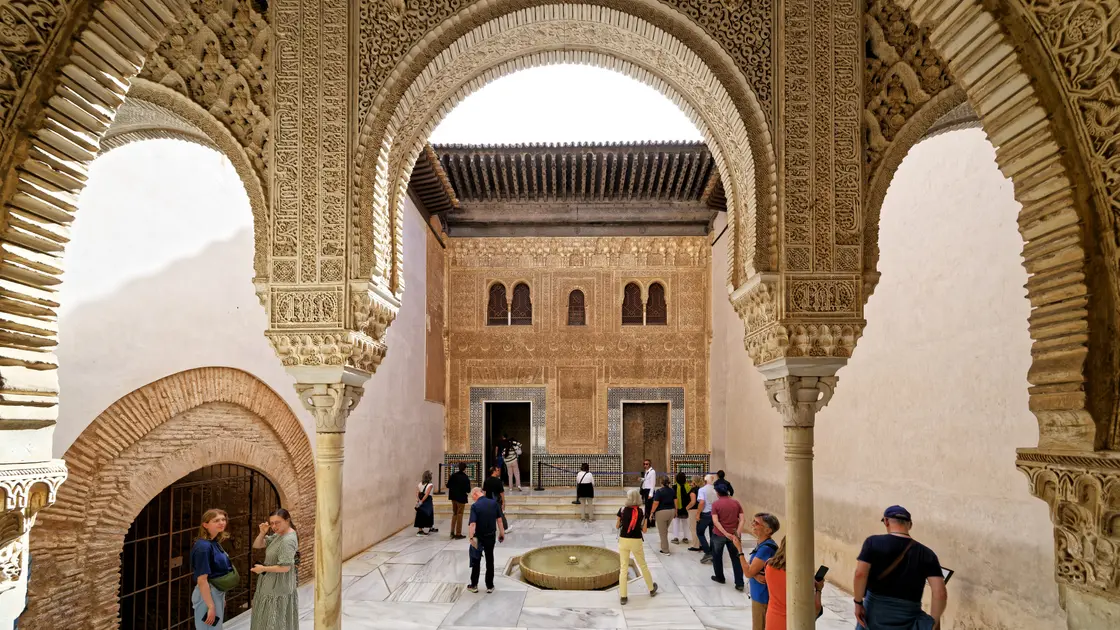
Alhambra
Granada's UNESCO fortress-palace on the Sabika hill. Nasrid Palace tickets sell out weeks ahead and daily entry is capped. Book via the Patronato website.
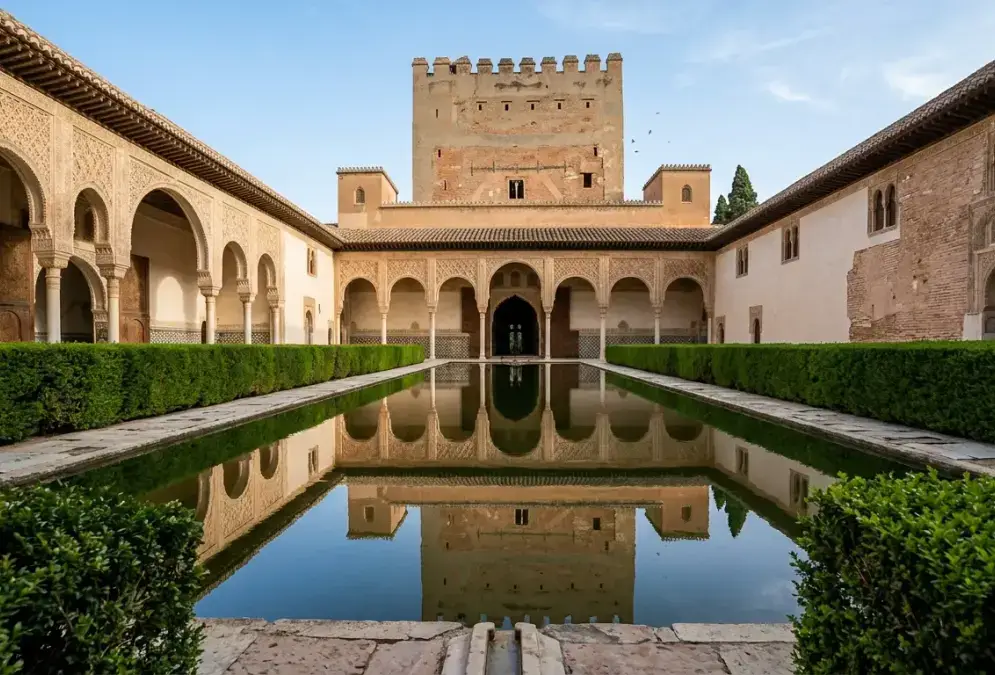
The pipes themselves are narrow, typically **10 to 15 centimetres in internal diameter**, which maintains the pressure over the relatively small elevation drops involved. The Nasrid engineers calibrated the pipe diameters against the elevation differences to produce specific effects: the quiet brimming overflow of the Comares Pool, the active arcing jets of the Court of the Lions fountain, the gentler flows in the Generalife channels. Each was a deliberate design decision, not an accident of plumbing.
The Court of the Lions: how the lion fountain works
The [Nasrid Palaces](/monument/nasrid-palaces)' most famous water feature is the central fountain of the **Court of the Lions**, completed around 1380 under Muhammad V.[^2] Twelve white marble lions stand in a circle, each with a spout in its open mouth. Water flows from a central basin into channels that radiate outward to the four surrounding pools at the ends of the cross-shaped arcades, and from there into the four surrounding halls.
The fountain's mechanics follow the same **hydrostatic principle** as the rest of the Alhambra system: water arrives from the cisterns above at a calculated pressure, fills the central basin, and overflows simultaneously through all 12 lion spouts. The channels cutting through the courtyard floor align with the four cardinal points, creating the classic chahar-bagh division. The court is literally a paradise garden in stone.
The court poet **Ibn Zamrak** described the fountain in an inscription carved around the basin.[^3] One passage reads: *"Melted silver flows between the jewels, one like the other in beauty; white running water and a solid marble that makes you doubt which of the two is really flowing."* The ambiguity between moving water and still stone was intentional: the court was designed to make the distinction between liquid and solid, moving and fixed, unclear.
During a major restoration between **2012 and 2021**, the lions and basin were removed, cleaned, and returned. Archaeologists used the opportunity to excavate the original pipe network beneath the courtyard floor, confirming the medieval routing of the supply channels and establishing that the fountain's basic mechanics have not changed since Muhammad V's construction.[^4]
Ibn Zamrak's inscription asks visitors to doubt whether the water or the marble is really flowing. The court was designed to make that distinction unclear: water as solid, stone as liquid.
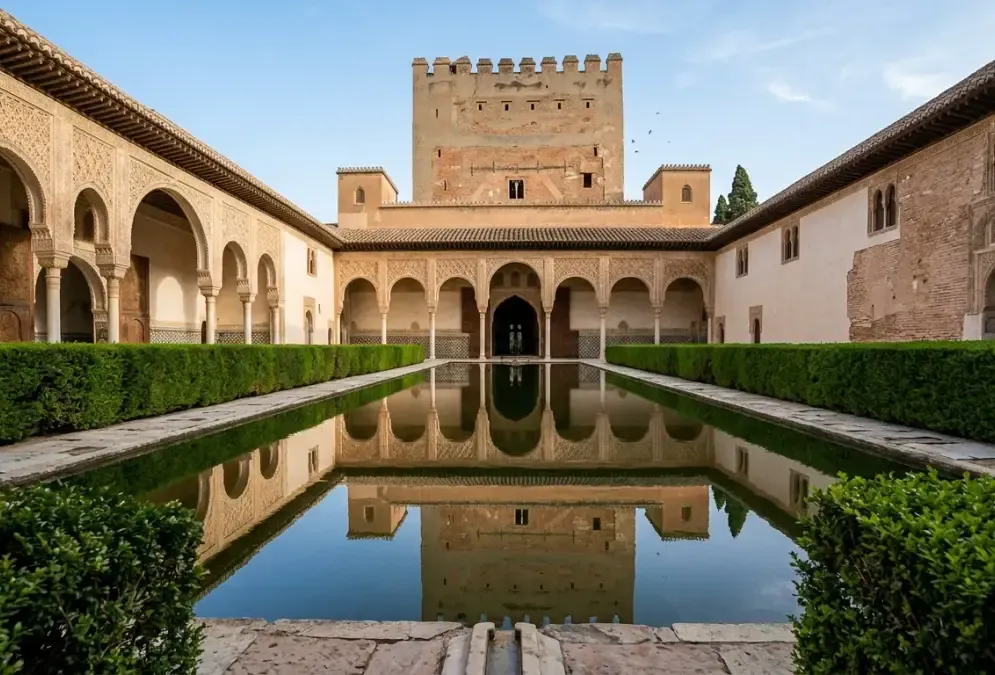
The lion fountain in the Court of the Lions, Nasrid Palaces, Alhambra, Granada, with 12 marble lions and water spouts, the central piece of the Alhambra water system
The Generalife: the acequia garden and water terraces
The [Generalife](/monument/generalife), the Nasrid summer palace on the hill above the main Alhambra complex, represents a different register of the same hydraulic thinking. The Nasrid Palaces used water architecturally (reflection, sound, contained pressure); the Generalife used it as garden infrastructure and sensory experience across open terraces.
The **Patio de la Acequia** (Courtyard of the Water Channel) is the Generalife's central garden: a long rectangular pool running down the middle of an open-air courtyard, with jets arcing from the sides over the central channel. The current jet arrangement, however, dates from early 20th-century restoration work. The **original Nasrid design** had only the central still channel running at low level, with no crossing jets. Walk past the jets to the far end of the patio and look back: the original geometry of still water, reflecting the sky and the surrounding myrtle hedges, becomes clearer.
Above the main courtyard, a series of terraced gardens descend the hillside toward the Alhambra, each with its own water feature. The **Escalera del Agua** (Water Staircase) is a staircase whose ceramic handrails are hollow channels carrying running water alongside the steps. The detail is so specific and impractical that it exists purely for sensory pleasure. On a hot afternoon, the sound of water running next to your hand as you climb is a deliberate Nasrid effect.
The relationship between the Generalife and the **Acequia Real** is direct: the same channel that supplies the palace complex diverts into the Generalife garden system. The sultans controlled the water allocation as a management decision, not unlike modern irrigation scheduling.
Modern maintenance and what visitors can experience today
The **Alhambra Patronato**, the body that manages the site, maintains the Acequia Real as a functioning hydraulic system. Annual maintenance involves cleaning the channel of sediment, repairing cracks in the stone lining, and managing water allocation across the complex. Archaeological excavations beneath the palace floors have continued to reveal new sections of the medieval pipe network; the most recent campaign, during the Court of the Lions restoration, mapped the supply routes in detail for the first time.
Visitors today can experience the water system in several ways:
- The **Acequia Real channel** is visible running through the pine forest between the Generalife and the main Alhambra entrance, about a 10-minute walk from the ticket gates - The **Comares Pool** (the large rectangular pool in the Court of the Myrtles) shows the quiet brimming-overflow effect of the Nasrid cistern system, with the reflection of the Comares Tower filling the water surface - The **Court of the Lions fountain** operates during visiting hours; the pressure from the cisterns above produces the same jet height as the 14th-century original - The **Escalera del Agua** in the Generalife, with its water-filled ceramic handrails, is accessible on the standard Generalife garden route
The sound of water is a consistent presence throughout the [Alhambra](/monument/alhambra). The Nasrid designers understood that **sound** was as important as sight in the enclosed courtyard spaces. On a quiet morning, before the tour groups arrive, the sound of the lion fountain in the empty Court of the Lions carries clearly across the entire courtyard. That acoustic effect was also calculated.