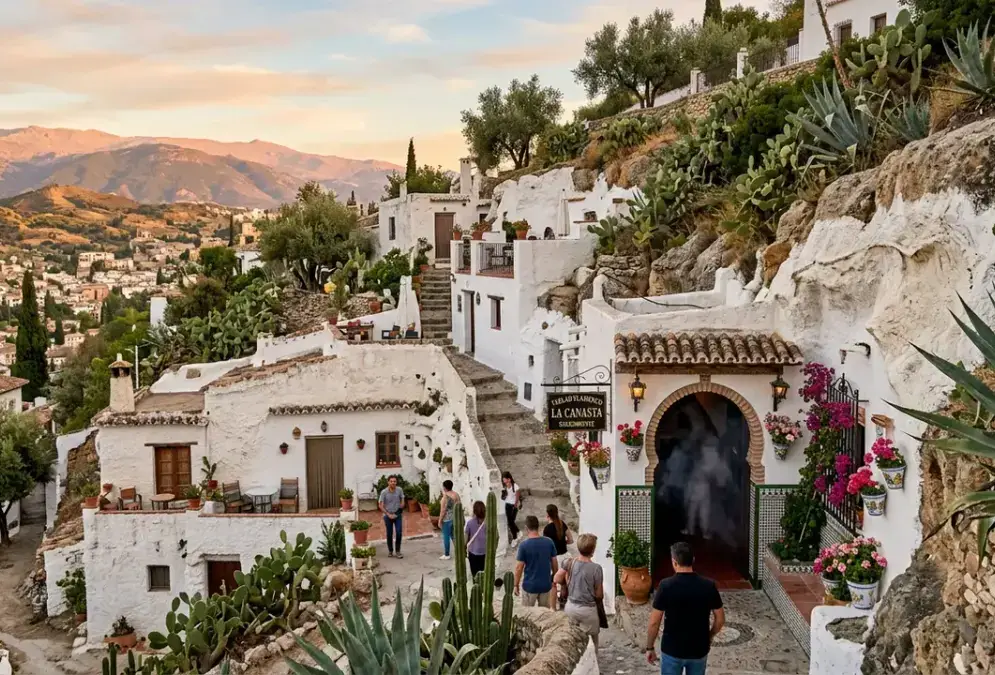
Sacromonte occupies the hill directly east of the Albaicín, above the Darro valley, and it looks different from every other neighbourhood in Granada. The houses are not built on the hillside — they are cut into it. Since the 15th century, when Roma families settled here after the Christian conquest of Granada, people have lived in the natural limestone caves of Valparaíso, extending and whitewashing them, hanging copper pots from the rock walls, fitting wooden doors into the raw hillface. Several hundred cave dwellings are still inhabited today.
Sacromonte is the origin of zambra flamenco: a form developed by the Roma community here, rooted in Arabic ceremonial music and dance. The neighbourhood's cuevas (cave venues) have hosted this art since the 16th century. Today's venues — Cueva de la Rocío, Venta El Gallo, Zambra María la Canastera — operate in the original caves, with stone walls, low ceilings, and the kind of acoustic intimacy that a purpose-built theatre cannot replicate. The performances are short by design: 45 to 60 minutes, a small ensemble, no amplification. Booking ahead is essential, particularly in summer, as capacity is limited by the caves themselves. See the full guide to flamenco shows in Sacromonte's caves for venue details, prices, and how to get there.
The Museo Cuevas del Sacromonte, midway up the ridge, opens the cave complex to visitors as an open-air folk museum. Eleven themed caves show domestic life, animal stabling, basketwork, ceramics, and textile production as they were practised here for centuries. Entry costs around €5. The abbey of Sacromonte, founded in 1600 on the site where Moorish Christian martyrs were allegedly buried, sits at the top of the hill and requires a separate ticket.
Getting up and getting around
The approach from the Albaicín is a 20-minute walk along the Camino del Sacromonte above the Darro valley — wide enough for two people and offering a continuous elevated view. Bus lines 31, 32, and 35 run from central Granada. The practical advice from locals is consistent: take the bus up and walk down. The descent along the Carrera del Darro in the early evening, with the Alhambra walls catching the last light above the river, is one of the better ways to end a day in Granada. Wear solid shoes — the camino and cave paths are uneven limestone, and the slopes are steep.