Most visitors to Granada spend their time moving between three fixed points: the Alhambra on the hill, the Cathedral in the centre, and the Albaicín across the Darro. The universidad quarter sits just west of all that, and almost nobody ends up there by accident. That is the point.
The Universidad de Granada was founded in 1531 by Emperor Charles V, four decades after the fall of the Nasrid kingdom, on the site of a Moorish predecessor: the Madrasah Yusufiyya, established in 1349 by Sultan Yusuf I to teach medicine, astronomy, and logic. Over 60,000 students now attend, making it the fourth largest university in Spain, and the city has grown around that population in ways that bear no resemblance to the tourist circuit. Walk ten minutes west from the Cathedral and the souvenir shops disappear. Bars list their menus by hand on chalkboards. The conversation is in Spanish.
The most important building in the quarter is the Hospital Real, on Calle Hospital Real at the northern edge of the campus. Founded in 1504 by the Catholic Monarchs to treat soldiers wounded in the Granada Wars, it was built over two centuries by Enrique Egas and later architects working under Charles V, absorbing Gothic arches, Mudéjar roof naves, Plateresque window frames, Renaissance courtyards, and a Baroque façade into a single building. In 1978 it became the university's rectorate and library. The interior is restricted to university members and official visits, but the exterior repays close attention: stand in front of the façade and count the distinct architectural registers. It reads like a compressed history of Spanish Christian architecture from 1504 to 1700.
A short walk south on Calle Rector López Argüeta brings you to the Faculty of Law, the Colegio de San Pablo. This building became the university's central headquarters in the eighteenth century, when Charles III suppressed the Jesuits and their college became available. The reason to come, beyond the facade, is the small botanical garden developed by the Pharmacy Faculty in the nineteenth century along the building's south side. Entry is free and open to the public from 10am to 2:30pm. The garden holds 70 large tree specimens, sections devoted to medicinal herbs, aquatic plants, and monocots, and a ginkgo biloba that is among the first planted in the Iberian Peninsula. It is one of the quieter corners of central Granada.
Federico García Lorca enrolled here in 1916, having completed secondary school the year before, and studied Law with the kind of commitment that produced a nine-year degree. He was, by all accounts, a more serious pianist than jurist. The Law Faculty building still stands exactly as he would have known it. La Madraza Centre for Contemporary Culture, which now occupies the old Moorish madrasa near the Cathedral, awards the Federico García Lorca Prize for artistic creation each year in his memory. It is a minor detail, but the Generation of '27 was a real Granada product, and the streets around here are where it grew.
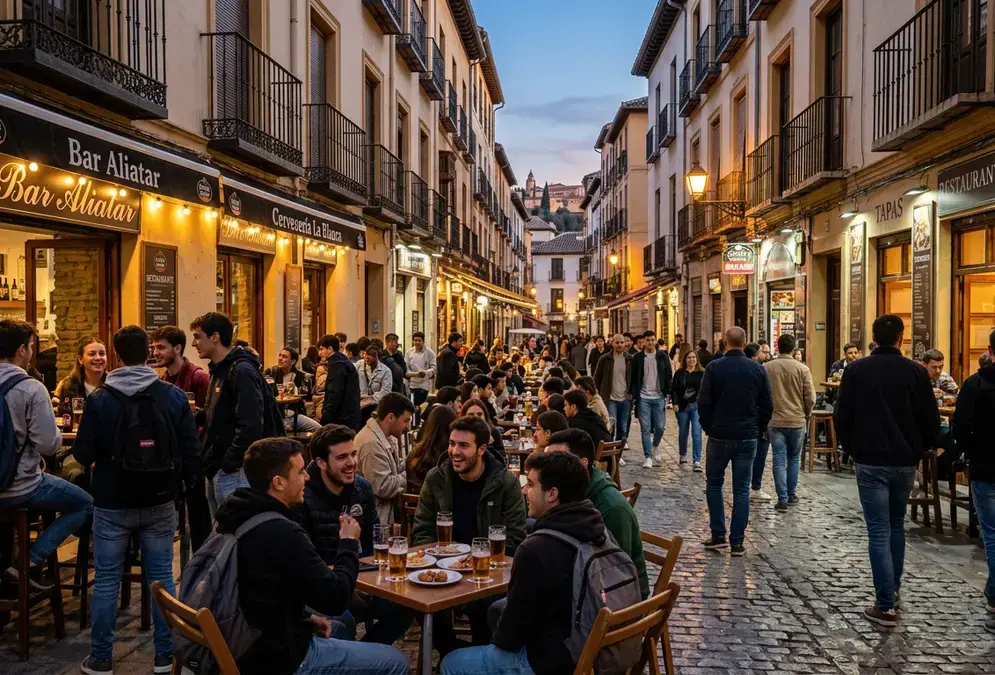
The student energy the university quarter is best known for concentrates on Calle Pedro Antonio de Alarcón, running north to south through the western part of the neighbourhood. The northern end, around Plaza Albert Einstein, is loud: modern bars, karaoke, chupiterías selling shots for under a euro. The southern end is quieter, more relaxed. A beer costs €2 to €2.50 anywhere on the street. The local shorthand for the bars here is the three Bs: bueno, barato, bonito. An evening on Pedro Antonio de Alarcón runs to €10 to €15 if you are eating tapas alongside the drinks, and the food is not an afterthought. This is not a tourist bar strip. The clientele is Spanish, overwhelmingly student-age, and the midweek peaks on Wednesday and Thursday are driven by Erasmus exchange students who have been filling Granada's European quota for thirty years.
For visitors staying several days, this is where Granada feels like a functioning city rather than an outdoor museum. The Alhambra deserves its reputation, but an afternoon in the universidad quarter, starting at Hospital Real, walking through the botanical garden, and ending at a table on Pedro Antonio de Alarcón around eight in the evening, is a different kind of Granada experience. Come during semester time, October to November or February to April. In July and August, the students leave and the quarter goes quiet.


