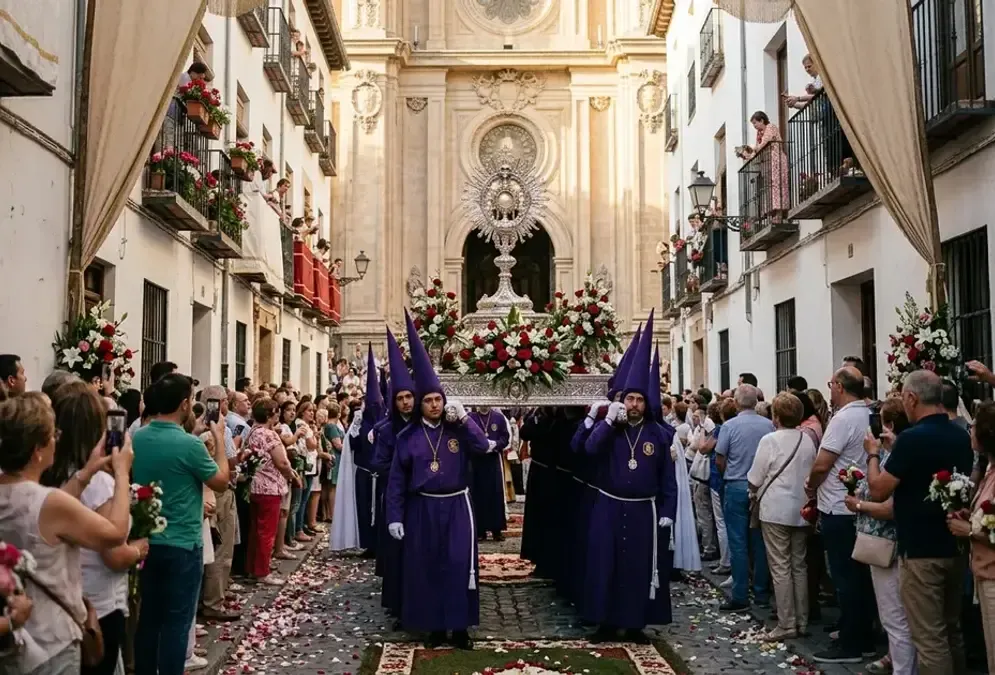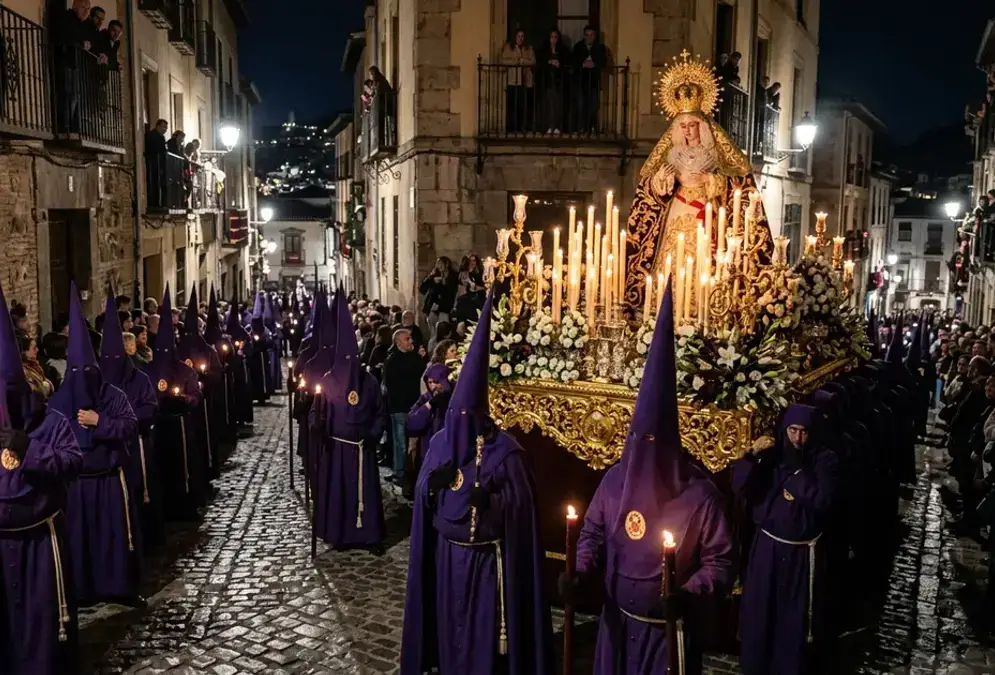
Granada's Holy Week is Festival of International Tourist Interest, declared in 2009 alongside Málaga and Seville as the only three Andalusian processions to earn that distinction. Thirty-two brotherhoods, 2,000 costaleros, and 58 processional floats take to the streets between 29 March and 5 April 2026. Watching costs nothing.
What actually happens
Each day has its own processions, departing from neighbourhood churches and converging on the city centre. Palm Sunday (29 March) opens with La Borriquilla, the most popular procession for families. It is cheerful by Holy Week standards.
Wednesday 1 April brings the moment that draws visitors from across Spain: the Cristo de los Gitanos climbs through Sacromonte. Residents light bonfires in front of cave homes and on the hillside paths as the float passes. Nothing else in Granada's calendar looks like this.
Maundy Thursday (2 April) is the night of the Cristo del Silencio. The brotherhood processes without music; only drums break the quiet. The contrast with Wednesday's bonfires is sharp.
Good Friday (3 April) has six processions — more than any other day. The most attended is the Señor de los Favores, which draws more than 5,000 people to the Realejo neighbourhood for traditional prayers at Campo del Príncipe before the float moves on. The Cristo del Expiración, El Rescate, and Cristo Resucitado also process on Good Friday. Expect the city centre to be at full capacity from mid-afternoon.
Holy Saturday (4 April) has a single procession: the Santa María de la Alhambra, which is quieter and worth seeing precisely because the crowds thin after Good Friday.
Easter Sunday (5 April) closes the week.
Where to watch
Processions are free from the street. The Tribune at Ángel Ganivet has paid reserved seating if you want a guaranteed spot for the main official route. Free standing positions fill quickly on Good Friday — arrive by late morning for the best views at Plaza de las Pasiegas, Puerta Real, or Plaza Mariana Pineda.
For Cristo de los Gitanos on Wednesday night, go to Sacromonte early. The narrow paths fill from around 8 pm. The combination of bonfires, cave-lit doorways, and the float emerging from the dark is unlike anything you will see elsewhere in Spain.
For Señor de los Favores, Campo del Príncipe in the Realejo is the gathering point. Side streets like Carrera de la Virgen and Mesones work well for watching floats on most other days without the crush of the main squares.
Practical logistics
All street-side viewing is free. Reserved tribune seats at Ángel Ganivet are available at extra cost — check the Real Federación de Hermandades y Cofradías de Granada for details. Procession routes close roads across the city centre; plan to walk. Public transport has reduced coverage during peak procession hours.
Book accommodation by January at the latest. Hotels fill for the full week, prices rise sharply, and short-notice options are few.
The numbers
32 brotherhoods (cofradías), 58 processional floats, 2,000 costaleros carrying the floats, 5,000 registered cofrades. The Señor de los Favores alone draws 5,000+ to a single location.