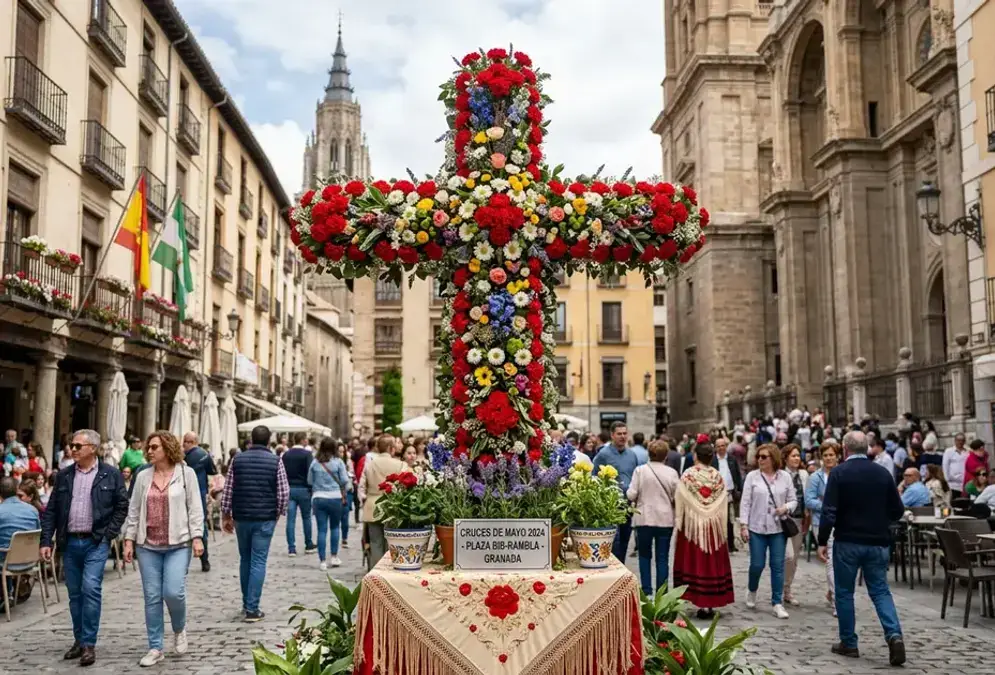
Granada's Cruces de Mayo turns the city's streets and patios into an open competition on the first weekend of May. Fifty-plus decorated crosses go up across the Albaicín, the Realejo, and around Plaza Bib-Rambla, each neighbourhood trying to outdo the next with flowers, embroidered fabrics, silver candlesticks, and natural materials. Entry is free everywhere.
The competition
The crosses compete across five categories: streets, patios, shop windows, schools, and religious brotherhoods. A judging panel assesses them during the weekend; winners are announced on Sunday. The patio and street categories draw the most serious investment from local organisers. Neighbourhoods that have won before take the competition seriously, and the quality of the decorations reflects it.
Two details are particular to Granada: decorators traditionally place an apple and a pair of scissors at the base of the cross, an old Andalusian folk custom said to ward off critics. And children position themselves near the crosses to approach visitors with the phrase "¿Un chavico para la cruz?" (a small coin for the cross). This is a longstanding tradition that children genuinely enjoy; having a few small coins in your pocket is the way to engage with it.
Where to go
Albaicín is the most atmospheric neighbourhood for the crosses. Medieval courtyards open along the narrow cobbled lanes of the Moorish quarter, flower arrangements filling doorways and patios that are otherwise closed to the public. The scent of orange blossom mixes with cut carnations and roses on a warm May afternoon.
Realejo, particularly the Campo del Príncipe area, offers decorated streets and outdoor seating with a more relaxed, local crowd. This is the neighbourhood where Sephardic Jewish history sits alongside Moorish layers in a single block.
Bib-Rambla square provides the most central and accessible location, practical for those with limited time or young children.
Entertainment and atmosphere
A flamenco stage operates at Plaza del Carmen across the weekend, with traditional Andalusian music performances. The overall mood is family-friendly and street-level: this is not a stadium event but a neighbourhood festival spread across multiple locations, each worth a half-hour visit.
Practical logistics
Both days run from morning through evening. The crosses are at their best in the afternoon, when the light is warm and the crowds are building. Sunday is generally busier than Saturday as the judging panel moves through the city. No tickets, no queues to buy anything, no transport needed beyond walking: the three main areas are within 20 minutes of each other on foot from the city centre.