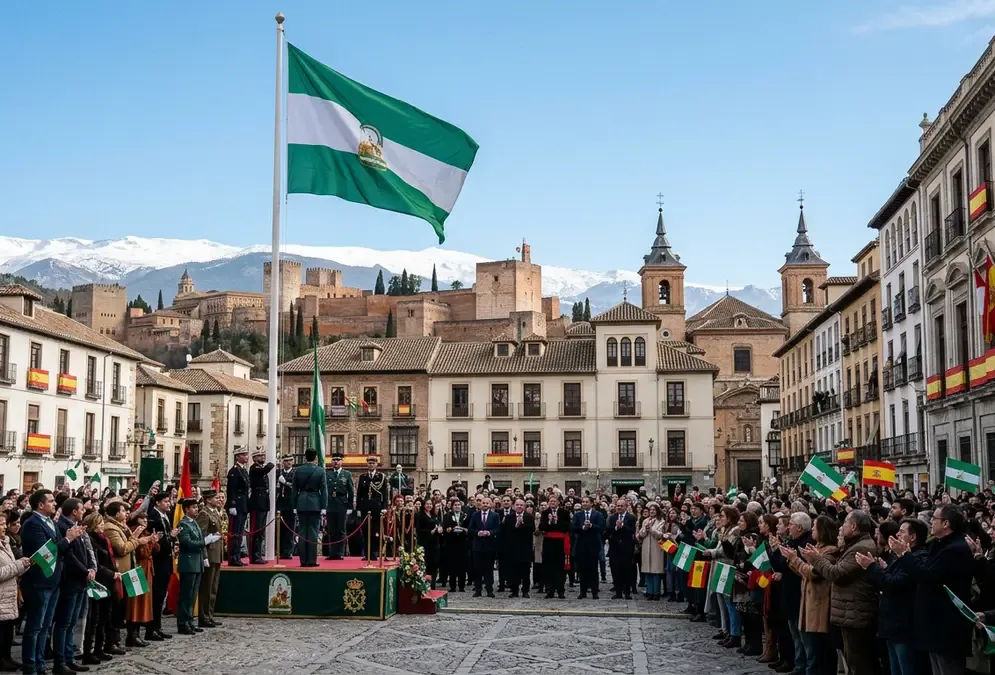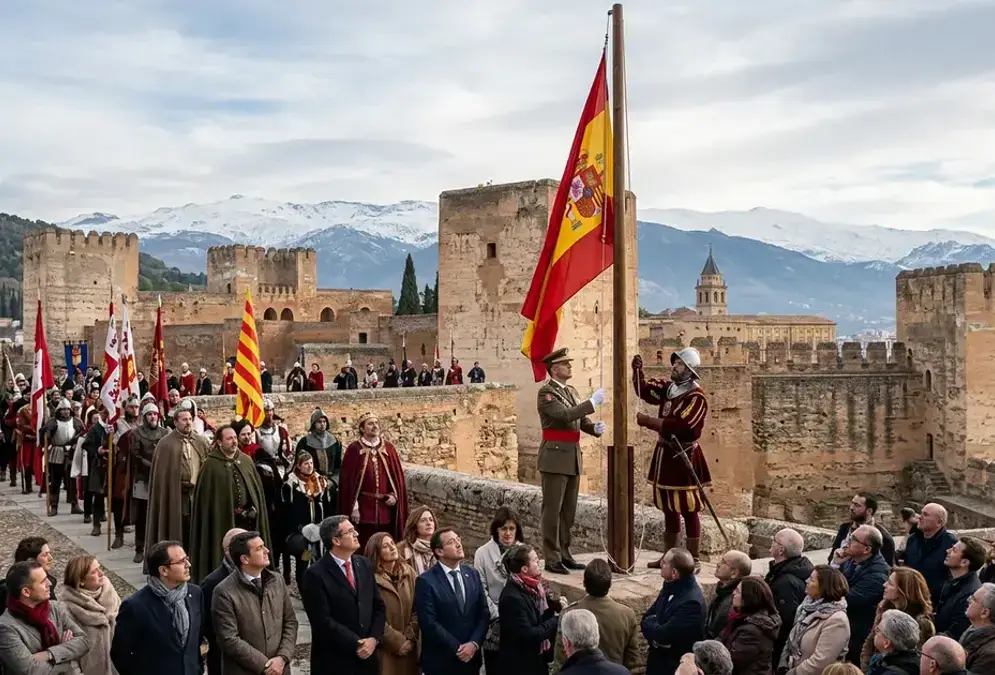
Every January 2, Granada holds a ceremony commemorating the handover of the city to the Catholic Monarchs on that date in 1492. The municipal corporation processes from the Town Hall to the Royal Chapel, where Isabella I of Castile and Ferdinand II of Aragon are entombed, and a mass follows at the Cathedral next door. The occasion is a local public holiday. Shops close, the city centre empties in the morning, and the Alcazaba opens for anyone who wants to ring the Tower of Vela bell.
That much is settled. What is not settled is whether this should be a public holiday at all.
The ceremony itself
The formal schedule starts at 11:30, when officials leave the Town Hall at Plaza del Carmen. By 11:50 they have collected the Royal Insignia from the Royal Chapel. Mass begins at noon inside the Cathedral. At 13:15 comes the Tremolación del Estandarte Real — the waving of the Royal Standard — from both the Chapel and the Town Hall balcony, which closes the official sequence.
The Legion typically participates, giving the ceremony a military character alongside the religious one. The Gate of Justice (Puerta de la Justicia) at the Alhambra opens an altar to the public from 08:30 to 18:00.
At the Alcazaba, the bell-ringing tradition draws locals throughout the day. The old saying attached to it (that an unmarried young woman who rings the Vela bell on January 2 will marry within the year) has kept the custom going long past the ceremony itself.
A contested date
January 2 is the most politically divided day on Granada's calendar. The Town Council (currently PP-led) maintains it as an official holiday and organises the ceremony. Far-right groups gather alongside the official participants, and symbols associated with Francoism and Carlism appear visibly in the crowds.
The civil society platform Granada Abierta has organised counter-events for several years under the slogan Por la convivencia, no por la Toma (For coexistence, not the Conquest). Their events run parallel to the official ceremony, drawing residents who object to what they describe as the celebration of an expulsion — the end of Muslim rule also preceded the forced conversion and eventual removal of Granada's Muslim and Jewish populations.
Spanish media, particularly progressive outlets, have covered the January 2 ceremony as a far-right rallying point. The Ayuntamiento and its supporters argue it is a legitimate civic tradition marking a historical fact. Both positions are held sincerely and are genuinely in dispute.
For visitors, this context matters. If you attend the ceremony, you will likely stand near people holding symbols that would be out of place anywhere else in the city. If you are curious about the counter-event, Granada Abierta announces its programme on local social media before January 2. The two events occupy different spaces and do not typically intersect.
What to see and do
Apart from the ceremony, January 2 is a reasonable day to visit the Royal Chapel and understand why the building exists. The sacristy museum holds the altarpiece Diego de Siloé designed for the monarchs, Isabel's personal collection of Flemish paintings, and the royal crowns and sceptres. The marble tombs by Domenico Fancelli date from 1517. On a normal day the Chapel is busy; on the morning of January 2, before the official procession arrives, it is unusually quiet.
For Granada's longer history — the Nasrid dynasty, the decades before 1492, and what came after — see the Granada history guide.
Dates and access
January 2 is a fixed date each year. The ceremony is free to observe from public space. The Cathedral and Royal Chapel are open on standard monument hours and admission applies as normal. The Alcazaba is open for the bell-ringing tradition. Public transport runs on a reduced holiday schedule.
Note that January 2 is a local holiday only. Shops and institutions in the rest of Andalusia and Spain operate normally; within Granada, closures vary by business.