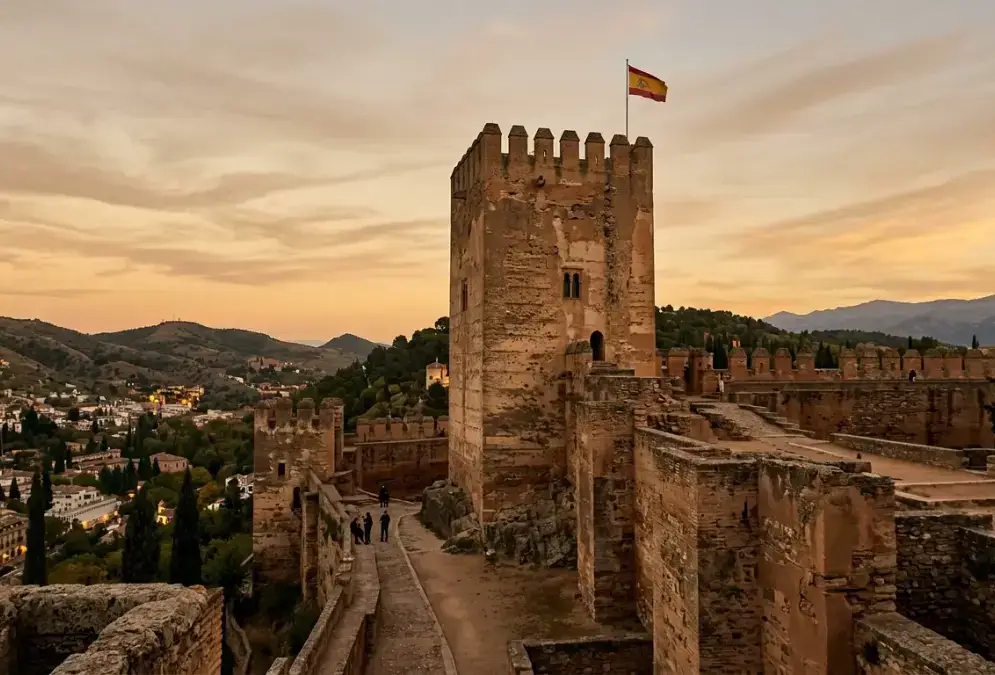

What was the Reconquista?
In **711 AD**, an Umayyad army crossed the Strait of Gibraltar and within a decade had conquered almost the entire Iberian Peninsula. The Visigothic kingdom collapsed within two years. By 718, Muslim rulers controlled everything from the southern coast to the foothills of the Cantabrian mountains in the north, where a handful of Christian lords held out in Asturias.
The Reconquista (the Christian reconquest) began from that northern fringe and took seven and a half centuries to complete. It was not a continuous military campaign but a fitful, interrupted process: decades of stability, then a shift of power, then a new conquest. **Toledo** fell to Alfonso VI of Castile in 1085, the first major symbolic victory. **Córdoba**, capital of the former Caliphate, fell in 1236. **Seville** followed in 1248. By the mid-13th century, only one Moorish kingdom remained: the Emirate of Granada, tucked into the mountains of southeastern Andalusia.
The term Reconquista was largely a **19th-century construction** used by Spanish nationalists. Medieval chronicles used it inconsistently, and the actual campaigns were driven as much by territorial ambition and dynastic politics as by religious ideology. Still, the religious framing (crusade language, the blessing of popes, the cry of *Santiago*) was present from early on and intensified as the centuries passed.
Why Granada survived for 250 years after Seville
The Emirate of Granada was founded in **1232**[^1] by Muhammad I ibn al-Ahmar, who chose survival over pride. His first act as ruler was to travel to Fernando III of Castile in Jaén and swear fealty, agreeing to pay annual tribute and to provide Castilian forces with military aid when required. It was a humiliating arrangement that kept the emirate alive for two and a half centuries.
**Geography** was the other factor. Granada occupied the Sierra Nevada foothills, one of the most naturally defensible positions in Iberia. The mountain passes were narrow. Supply routes from the coast were difficult to cut. Any besieging force faced an exhausting campaign against terrain that favoured the defender. The city itself sat on a hill with the Alhambra at its highest point, and the Darro river cutting a gorge to the north.
Castile's internal politics also helped. Through the 14th and early 15th centuries, Castile was repeatedly distracted by civil wars, succession crises, and conflicts with Portugal and Aragon. Granada's sultans were skilled at reading these divisions. When Castile was weak, they stopped tribute payments. When Castile was strong, they paid and waited. The **Nasrid dynasty** produced 23 sultans in 260 years[^2]; the more able among them understood that pure diplomacy, not military strength, was what kept the emirate alive.
The fall of the Emirate: 1482 to 1492
The final decade of the Nasrid emirate began with two events that destroyed the emirate's one structural advantage: unity against the outside. In **1479**, the marriage of Ferdinand of Aragon and Isabella of Castile united the two most powerful Christian kingdoms. Granada now faced a single state with the resources to sustain a long campaign. In **1482**, a palace coup brought Boabdil to power against his father, Abu al-Hasan Ali. His uncle Muhammad al-Zaghal eventually joined the contest as a third claimant. The three-way civil war consumed exactly the decade Granada could least afford to waste.
Ferdinand and Isabella prosecuted the war methodically, taking Moorish cities one by one rather than attempting a single decisive siege of Granada:
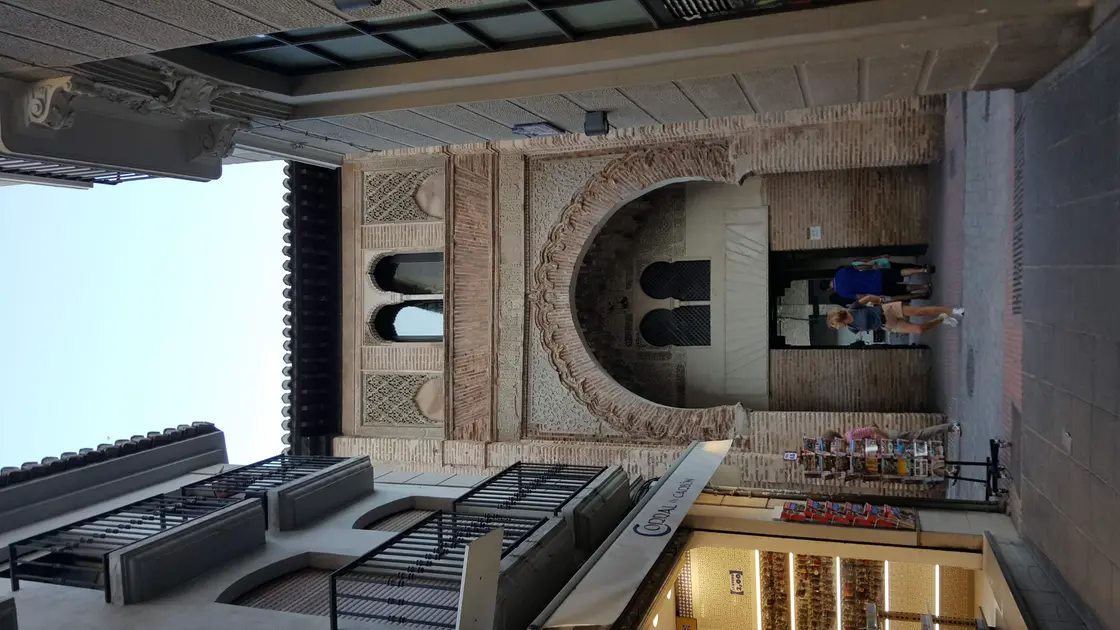
Explore nearby · Monument
Corral del Carbón
Granada's oldest Arab monument, the Corral del Carbón was built before 1336 as a Nasrid merchant inn, entered through an ornate horseshoe-arch portal.
- **Ronda** fell in 1485 - **Loja** fell in 1486 - **Málaga** fell in 1487, after a brutal four-month siege - **Almería** fell in 1489 - **Baza** fell in December 1489, after an eight-month siege in which Isabella herself came to the front to prevent the army from withdrawing
Al-Zaghal surrendered his remaining territories in early 1490 and crossed to Morocco. Boabdil was left with the city of Granada alone. In **spring 1491**, Ferdinand established a siege camp west of the city on the open vega. The camp burned down after an accidental fire; Ferdinand replaced it with a permanent town, **Santa Fe**, built in four months, signalling that the siege would not be lifted.
By autumn 1491, food supplies inside the [Alhambra](/monument/alhambra) district and the wider city were running low. Negotiations began in secret, at night, through intermediaries. The outcome was agreed in November.
The Granada Capitulations and their violation
The treaty signed on **25 November 1491**, the Granada Capitulations (Treaty of Granada), was, by the standards of 15th-century warfare, unusually protective of the conquered population. Its key terms:
- Muslims could continue to practise their religion freely - Existing laws, customs, and property rights would be respected - Arabic could remain in use in courts and commerce - No person would be forced to convert to Christianity - Those who wished to cross to North Africa could do so - Boabdil received the Alpujarras region as a personal estate, along with financial compensation
The document ran to **67 articles**[^3]. It was negotiated in Arabic and Castilian simultaneously. The Castilian legal team, headed by Hernando de Zafra, worked alongside Boabdil's chief negotiator Ali al-Amin. Both sides had reasons to want a clean settlement: Ferdinand needed Granada intact as a functioning city, not a ruin; Boabdil needed terms that would hold.
Historians often compare the capitulations to other late medieval surrender documents. They were more protective than the terms imposed on **Málaga** in 1487, where the population was enslaved. They were more detailed than the fall of **Constantinople** in 1453. The specific protections for religious practice were not boilerplate: they were hard-won concessions that the Granadan negotiators pushed for explicitly, knowing what had happened in cities that surrendered without such guarantees. The [Nasrid Palaces](/monument/nasrid-palaces) survived because those terms held, at least initially.
The Granada Capitulations ran to 67 articles, negotiated simultaneously in Arabic and Castilian. They were more protective than almost any other surrender document of the 15th century. They lasted eight years.
The capitulations held for seven years. In **1499**, Cardinal Francisco Jiménez de Cisneros, the Archbishop of Toledo, arrived in Granada with a different agenda. He began a campaign of forced conversion, mass baptisms, and book burnings. Arabic manuscripts, thousands of them, were burned in the Plaza Bib-Rambla, near where the cathedral stands today. The legal right to practise Islam was dismantled article by article.
The Granadan Muslim population responded with a revolt in the **[Albaicín](/neighborhood/albaicin)** in December 1499, followed by a larger uprising in the Alpujarras mountains in 1500. Both were suppressed militarily. Ferdinand and Isabella used the revolts as legal justification to void the religious guarantees of the capitulations: by taking up arms, the argument went, the Granadan Muslims had broken the peace terms themselves.
In **1502**, a royal decree ordered all Muslims in Castile to either convert to Christianity or leave. Most converted, becoming known as **Moriscos** (converted Moors). They continued to speak Arabic in private, maintain dietary customs, and practise their faith covertly. The Morisco community was surveilled, persecuted by the Inquisition, forcibly dispersed across Spain in 1570 after the Second Revolt of the Alpujarras, and finally expelled entirely by decree of Philip III in **1609**[^4], more than a century after the fall of Granada.
The gap between the **1491 capitulations** and the 1502 forced conversions is not a detail. The capitulations have often been cited, by Boabdil's defenders, as evidence that the surrender was the best available outcome. The violation of those terms, within a decade, was a separate decision made by Cisneros and backed by the crown.
What the Reconquista left behind in Granada
The physical legacy of eight centuries of Moorish rule in Granada is more intact than anywhere else in Spain, for a precise reason: the capitulations protected the [Alhambra](/monument/alhambra) and the city's fabric from destruction. What was not destroyed in 1492 was not destroyed at all. Compare Córdoba's Great Mosque, which became a cathedral with a nave punched through its centre, or the Alcázar of Seville, progressively rebuilt in Castilian style.
The **Albaicín** retains its street pattern from the Nasrid period. The name comes from the Arabic *rabad al-bayyazin*, the quarter of the falconers. Its narrow lanes, carmenes (walled garden houses), and the absence of a grid plan all reflect its medieval Moorish layout. UNESCO listed it alongside the Alhambra in 1994.
Language carries traces too. Hundreds of Spanish words in everyday use derive from Arabic: *alcázar* (palace), *acequia* (irrigation channel), *alberca* (pool), *azulejo* (tile), *almohada* (pillow). Granada's own street names preserve the medieval occupational geography: Calle Calderería Nueva was the coppersmith row; Calle Elvira follows the route to the old Elvira gate of the Nasrid city wall.
The [Royal Chapel](/monument/royal-chapel-granada) beside Granada Cathedral holds the tombs of Ferdinand and Isabella, the monarchs whose marriage made the final conquest possible. They chose Granada as their burial place deliberately, as the city that represented the completion of the Reconquista and the unification of Spain under a single crown.
How Granada commemorates 1492 today
Every **2 January**, Granada holds the Día de la Toma (Day of the Taking). The ceremony involves raising the royal standard at the [Torre de la Vela](/monument/alcazaba-granada) in the Alcazaba, a bell tower visible across the vega. A formal procession moves to the Royal Chapel, where Ferdinand and Isabella's marble tombs are a permanent fixture. The ceremony has been held every year since 1492.
It has become one of the more **politically contested** civic rituals in Spain. In recent decades, far-right groups have used the Día de la Toma as a nationalist rally. The city council has responded with restrictions on certain symbols and, in some years, with counter-cultural programming on the same date. The Albaicín and local Moorish heritage associations hold alternative events that frame January 2 as a date of loss rather than triumph.
Read next — Monument
Royal Chapel of Granada
Isabelline Gothic chapel with the tombs of Isabella I and Ferdinand II. The sacristy holds royal regalia and paintings by Memling, Botticelli, and Bouts.
The tension is real and not easily resolved. Granada's economy depends heavily on tourism centred on Moorish heritage. The Alhambra is the most visited monument in Spain, and the city markets its Islamic past while observing a ceremony that marks its conquest. Both things are true, and Granada has not found a single official tone for holding them together. Visitors who arrive on 2 January will find both the standard at the Torre de la Vela and, sometimes, protesters in the streets below.