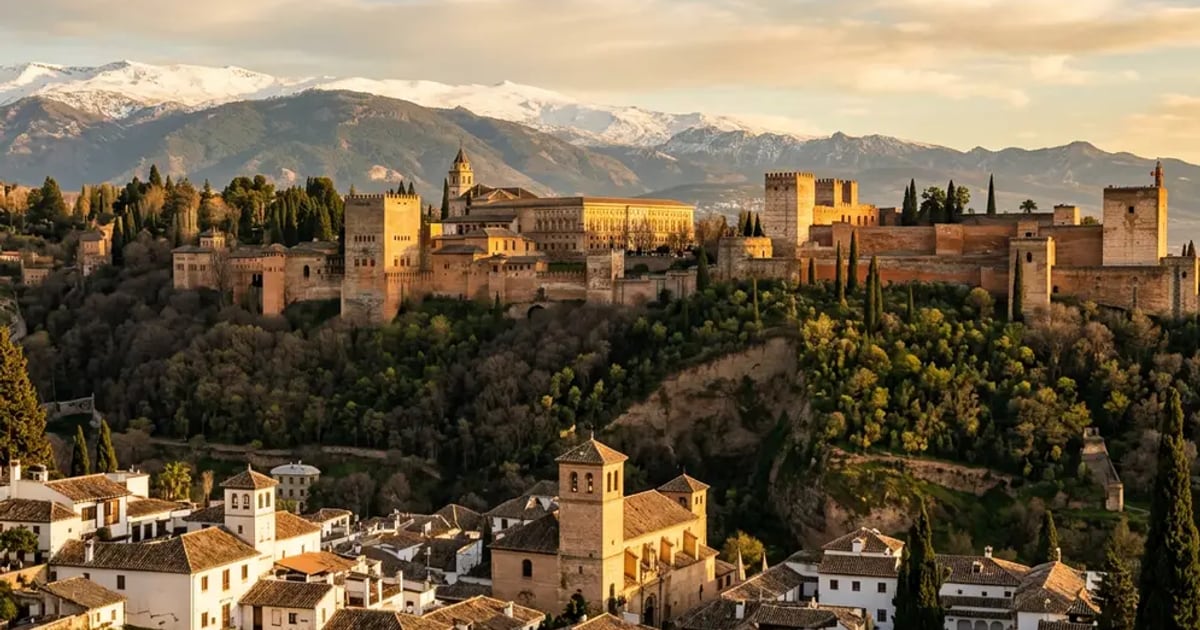
The city's name in Spanish IS the word for pomegranate. Whether that is coincidence or etymology is contested. Either way, the connection runs through the Alhambra's carved walls, the Shield of Spain on every Spanish euro coin, and the autumn harvest on the Costa Tropical 50 kilometres south.
Ten years in food journalism specialising in Spanish and Andalusian cuisine. Four years focused on Granada's food scene.
Published
Updated
Spend a day in Granada and the pomegranate turns up everywhere. Stone ones crown the gate at the foot of the Alhambra approach road. Carved ones appear on column capitals inside the Nasrid Palaces. Cast-iron ones sit on the municipal manhole covers. The city flag has one at its centre. Every ceramic tile seller in the Alcaicería prints them on mugs, plates, and teatowels. This is not a marketing decision. The word granada in Spanish means pomegranate. The city and the fruit share a name, and the overlap saturates everything from royal heraldry to autumn market stalls.
This guide traces the pomegranate through etymology, Nasrid architecture, Spanish heraldry, commercial agriculture, and local cooking. It also tells you where to look in the city and when the fruit itself is in season.
The pomegranate in Granada: at a glance
Spanish word
granada = pomegranate (the fruit)
Puerta de las Granadas
Gate of the Pomegranates, main pedestrian approach to the Alhambra
Coat of arms
Pomegranate added by Ferdinand and Isabella after the 1492 conquest
Euro coins
Granada pomegranate appears on the Shield of Spain on all Spanish euro coins
Harvest season
September to November, Costa Tropical (Motril to Almuñécar)
Where to find it in the city
Gate arch, Nasrid Palaces carvings, city flag, manhole covers
What does Granada mean?
The Spanish word granada means pomegranate. The city shares this word with the fruit, and the two meanings have been inseparable for at least five centuries. Beyond that, the etymology gets contested.
One theory holds that the city was named for the pomegranate directly: the fruit grew abundantly in the Vega de Granada, the fertile plain surrounding the city, and an early settlement on the hillside took its name from the orchards below. Under this reading, the pomegranate connection is original, and the modern Spanish word preserves it.
A competing theory traces the name back to the Arabic Qarnata, sometimes rendered as "hill of strangers" or "hill of pilgrims," which appears in early Islamic sources to describe the settlement before and after the Arab conquest of 711. Under this account, Granada is a Spanish phonetic evolution of an Arabic toponym, and the pomegranate meaning is folk etymology imposed after the fact — a later generation noticing the coincidence and running with it.
A third position holds that the two theories are not mutually exclusive: Qarnata may itself have referred to a place where pomegranates grew, and the Arabic name and the Spanish word reinforced each other across the language shift of the Reconquista. Historians have been arguing about this for two hundred years. No definitive evidence settles it.
What is not disputed: by 1492, when Ferdinand and Isabella conquered the city, the association between Granada and the pomegranate was established enough for them to place the fruit on the royal coat of arms. Whether the name came from the fruit, or the fruit was chosen to match the name, the result is the same. The city and the pomegranate have been formally linked for over 530 years.
The pomegranate on the coat of arms
When Muhammad XII (known to the Spanish as Boabdil) surrendered the Alhambra to Ferdinand and Isabella on 2 January 1492, it ended 781 years of Islamic rule in Granada and completed the Reconquista. The Catholic Monarchs marked the victory by adding a pomegranate to the bottom of the royal coat of arms, the Shield of Spain, to represent the newly incorporated Kingdom of Granada.
The pomegranate sits at the base of the shield in a specific heraldic form: the fruit shown half-open, with the seeds visible. This open-pomegranate design has been in continuous use on the Spanish coat of arms from 1492 to the present day. It appeared on the coins of the Spanish Empire, on the flags of the Kingdom of Spain under various constitutions, and now on every Spanish euro coin minted since 2002.
From conquest to coins: the pomegranate's heraldic timeline
1492
Ferdinand and Isabella add the pomegranate of Granada to the base of the royal Shield of Spain after the Reconquista conquest on 2 January.
16th–19th c.
The pomegranate appears on the coins of the Spanish Empire and on the flags of successive Spanish constitutions, with the shield design evolving slightly across each reign.
2002
Spain adopts the euro. The Shield of Spain, pomegranate included, is placed on the national side of all Spanish euro coins.
today
Every Spanish 1 cent, 2 cent, and 5 cent euro coin carries the full shield. The Granada pomegranate is at the base of each one.
Granada's own coat of arms also carries the pomegranate, in the same half-open heraldic form. The city flag, red and white, has the pomegranate at its centre. Both are visible throughout the city on municipal buildings, street signs, and official vehicles. For a focused look at how the fruit became the defining symbol of the city — spanning Nasrid architecture, heraldry, etymology, and everyday life — read the pomegranate as Granada's symbol.
Pomegranate symbolism in the Alhambra
The pomegranate predates Ferdinand and Isabella's heraldic use by more than a century. The Nasrid sultans who built the Alhambra between 1238 and 1492 used the pomegranate as one of their heraldic symbols, and its carved form appears throughout the complex. In Nasrid iconography the fruit carried the same meanings as in other Islamic traditions: fertility, abundance, paradise. A pomegranate's many seeds within a single skin made it a natural symbol of unity and royal power.
Puerta de las Granadas
The main pedestrian gate at the base of the Cuesta de Gomérez, the road climbing from the city to the Alhambra. Charles V built the current Renaissance arch in the 16th century, replacing an earlier Nasrid gate. Three stone pomegranates crown the top of the arch. Walk up from the city centre, stop at the gate, and look up. Most visitors pass through without pausing. No ticket required. The gate is open at all hours.
Inside the Nasrid Palaces, pomegranate motifs appear in the carved stucco friezes at mid-wall height, in ceramic tile borders, and in carved column capitals. The carved plasterwork of the Court of the Lions includes pomegranate forms in the vegetal scroll borders above the tile dado. In the Comares Palace, the pomegranate appears in the tile borders of the Ambassadors' Hall. None of this is easy to spot on a first visit; the eye goes to the arabesque calligraphy and the honeycomb muqarnas ceilings. Look at the tile borders and the lower carved panels.
The royal summer estate above the main Alhambra complex. The Generalife gardens have been replanted many times since the Nasrid period, but the terraced layout roughly follows the original. Pomegranate trees were planted in Nasrid royal gardens as both symbolic and productive specimens. Several survive in the current garden, most visible in the upper terraces. In September and October they carry fruit. The name Generalife comes from the Arabic Yannat al-'Arif (garden of the overseer or garden of the architect); the garden's original Islamic character as a productive pleasure garden, not just an ornamental one, is part of what the pomegranate trees preserve.
Finding the motif without a guide
The pomegranate carvings in the Nasrid Palaces are easiest to spot in the Comares Palace, particularly in the Ambassadors' Hall tile dados and in the carved stucco around the windows. In the Court of the Lions, look at the arches directly above the four channels leading to the central fountain. Bring binoculars or use your phone camera's zoom for the upper friezes.
Where to spot the motif around the city
Outside the Alhambra, the pomegranate appears in Granada in ways both formal and incidental. A partial list of reliable sightings:
Municipal manhole covers
Cast-iron covers throughout the city centre carry the city coat of arms, pomegranate prominent. The pedestrian zone around the cathedral and the streets of the Albaicín have the densest concentration. A specific-detail photograph for anyone keeping a record of the symbol across the city.
The Alcaicería
Granada's old silk market, adjacent to the cathedral, is now mostly souvenir stalls. The pomegranate motif dominates: printed on ceramics, woven into textiles, stamped on leather goods. The current structure is a 19th-century rebuild after a fire; the souvenir trade replaced the silk trade. The quality of goods is variable. The pomegranate ceramics made in the Fajalauza style (blue and green on white with a pomegranate central motif) are the local tradition worth knowing.
City flag and official buildings
The red-and-white city flag with the pomegranate at its centre flies on the town hall (Ayuntamiento) on Plaza del Carmen, on official buildings throughout the city, and on lampposts along the main streets for municipal events. The Granada provincial government (Diputación) building on Gran Vía de Colón also flies it.
Your pocket change
Spanish-minted euro cents carry the Shield of Spain with the Granada pomegranate at the base. If you pay with cash in Spain and receive Spanish-minted coins in change, the pomegranate is on each one. The 1-cent coin has the clearest version of the full shield.
The Moorish Granada guide covers the Nasrid monuments and Albaicín quarter in more detail if you want the architectural context for the pomegranate's presence in the city.
Granada province grows pomegranates commercially
The symbolism and the agriculture are both real. Granada province produces commercial pomegranates on the Costa Tropical, the coastal strip between Motril and Almuñécar on the Mediterranean, 50 to 70 kilometres south of the city. The microclimate there is subtropical: warm winters, negligible frost risk, and a combination of Mediterranean humidity and mountain proximity that suits the fruit. Pomegranates grow here alongside avocados, chirimoyas, and custard apples. All three would die in Castile.
The variety most commonly grown is the Mollar de Elche, a Spanish heritage cultivar with thin skin, soft seeds, and a sweeter, less astringent flavour than the Wonderful variety sold in Northern European supermarkets. Local growers also maintain older regional varieties whose names vary by village. The harvest runs from September through November; peak season is October.
Motril, the main town on the Costa Tropical, has a weekly market where pomegranates are sold direct from growers during the season. The drive from Granada takes around 50 minutes on the A-44 motorway, which descends through the Sierra Nevada foothills. The route is one of the more dramatic in Andalusia: the road drops from 680 metres in the city to sea level in 50 kilometres, passing through several distinct ecological zones. If you go in October for the pomegranates, go via the Las Alpujarras villages on the way back, where the Las Alpujarras day trip covers the route in detail.
The fruit in local cooking
The pomegranate has a small but specific place in Granada's food culture. It is not a dominant flavour in the way that jamón or olive oil are, but it appears in several contexts worth knowing.
Pomegranate molasses (melaza de granada)
A thick syrup made by reducing pomegranate juice, used as a condiment on salads, grilled cheese, and desserts. Sold in jars at delicatessens and food shops throughout the city. Not a new trend: the use of pomegranate in Andalusian cooking traces back to the Moorish period, when the fruit's sour-sweet juice was used in sauces and marinades. Local producers from the Costa Tropical sell their own versions at the Mercado San Agustín.
Fresh seeds on salads
In autumn, some tapas bars and restaurants add pomegranate seeds to green salads and cold dishes. Not universal, but common enough in October and November that you will encounter it. The acidity and crunch work well against the local olive oil. Ask whether the seeds are from the Costa Tropical or imported; local ones are noticeably different in flavour.
Fresh juice at autumn markets
During the harvest months, stalls appear in the Alcaicería area and at the Mercado San Agustín selling fresh pomegranate juice pressed to order. The local Mollar variety produces a juice that is darker and sweeter than commercial pomegranate juice. One glass (around €2 to €3) is worth the comparison.
For a fuller picture of Granada's food culture, the Granada food lovers guide covers the free tapa tradition, local dishes, and the markets in detail. The Granada food guide has restaurant recommendations.
Frequently asked questions
Frequently asked questions
Why is Granada named after a pomegranate?
The short answer: nobody is completely certain. The most widely repeated story is that the city took its name from the Spanish word for pomegranate because the fruit grew abundantly in the surrounding vega. But linguists point to a competing theory: the name may derive from the Arabic Qarnata, sometimes translated as "hill of strangers" or "hill of pilgrims," which referred to the settlement before the Arab conquest of 711. Under this reading, Granada is a Spanish phonetic adaptation of the Arabic, and the pomegranate connection is folk etymology assigned after the fact. A third theory holds that Qarnata itself may have been chosen because of the fruit's presence, with the Arabic-to-Spanish evolution and the pomegranate's symbolism reinforcing each other over centuries. The ambiguity has never been resolved, and historians still disagree. What is not disputed is that the Spanish word granada does mean pomegranate, and that by the time Ferdinand and Isabella placed the fruit on the royal coat of arms in 1492, the association was established and intentional.
Where does the pomegranate appear in the Alhambra?
Throughout the complex. The most direct reference is the Puerta de las Granadas (Gate of the Pomegranates), the main pedestrian entrance to the Alhambra grounds from the city below. Three stone pomegranates crown the Renaissance archway, added by Charles V in the 16th century. Inside the complex, pomegranate motifs appear in the carved plasterwork friezes of the Nasrid Palaces, stamped into ceramic tile borders, and carved on column capitals. The Nasrid sultans used the pomegranate as a heraldic symbol: its many seeds signified abundance, fertility, and royal power. In the Generalife gardens, pomegranate trees were planted historically alongside citrus and cypress. Some survive.
What is the Puerta de las Granadas?
The Puerta de las Granadas is the triumphal arch at the base of the Cuesta de Gomérez, the road that climbs from Granada's city centre to the Alhambra hill. Built in the 16th century under Charles V in Renaissance style (replacing an earlier Nasrid gate), it marks the beginning of the Alhambra grounds. Three stone pomegranates sit on top of the arch. Most visitors pass through it without noticing the fruit overhead. The gate is free to walk through at any hour; it is not a ticketed entrance, just the start of the approach road. From there, the path forks: left leads to the Alcazaba and Nasrid Palaces entrance, right leads toward the Generalife.
Does Granada province grow pomegranates commercially?
Yes. The Costa Tropical, Granada's coastal strip between Motril and Almuñécar, is one of the main commercial pomegranate-growing areas in Spain. The microclimate there is subtropical: warm winters, almost no frost, and an unusual combination of mountain air from the Sierra Nevada and moisture from the Mediterranean. The variety grown in this area differs from supermarket imports. The local standard is the Mollar de Elche and related heritage varieties, sweeter and with softer seeds. The harvest runs from September through November. Motril market sells fresh pomegranates and molasses during the season.
Can you buy fresh pomegranates in Granada?
During the autumn season (September to November), yes. The Mercado San Agustín in the city centre and the stalls around the Alcaicería area carry fresh pomegranates from the Costa Tropical. Look for the darker-skinned local varieties rather than the paler imported ones. Outside harvest season, pomegranate molasses (melaza de granada) is available year-round in delicatessens and food shops near the cathedral. It is sold as a condiment and used in local salads and desserts.
Why does the pomegranate appear on Spanish euro coins?
Spanish euro coins carry the Shield of Spain on the reverse side. The shield incorporates the coats of arms of the kingdoms united under Ferdinand and Isabella in the late 15th century: Castile, León, Aragon, and Navarre. At the base of the shield sits a pomegranate, representing the Kingdom of Granada, the final territory brought into the unified Spanish crown after the 1492 Reconquista. Ferdinand and Isabella ordered the pomegranate placed on the royal coat of arms immediately after the conquest. When Spain adopted the euro in 2002, the Shield of Spain design (pomegranate included) moved to the national coins. Every 1 cent, 2 cent, and 5 cent Spanish euro coin carries the full shield with the Granada pomegranate at its base.
Reporter notebook
Insider tips
Practical observations gathered the way a local journalist would keep them: short, specific, and more useful than brochure copy.
Photo spot
Look up at the Puerta de las Granadas before you pass through
Almost everyone walking up the Cuesta de Gomérez to the Alhambra passes through the Puerta de las Granadas without looking up. The three stone pomegranates sit directly above the central arch, worn and slightly weathered from five centuries of exposure. The best light for photographing them is morning, when the sun hits the stonework from the east. The gate is open at all hours, no ticket required. Come at 8am when the road is quiet.
Best time
October is when the fruit and the symbolism converge
September and October are pomegranate harvest season on the Costa Tropical. Motril market (50 km south on the A-44) sells the local Mollar variety direct from growers: sweeter and with softer seeds than anything in a supermarket. At the same time in the city, the Generalife gardens have the Nasrid pomegranate trees in late fruit and the light on the Alhambra stonework is better than in summer. If you visit Granada only once and want to understand the pomegranate as symbol, as crop, and as food, October puts all three in reach.
Money tip
The pomegranate on your pocket change is from Granada
Spanish 1 cent, 2 cent, and 5 cent euro coins carry the Shield of Spain. The small fruit at the base of the shield is the pomegranate of Granada, placed there by Ferdinand and Isabella in 1492. Before you leave, check your change. If you have Spanish-minted euro cents, the Granada pomegranate is on each one. A cheap and specific souvenir. The 1-cent coin has the full shield at its clearest.