
A city named after a fruit: the etymology of Granada
The Spanish word *granada* means pomegranate. That connection seems obvious once you know it, but the naming was probably never that simple.
The city's Arabic name during the Nasrid period was *Gharnata* (also transcribed Gárnata or Qarnata). Linguists have long argued about whether *Gharnata* itself refers to the fruit. One tradition traces it to the Berber root meaning "hill of strangers" or "hill of pilgrims" — referring to the diverse population of Jews, Berbers, and Arab settlers who lived here before and after the Muslim conquest of 711. Under this reading, *Granada* is a Spanish phonetic adaptation of *Gharnata*, and the pomegranate connection emerged later, as folk etymology smoothed over a more complicated past.
A competing tradition, favoured by some medieval Arabic scholars, holds that *Gharnata al-Yahud* (Pomegranates of the Jews) was the settlement's early name, drawn from the fruit-growing slopes of the Darro and Genil valleys where Jewish communities farmed.[^1] The pomegranate was already common in the vega and on the lower Alhambra hill long before any dynasty made it a symbol.
The honest answer is that nobody has resolved this with certainty. Medieval topographers disagree. What we can say is that by the 13th century, when the Nasrid dynasty established Granada as the capital of the last Muslim kingdom on the Iberian Peninsula, the city's identity and the fruit were already entangled — and that entanglement would deepen spectacularly over the following 250 years.
For the agricultural history of the pomegranate in the region, including where to buy fresh fruit and what grows commercially in the Lecrín Valley today, see the [pomegranate history guide](/discover/granada-pomegranate-history).
The pomegranate in Islamic Granada: paradise, abundance, and Quranic roots
The Nasrid sultans who ruled Granada from 1238 to 1492 were not primarily a pomegranate dynasty. Their actual heraldic motto — carved in Kufic script across virtually every surface of the Alhambra — was *La Ghalib illa'llah*: "Only God Triumphs." That phrase, not any fruit, was the Nasrid emblematic device. It appears on pillar capitals, tile borders, plaster friezes, and doorway arches thousands of times. Pomegranate imagery in the Nasrid palaces is real, but it sits within a much larger vocabulary of Islamic ornament.
That said, the pomegranate held deep religious and symbolic weight in the Islamic tradition that shaped Granada's court culture. The Quran mentions the pomegranate explicitly in two passages: Surah 6:99 and Surah 6:141, where it appears among the fruits of paradise, the garden of divine abundance that awaits the faithful.[^2] The Prophet Muhammad is recorded in the hadith literature as saying that every pomegranate contains a seed from the garden of paradise, and as recommending the fruit for its medicinal and spiritual properties. For Nasrid courtiers living inside a palace complex explicitly designed to evoke paradise on earth, the pomegranate was not a casual decoration. It resonated.
Explore nearby · Monument
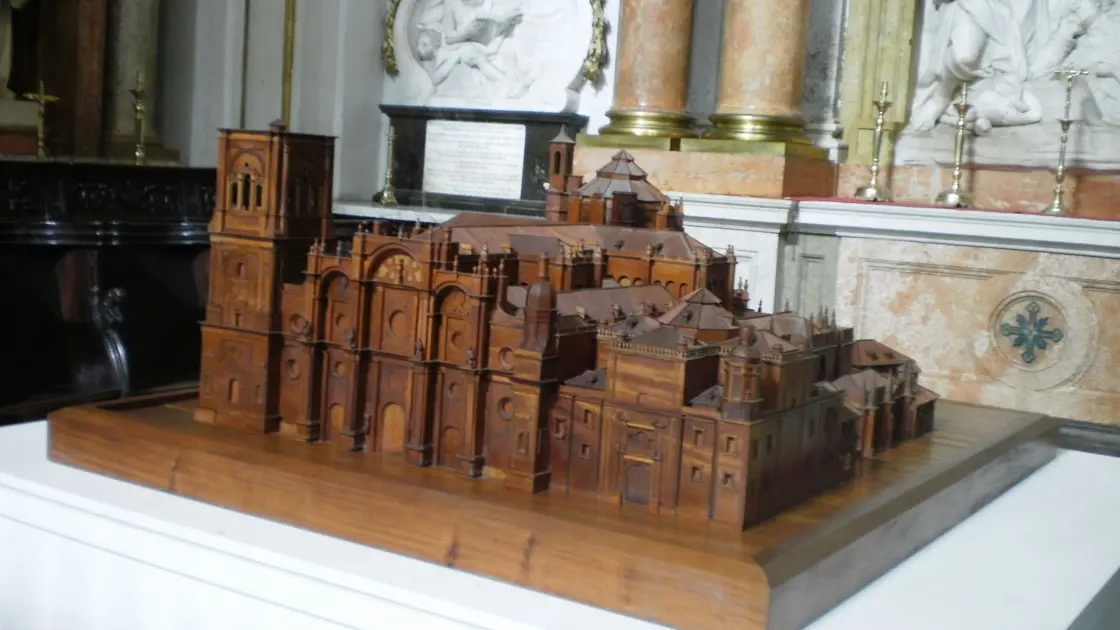
Granada Cathedral
Granada Cathedral, built over 181 years from 1523, blends Gothic foundations with a Renaissance interior of five naves and a circular chapel with a gilded dome.
The concept of the *janna*, the Islamic paradise garden, shaped Alhambra architecture directly. Water channels, citrus and pomegranate plantings, and geometrically ordered courtyards all referenced the four rivers of paradise described in Quranic tradition. Pomegranate trees grew in the Generalife gardens, alongside myrtles and cypresses. Whether planted for their symbolism or simply because they thrived on the Granada hillside is a question the historical record cannot fully answer. The two reasons were not mutually exclusive.
The visual language of Nasrid decorative art, while rarely depicting fruit naturalistically (Islamic ornament generally avoids literal representation), used abstracted plant forms including stylised pomegranate and pine-cone shapes in carved stucco and tilework. Scholars of Hispano-Islamic art identify pomegranate-derived forms in the uppermost friezes of the Comares Palace and in border patterns throughout the palace complex. The connection was available, if not always explicit.
The conquest and the coat of arms: Ferdinand's trophy fruit
On 2 January 1492, Muhammad XII, known in Spanish sources as Boabdil, handed the keys of the Alhambra to Ferdinand and Isabella's envoys. Granada was the last Muslim-ruled city in Iberia. The Reconquista, the Christian campaign to retake the peninsula that had lasted in some form since the 8th century, was complete.
Ferdinand and Isabella needed a symbol for that completion. They chose the pomegranate.
Within months of the conquest, Spanish royal heraldry was updated to add a new quarter to the coat of arms: a pomegranate fruit, split open to show its red seeds (*proper faceted gules*, in heraldic terminology)[^3], with green leaves (*vert*) at the base. The fruit was placed at the bottom of the shield, below the quarters representing Castile, León, Aragon, and Sicily. It was, explicitly and deliberately, a trophy: the visual announcement that the last piece of the Iberian puzzle was now in Christian hands.
Isabella I adopted the pomegranate as one of her personal emblems alongside the yoke (*yugo*), the F-and-Y monogram, and the castle. These devices appeared on royal documents, tapestries, metalwork, and church furnishings across Castile. The yoke and the pomegranate together suggested: submission and abundance, both under Christian sovereignty.
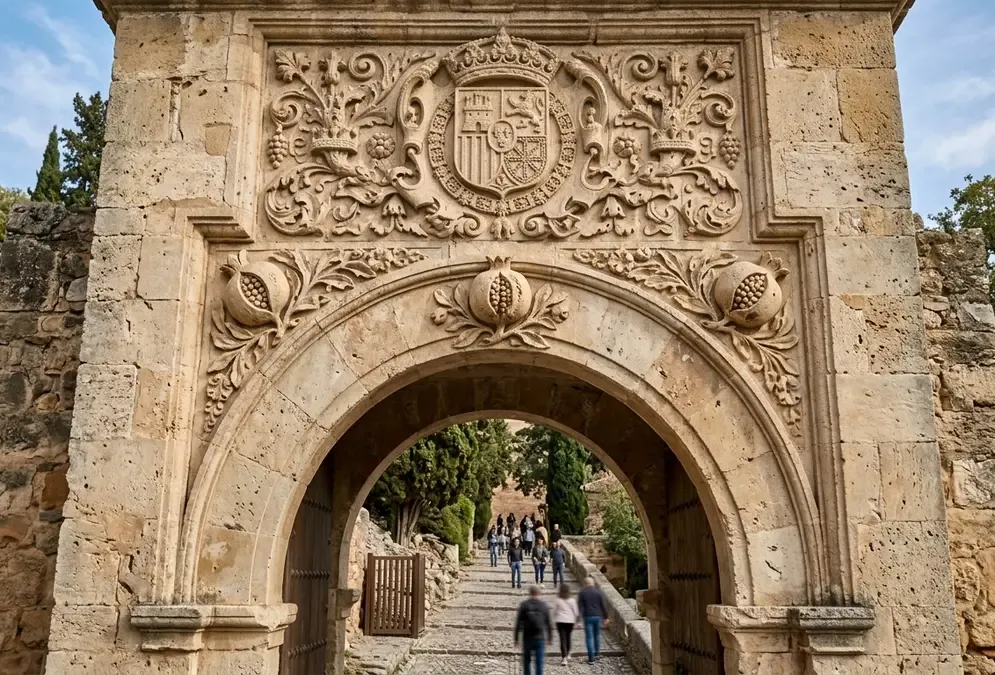
The granada pomegranate symbol carved in stone above the Puerta de las Granadas in Granada, Spain
The pomegranate has never left Spanish royal heraldry. Open the official coat of arms of the Kingdom of Spain today and you will find the same split pomegranate at the base of the shield — placed there by monarchs who wanted the world to know they had taken Granada. More than five centuries later, the trophy remains.
This is the layer of meaning that the discover pages and tourist plaques usually skip. The pomegranate above every street sign and manhole cover in Granada is not simply civic branding. It started as a declaration of military victory, stamped into the heraldry of the winning side. The city that lost — Nasrid Granada — also loved the pomegranate, but for reasons that had nothing to do with conquest.
The pomegranate in the Alhambra: where to look and what you are seeing
Most visitors to the [Alhambra](/monument/alhambra) come away knowing they were in one of the finest medieval palaces on earth. Fewer come away knowing what the decorative vocabulary was actually saying.
Read next — Monument
Alhambra
Granada's UNESCO fortress-palace on the Sabika hill. Nasrid Palace tickets sell out weeks ahead and daily entry is capped. Book via the Patronato website.
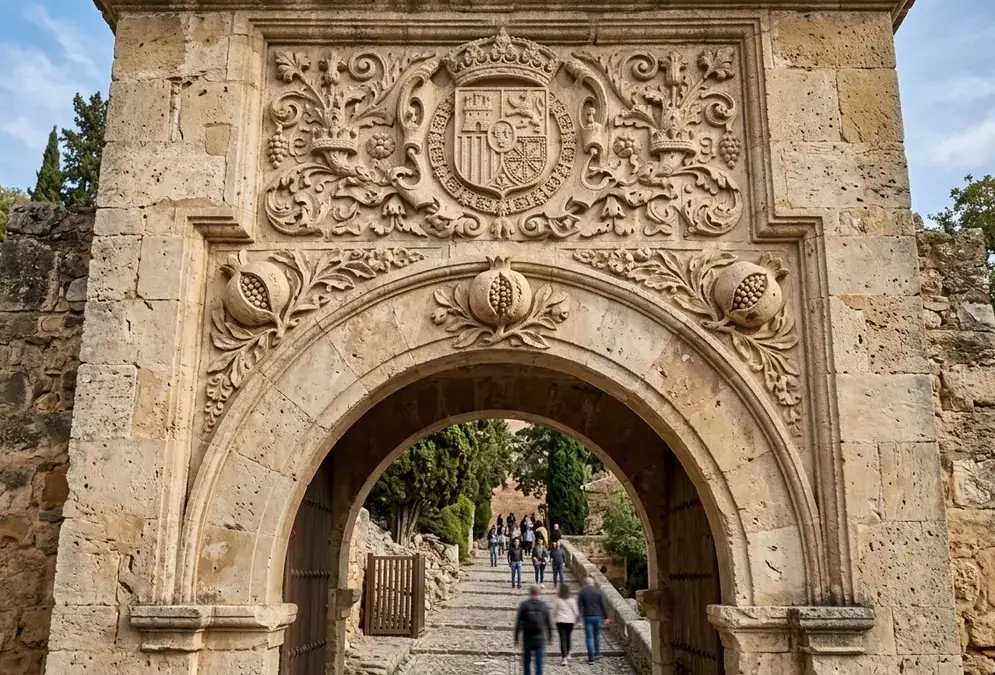
The most direct pomegranate reference on the Alhambra hill is outside the palace walls entirely: the **Puerta de las Granadas**, the Renaissance triumphal arch at the foot of the Cuesta de Gomérez, built under Charles V in the 16th century. Three stone pomegranates crown the arch. This is unambiguously conquest-era heraldry — Charles V was reinforcing the symbolic claim his grandparents had established in 1492. Visitors pass through it going uphill without usually noticing the fruit above their heads.
Inside the [Nasrid Palaces](/monument/nasrid-palaces), the pomegranate appears differently. The carved plasterwork friezes contain abstracted botanical forms, and art historians have identified stylised pomegranate shapes in the upper bands of decorative stucco in the Comares Tower and in the tile borders of the Court of the Lions. These are subtle — not the split-open heraldic fruit of Ferdinand's coat of arms, but the closed, abstract plant form of Islamic decorative convention.
The Generalife, the summer palace and garden complex above the main Alhambra, is where the pomegranate appears most directly in its natural state. Pomegranate trees are planted in the lower gardens and on the terraced slopes, alongside the myrtle hedges and water channels that have defined the space since Nasrid times. In late summer and autumn, the fruit hangs on the branches in a colour that matches the red-and-white of the Nasrid plasterwork inside. Whether that visual rhyme was intentional or fortuitous, it is one of Granada's more arresting small moments.
One thing the Alhambra does *not* prominently feature is the heraldic pomegranate of Ferdinand and Isabella. The palace was completed by the Nasrids and then occupied, not rebuilt, by the Christian monarchs. The Royal Chapel in the city below — where Ferdinand and Isabella are buried — is the more appropriate place to look for their personal heraldry. In the [Royal Chapel of Granada](/monument/royal-chapel-granada), the pomegranate appears in carved stone alongside the yoke and other royal emblems, positioned above the monarchs' own tombs.
From trophy to convergence: how the pomegranate's meaning shifted
For most of the five centuries between 1492 and the late 20th century, the official narrative in Granada treated the pomegranate straightforwardly as a symbol of Christian victory. The Reconquista was considered a triumph of civilisation; the conquest of Granada its culminating moment. The pomegranate meant: we won.
That reading began to change as Spain reckoned with *convivencia*, the medieval coexistence of Christian, Muslim, and Jewish cultures on the Iberian Peninsula, a period that produced Averroes, Maimonides, and some of the most sophisticated scholarship and architecture in medieval Europe. The Alhambra, which had been a Christian royal residence for centuries and a military barracks in the 19th century, was declared a UNESCO World Heritage Site in 1984.[^4] Granada's Islamic heritage stopped being something to be superseded and started being something to be preserved, studied, and promoted.
The pomegranate sat at the exact centre of this reinterpretation. It was both Islamic — a fruit of paradise, a Quranic symbol, a plant the Nasrids cultivated and loved — and Christian heraldry, the trophy of conquest. No other symbol in Granada contained both histories so directly.
Contemporary Granada has leaned into this ambiguity. The city's tourism branding uses the pomegranate as a universal welcome sign, explicitly invoking the city's multicultural past rather than its military history. The fruit appears on tiles, street furniture, ceramics, and restaurant menus as a symbol of what the city's tourist economy now sells: authenticity, history, the encounter between cultures. Whether this rebranding fully reckons with the conquest or papers over it depends on who you ask. Granadan scholars of Islamic heritage and local activists involved in commemorating *al-Andalus* are not always satisfied with a tourist-friendly version of reconciliation.
No other symbol in Granada contained both histories so directly — a fruit of Islamic paradise and a trophy of Christian conquest, in the same carved stone.
What is harder to dispute is that the pomegranate now carries more meaning than it did in 1492. A symbol that started as a military trophy has absorbed the much older Islamic symbolism it displaced, and the result is genuinely layered. That rarely happens with heraldry. It happened here, in part, because Granada kept living with both histories long after the battle was over.
For a deeper exploration of the Islamic culture that shaped the city, the [Moorish Granada guide](/discover/moorish-granada) covers al-Andalus architecture, the Albaicín, and the legacy of Nasrid urbanism in detail.
The pomegranate in Granada today: juice, motifs, and manhole covers
The abstract argument about meaning and conquest is one thing. What you actually encounter in Granada is something more immediate: the fruit is everywhere, in every form, at every price point.
The easiest place to see it is underfoot. Granada's cast-iron manhole covers are stamped with the pomegranate motif, a small act of civic design that most residents walk over without noticing. Street signs throughout the city use a painted red pomegranate at the sign's crown. The Alhambra hill entrance archway has its three stone specimens. Pottery and ceramic shops in the Albaicín and the Alcaicería sell plates, tiles, and bowls in every variation of the motif. Some are tasteful; many are not. The pomegranate has been as thoroughly merchandised as the Alhambra itself.
The food and drink uses are more interesting. Fresh pomegranates from the Lecrín Valley, the main growing area southeast of the city, ripen between September and November. During those months, market stalls in the Mercado San Agustín sell them whole for under two euros. Juice bars around the Alcaicería and on Calle Navas press them on the spot; a glass of granizado de granada — pomegranate crushed ice — is one of the city's more specific pleasures on a hot afternoon.
Restaurants use pomegranate seeds as a garnish on salmorejo and gazpacho, and occasionally in more elaborate ways: pomegranate molasses appears in some Moroccan-influenced cooking in the Albaicín, where a cluster of Moroccan-run teahouses and restaurants around the mosque serves dishes that use the fruit as a souring agent alongside lemon and tamarind.
For anyone wanting to understand the [Granada history guide](/discover/granada-history-guide) in full, the pomegranate is a useful lens: it concentrates, in a single fruit, the city's Arabic name, its Islamic court culture, its violent conquest, its royal heraldry, and its current identity as a multicultural tourism destination. That is a lot of weight for one piece of fruit to carry. It manages.