The Monastery of San Jerónimo sits on a quiet street northwest of the cathedral, away from Granada's main tourist circuits, yet it contains what many scholars consider the finest Renaissance altarpiece in Andalusia. The complex was founded by the Catholic Monarchs during the siege of Granada and moved to its current location after the city fell in 1492. Construction of the church began in 1504 and the main chapel was consecrated in 1522. The building belongs to the Hieronymite order, a Castilian monastic tradition with close ties to the Spanish crown.
The interior of the church is divided by a raised choir on a stone platform, below which visitors pass to reach the main chapel. The altarpiece rises some 22 metres, covering the entire apse wall in carved and gilded reliefs of scenes from the life of Christ, flanked by rows of saints and historical figures. At its base, two niches contain the remains of Gonzalo Fernández de Córdoba, the general known as the 'Great Captain' who conquered Naples for the Spanish crown, and his wife María Manrique. Their tomb is a key draw for visitors interested in the early-modern Spanish empire and its military figures.
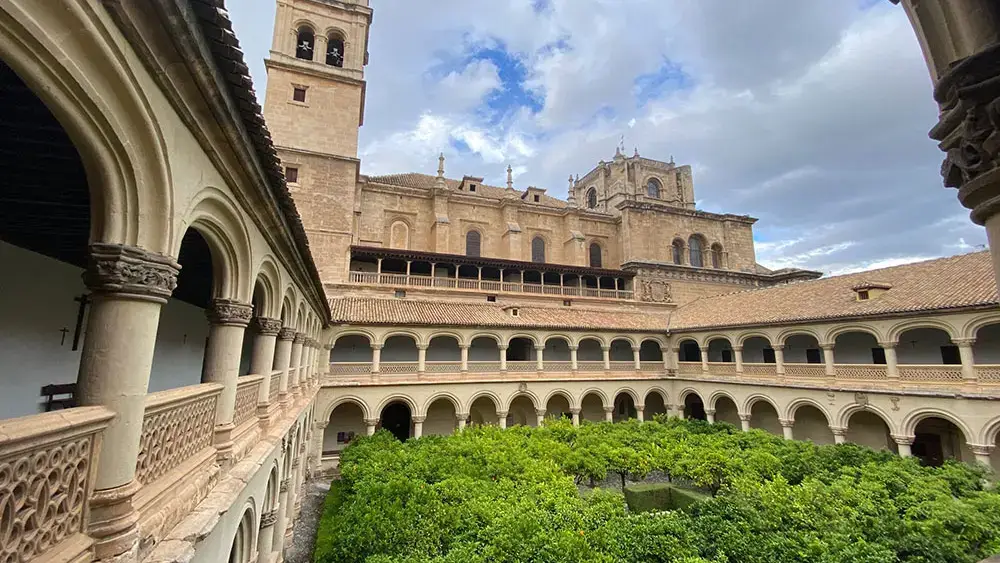
Two cloisters adjoin the church. The larger, 16th-century cloister has two arcaded levels of rounded arches resting on slender columns, and a central garden. The smaller cloister is more austere and gives a clearer sense of the monastery's working, contemplative origins. The complex was badly damaged during the Napoleonic invasion: French troops used stones from the tower to construct a bridge, and the complex underwent major restoration between 1916 and 1920. A second round of restoration began in 2004.
The monastery is still an active religious community, so certain areas may be closed during services or religious events. The entrance fee is modest, and the site tends to attract a quieter, more architecturally focused crowd than the Alhambra. If you are walking from the cathedral, allow about 15 minutes on foot, crossing the university campus along Calle San Jerónimo.