Literary guide
García Lorca in Granada
Born near the city, exiled from the Alhambra by Romanticism and returned to it by imagination. Lorca's Granada: where to find it and what it means.

Written by
James Walker Seven years resident in Granada. Specialist in Nasrid architecture, Al-Andalus history, and Andalusian walking routes.
Published
Federico García Lorca was born on 5 June 1898 in Fuente Vaqueros, a small village 20 kilometres west of Granada. He died on 19 August 1936, shot by Nationalist forces on a stretch of road between Víznar and Alfacar, on the outskirts of the same city. Between those two dates he wrote some of the most performed theatre in the Spanish-speaking world, helped revive the flamenco tradition he heard in Sacromonte, and produced poetry that remains in the curriculum of schools in twelve countries. He was thirty-eight years old.
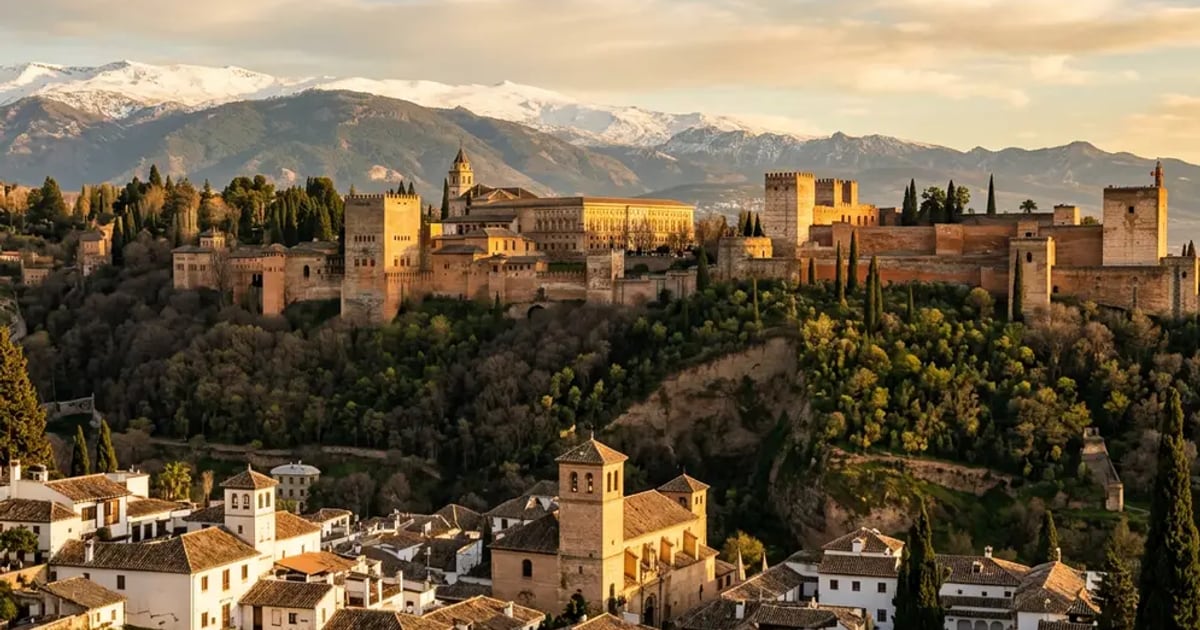
Granada shaped Lorca in ways that are specific and traceable. The Alhambra's Arabic epigraphic poetry — the inscriptions on its walls — was one of the models for his own verse. The Roma community of Sacromonte was the subject and inspiration for Romancero Gitano. The cante jondo tradition he helped save in 1922 runs through everything he wrote. A visit to Granada that engages seriously with the Lorca connections is a different kind of visit from the standard Alhambra + Albaicín circuit — and, for certain travellers, the more important one.
Centro Federico García Lorca
Opened in 2023 on the Plaza de la Romanilla in central Granada, the Centro Federico García Lorca is the primary institutional home for the poet's archive and legacy. It is not a house museum — Lorca did not live here — but a cultural centre with exhibition spaces, a research library, an auditorium, and rotating shows exploring different aspects of his life and work.
The permanent collection includes manuscripts, personal correspondence, first editions, photographs, and objects from his circle. The library and archive are accessible to scholars by appointment (Monday to Friday, 09:00–14:00). For general visitors, the exhibition spaces are open without booking and the experience depends on what is currently showing; the Centre publishes its programme on its website and changes exhibitions regularly.
Hours: Tuesday to Saturday, 11:00–14:00 and 17:00–20:00 (winter) / 18:00–21:00 (summer); Sunday and bank holidays 11:00–14:00; closed Monday. Admission: free. The building is two minutes from the Granada Cathedral; visit it before or after the Cathedral and Royal Chapel as part of a city-centre morning.
Huerta de San Vicente
The Huerta de San Vicente was the García Lorca family's summer house from 1926, and the place where Lorca wrote most of his late work. The house sits in what is now the Federico García Lorca Park, a 10-minute walk south of the city centre. The surrounding orchards and farmland that once gave the house its isolation are gone — the park was created by the city council after acquiring the property in 1985, and today it is enclosed by apartment blocks — but the house itself is preserved largely as it was.
Visits are guided and the groups are small, which means you see the rooms properly rather than filing past them. The study where Lorca wrote Bodas de sangre (Blood Wedding, 1932), Yerma (1934), and the Diván del Tamarit poetry collection (modelled on Andalusian Arabic ghazals) is the focal point. His desk, his piano, family photographs, and objects from his years in Madrid are here. The garden, with its cypress and rose beds, has been restored to approximately its 1930s state.
The Huerta opened to the public in 1995 and is administered by the Federico García Lorca Foundation. Hours and admission: vary by season; verify with the foundation or Granada's tourism office before visiting. Allow 1–1.5 hours. The walk from the city centre passes through a quiet residential neighbourhood and is signposted from Avenida de Cervantes.
Fuente Vaqueros: the birthplace museum
Fuente Vaqueros is a village of around 5,000 people on the plain west of Granada. The house where Lorca was born on 5 June 1898 is now the Casa-Museo Federico García Lorca, maintained by the local council. It is smaller and more personal than the Huerta de San Vicente — a working-class village house from the 1890s, preserving family furniture, childhood photographs, and memorabilia from his early career.
The village also gives you something the city cannot: an understanding of the landscape he grew up in. The vega de Granada — the flat irrigated plain surrounding the city — is visible from Fuente Vaqueros in all directions. The mulberry trees and irrigation channels he described in early poems are still there. The village church, the main square, the dust of a Castilian summer. Lorca described Fuente Vaqueros with ambivalence — he moved to Granada and then to Madrid as quickly as he could — but its influence on his writing is direct.
Getting there without a car: Autobuses Rober operates services from Granada bus station to Fuente Vaqueros (journey around 30–40 minutes). Check current timetables at the station or with Granada's tourism office. The museum is a short walk from the bus stop in the village centre. Allow a full half-day for the return trip including time at the museum.
Sacromonte and the deep song
In February 1922, Lorca and the composer Manuel de Falla organised the Concurso de Cante Jondo — a competition for singers of the deep song — in Granada. Their aim was to document and preserve a tradition they believed was disappearing. The competition drew singers from across Andalusia to the Alhambra; some of those recorded are now considered the last masters of a style that was already being replaced by commercial flamenco.
Lorca's Poema del Cante Jondo, written in 1921 and published in 1931, grew directly out of this project. The poems attempt to recreate the emotional quality of cante jondo in written verse — the duende, the awareness of death, the specific Granada Roma community from which the tradition emerged. Sacromonte is where that community lived, in whitewashed cave houses above the Darro. It still does.
The flamenco guide covers the practical side of seeing a cave flamenco show in Sacromonte. For the Lorca connection specifically, knowing that he spent time in those same caves — watching, listening, taking notes — makes the experience of a live show sit differently. It is not a tourist attraction that happens to be in Sacromonte. It is the thing itself, the same thing, in roughly the same place.
The execution and what followed
Lorca returned to Granada in July 1936, shortly before the Nationalist coup. He was arrested on 16 August — the exact chain of events and who gave the order remains disputed — and shot on 19 August near the road between Víznar and Alfacar. He was 38. The Francoist regime suppressed his work for the next four decades; his books were banned in Spain. Outside Spain, he was already internationally known; Bodas de sangre had been staged in New York. The contradiction between his posthumous fame abroad and his erasure at home defined his legacy for a generation.
His remains were never found. Excavations near Alfacar in the 2000s and 2010s located mass graves from the period but could not confirm his burial site. A memorial park at Fuente Grande, between Víznar and Alfacar, marks the general area. The road between those villages is narrow and not signposted for tourists; it is a working Andalusian countryside route, not a heritage trail. Those who want to visit approach it on those terms.
Granada today has named streets, parks, and institutions after him. The park where the Huerta de San Vicente stands bears his name. The cultural centre opened in 2023. The contradictions of that posthumous honour — given by a city that acquiesced to his murder — are not resolved, merely noted. They are part of what makes the Lorca visit in Granada different from a standard literary pilgrimage. There is no comfortable ending here.
Practical visit guide
Centro Federico García Lorca
Plaza de la Romanilla, s/n, 18001 Granada. Free entry. Tue–Sat 11:00–14:00 + 17:00–20:00 (winter) / 18:00–21:00 (summer). Closed Monday. 1–1.5 hours.
Huerta de San Vicente
Federico García Lorca Park, 10 min walk from city centre. Guided visits; small groups. Hours vary by season — verify before visiting. Modest admission. 1–1.5 hours.
Fuente Vaqueros birthplace
20 km west of Granada. Bus from Granada bus station (~35 min). Open Tue–Sun with guided tours (hours vary). Half-day excursion from Granada.
Sacromonte connection
Bus C34 from Plaza Nueva. Cave flamenco shows in the evening (book ahead). See the flamenco guide for current venues and booking.
A focused Lorca day in Granada: morning at the Centro Federico García Lorca, lunch in the city centre, afternoon at the Huerta de San Vicente, evening cave flamenco in Sacromonte. That sequence — from scholarship to biography to live performance — covers Lorca's major registers in the city where all of them have their roots.
Frequently asked questions
Frequently asked questions
What are the main Lorca sites to visit in Granada?
Three sites in or near Granada: the Centro Federico García Lorca (Plaza de la Romanilla, central Granada — free, rotating exhibitions and archive), the Huerta de San Vicente (the family summer home in the Federico García Lorca Park, 10 minutes' walk from the centre — modest admission, house preserved as in Lorca's time), and the Casa-Museo Federico García Lorca in Fuente Vaqueros, his birthplace village 20 km west of Granada. A full Lorca day in Granada covers the Centro and the Huerta; Fuente Vaqueros requires additional travel and is worth adding if you have a full extra day.
Where was García Lorca executed?
Lorca was arrested by Nationalist forces in Granada on 16 August 1936 and shot on 19 August near the road between Víznar and Alfacar, two villages east of Granada. The exact burial location remains uncertain despite multiple archaeological excavations. The site near Fuente Grande (La Gran Fuente) between Víznar and Alfacar has been marked as a memorial. For anyone wanting to make the visit, Víznar is about 12 km from Granada — accessible by car; public transport is limited.
What is the duende and why does it matter for understanding Lorca?
Duende is Lorca's term for the dark, irrational force that gives art its power — what he called the awareness of death, connection to the earth, and the acknowledgement that reason cannot account for everything. He developed the idea in a 1933 lecture called Juego y teoría del duende (Theory and Play of the Duende). For Lorca, flamenco in Sacromonte embodied duende at its most direct. He spent his career trying to bring the same quality into poetry and theatre. Understanding duende is the key to understanding why his work reads differently from other Spanish modernism of the same period.
What did Lorca write in Granada?
Most of his major late work was written at the Huerta de San Vicente, the family's summer house in Granada. During summers there between 1926 and 1936 he wrote: Así que pasen cinco años (1931), Bodas de sangre (Blood Wedding, 1932), Yerma (1934), and the Diván del Tamarit poetry collection (1931–1936), written in the tradition of Andalusian Arabic poetry. His earlier work — Romancero Gitano (1928) and Poema del Cante Jondo — draws heavily on his Granada childhood and the Sacromonte flamenco tradition.
Is the Centro Federico García Lorca worth visiting?
Yes if you have any interest in Lorca or 20th-century Spanish literature. The Centre is primarily a cultural institution rather than a house museum, so what you see depends on the current exhibition. The permanent collection includes manuscripts, photographs, and personal effects; rotating exhibitions explore different aspects of his work. Entry is free. It pairs well with a visit to the Huerta de San Vicente in the same day — the Centre provides the intellectual framework; the Huerta provides the physical context.