
Founding the dynasty: Muhammad I and the emirate of 1232
In **1232**, a Granadan nobleman named Muhammad ibn Yusuf ibn Nasr — later known as Muhammad I ibn al-Ahmar (the Red, for his reddish beard) — established the Nasrid emirate by taking control of the city of Jaén, then of Granada itself.[^1] He did so at a moment of maximum chaos: the Almohad empire, which had governed Al-Andalus for nearly a century, was collapsing. The Reconquista was pressing south. Córdoba had fallen to Fernando III of Castile in 1236, Seville in 1248. Ibn al-Ahmar watched both cities fall and drew a clear conclusion: military resistance alone could not hold Granada.
His solution was diplomacy in its most pragmatic form. He travelled to Fernando III's court and agreed to become his vassal, paying **annual tribute in gold** and providing Castilian forces with military assistance when required. He helped Fernando III besiege Seville in 1247, fighting alongside his Christian overlord against a fellow Muslim city. The arrangement was humiliating. It kept the emirate alive.
He moved his capital from Jaén to Granada and began construction on the **[Alcazaba](/monument/alcazaba-granada)**, the military fortress at the western tip of the Sabika hill that would eventually become the Alhambra complex.[^2] The earliest Nasrid structures are still visible there: rough military walls and towers built for defence, not for the elaborate decoration that would come later. Granada at this point was a city of perhaps **20,000 people**, defended by its walls and its new sultan's skill at reading political weather.
The golden age: Yusuf I and Muhammad V in the 14th century
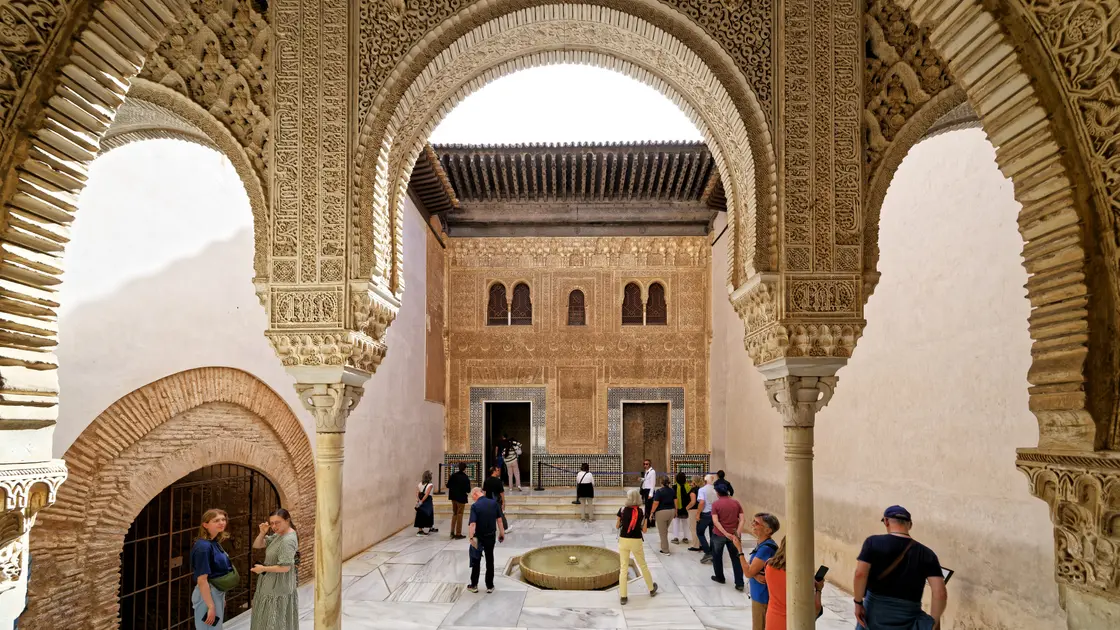
The Nasrid dynasty reached its artistic peak under two sultans who ruled consecutively in the mid-14th century. **Yusuf I** (reigned 1333–1354) built the Comares Tower and the Hall of Ambassadors, the most formally impressive room in the Alhambra, with a cedar ceiling 18 metres high representing the seven heavens of Islamic cosmology and walls covered floor-to-ceiling in **arabesque stucco** carved to a depth and intricacy that has never been replicated. He also built the Madraza (Islamic university) in 1349 in the city below the hill.
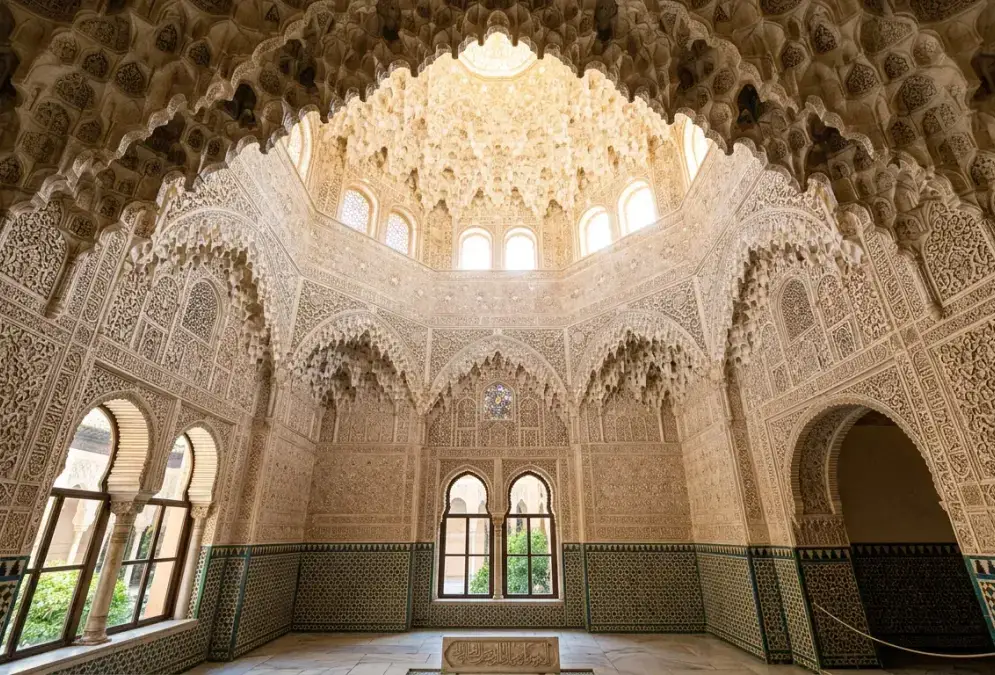
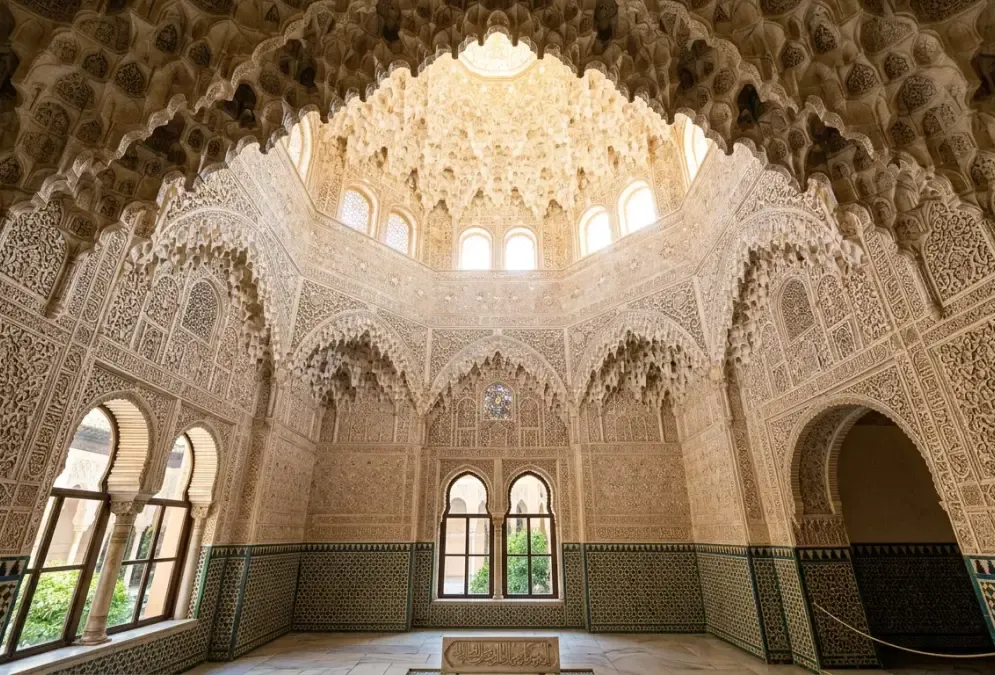
Yusuf I was murdered by a deranged servant while praying in the Alhambra mosque in 1354. His son **Muhammad V** (reigned 1354–1359, then 1362–1391 after an interruption) continued and surpassed the building programme. He added the **Court of the Lions** in the [Nasrid Palaces](/monument/nasrid-palaces), with its central fountain supported by 12 marble lions, its 124 slender columns, and the muqarnas (stalactite vault) ceiling of the Hall of the Two Sisters, containing over 5,000 individual plaster cells.[^3] The court was completed around **1380** and remains largely intact.
The poetry inscribed throughout both structures was composed by Ibn Zamrak, court poet to Muhammad V, and it functions as a commentary on the spaces themselves. The inscription around the dome of the Hall of the Two Sisters reads, in part: *"I am a garden adorned with beauty. Gaze at my beauty and you shall know it."* These were not decorative gestures; they were theological and aesthetic programmes, integrated into the architecture.
How the Nasrids survived: diplomacy and the double-vassal strategy
The Nasrid survival strategy rested on a structural contradiction that the sultans managed for 260 years: paying tribute to Castile as nominal vassals while maintaining real independence and sometimes allying with North African powers against Castile. Historians call this the **double-vassal arrangement**: subordinate to Castile in formal terms, aligned with Morocco's Marinid dynasty in military terms, and autonomous in practice.
The tribute payments were substantial: estimates range from **12,000 to 20,000 gold dinars per year** in the 14th century, drawn from Granada's textile trade in silk and from customs duties on goods passing through the port of Almería. The emirate's economy was productive enough to sustain both the tribute and the building programme at the Alhambra simultaneously. Granada at its 14th-century peak had a population of around **50,000 in the city proper**, with major commercial districts for silk weaving, metalwork, and ceramics.
When Castilian kings were weak or distracted, **tribute payments were suspended**. When Castile pressed, payments resumed and the diplomatic tone softened. The Granadan emirs read Castilian court politics with precision and adjusted accordingly. The system worked as long as the two Christian kingdoms of Castile and Aragon remained separate. The marriage of Ferdinand and Isabella in 1469, and their joint coronation as rulers of a unified Spain in 1479, removed the structural condition that had kept the strategy viable for two and a half centuries.
Explore nearby · Monument
Alhambra
Granada's UNESCO fortress-palace on the Sabika hill. Nasrid Palace tickets sell out weeks ahead and daily entry is capped. Book via the Patronato website.
Art and architecture: what the Nasrids built
The [Alhambra](/monument/alhambra) is the most complete surviving example of medieval Islamic palace architecture in the world. The Nasrid building programme lasted from the 13th to the late 14th century and produced three distinct palace complexes on the Sabika hill, connected by courtyards and gardens:
- **Mexuar**: the oldest surviving section, built by Muhammad III (1302–1309), originally a council chamber and throne room - **Comares Palace**: Yusuf I's great work, with the Hall of Ambassadors and the rectangular Comares Tower - **Palace of the Lions**: Muhammad V's completion, built around the famous courtyard with its 12-lion fountain
Court of the Lions in the Nasrid Palaces of the Alhambra, Granada, built by Muhammad V around 1380, with 12 marble lions supporting the central fountain
The design vocabulary throughout draws on a consistent set of elements:
- **Muqarnas**: stalactite vaulting made from thousands of small plaster cells, each calculated geometrically to produce the overall form - **Arabesque stucco**: repeating geometric and vegetal patterns carved into plaster walls, based on mathematical grids - **Kufic calligraphy**: angular Quranic inscriptions and poetry integrated into wall panels and cornices - **Zellige tilework**: geometric ceramic tiles at dado height, providing colour contrast to the white stucco above
The muqarnas ceiling of the Hall of the Two Sisters contains over 5,000 individual plaster cells. Each was hand-carved and fitted geometrically. The result looks improvised. It is the opposite.
The [Generalife](/monument/generalife), the Nasrid summer palace on the hill above the main complex, added a different register: outdoor terraced gardens with water channels, arbours of climbing plants, and views across the city. The Acequia Real aqueduct that supplied the Alhambra with water from the Río Darro was an integral part of this design; water and architecture were planned together.
Political instability and the final collapse
Twenty-three sultans in **260 years** is an average reign of just over 11 years. Several reigned twice after being deposed and restored. At least three were murdered. The family politics of the Nasrid court were characterised by concubine rivalries, disputed succession, and regular appeals to Castile or Morocco to intervene on one claimant's behalf against another.
The most politically damaging period was the final decade. **Abu al-Hasan Ali** (reigned 1464–1485) had two rival factions at court: his wife Aixa, mother of the future Boabdil, and his favoured concubine Zoraya (originally a Christian captive named Isabel de Solís), whose sons stood to inherit. In **1482**, Aixa backed a palace revolt that briefly put her son **Boabdil** on the throne. Abu al-Hasan retook power. His brother **Muhammad XIII al-Zaghal** eventually seized power after Abu al-Hasan fell ill.
Ferdinand and Isabella exploited the three-way division with precision. When Boabdil was captured at the Battle of Lucena in **1483**, Ferdinand released him not for ransom but as a vassal, sending him back to contest the throne against his father and uncle. The strategy worked: the Nasrid civil war consumed the 1480s while Castile methodically reduced the surrounding cities.
The building programme of the Alhambra is striking against this backdrop. The most turbulent dynasty in Andalusia, constantly fighting itself, produced **architecture of exceptional calm and geometric order**. The contrast is not incidental: the palaces were the ideological claim to legitimacy that the court politics continually undermined.
By **1487**, when Málaga fell to Ferdinand after a four-month siege, the Nasrid emirate had been reduced to the city of Granada and its surrounding hinterland. Al-Zaghal held the eastern part of the kingdom and proved the more capable military commander: he inflicted several defeats on Castilian forces and held Baza for eight months in 1489 before surrendering when supply lines were cut. He crossed to Morocco in early 1490. Boabdil was left alone.
The siege of Granada began in **spring 1491**. Ferdinand established a permanent camp west of the city, on the open vega, cutting supply routes from the coast and from the Alpujarras. By autumn, food was running short inside the city. Negotiations began in October through intermediaries. The treaty was signed on 25 November 1491, and the handover took place on **2 January 1492**.
Boabdil descended from the Alhambra and handed Ferdinand the keys of the city at the foot of the hill. The Spanish flag went up over the **Torre de la Vela**. The 260-year Nasrid dynasty ended without a battle for the capital itself. That the palace complex survived intact was a direct consequence of the surrender terms: the capitulations protected the Alhambra from conversion or demolition, at least initially. Ferdinand and Isabella took up residence there within days.
The Nasrid legacy: what survived
The physical legacy of the **Nasrid dynasty** is concentrated in Granada's upper hill, but it extends across the city and into the wider region. The Alhambra is the most visited monument in Spain. Its Nasrid Palaces, the Alcazaba, and the Generalife gardens together form the most intact surviving medieval Islamic palace complex in the Western world.
The **Albaicín** neighbourhood on the hill facing the Alhambra retains its Nasrid street pattern: the narrow winding lanes, the carmenes (walled garden houses with interior courtyards), the public fountains fed by the same channel system the Nasrids built. UNESCO listed both the Alhambra and the Albaicín in **1994** as a single World Heritage Site.[^4]
The **Madraza** on Calle Zacatín, built by Yusuf I in 1349 as Granada's Islamic university, survived in altered form: it became the city hall after 1492, then a university chapel, and was later absorbed into the University of Granada. Its original oratory, with a muqarnas ceiling, was uncovered and restored in the 20th century and is now open to visitors.
The **silk-weaving tradition** the Nasrids brought to its peak survived them, at least for a time. The Alcaicería, the covered silk market near the cathedral, was rebuilt after a fire in the 19th century, but the street network follows the original Nasrid layout. Granada silk (particularly the *tafetán* weave associated with the Vega workshops) continued under Morisco craftsmen until the 1609 expulsion.