Ten years in food journalism specialising in Spanish and Andalusian cuisine. Four years focused on Granada's food scene.
Published
Updated
The Alhambra is the most expensive thing you'll do in Granada. At €15–22 for the Nasrid Palaces, it's not cheap. But it is a one-off. Outside that single ticket, Granada runs cheaper than almost any other major city in Andalusia: hostel beds from €18, a full evening of food and drink for under €12, a city bus for €1.50. The free tapas culture alone restructures how much meals cost.
This guide covers what Granada actually costs, day by day and tier by tier. No vague claims about it being "affordable" — specific numbers, realistic breakdowns, and the specific mistakes that push budgets up unnecessarily.
What a day in Granada actually costs
Three realistic tiers, based on where you sleep and whether you visit the Alhambra on a given day.
Granada daily budget breakdown
Backpacker — around €25/day
Hostel dorm: €18–28
Three drinks at tapas bars (food included): €7.50–10.50
Coffee and a pastry: €2–3
Attractions: €0 (viewpoints, Albaicín, Realejo, river walks)
Add €15–22 on Alhambra day — budget extra that day or push the total to €40–50.
Mid-range — around €60/day
Budget hotel or high-end hostel: €25–35
Alhambra ticket (on that day): €15–20
Tapas crawl + one sit-down meal: €20–25
Bus or taxi: €5–10
Comfortable — €120+/day
3-star hotel: €50–70
Alhambra plus extras: €25–30
Mixed dining (tapas + restaurant): €30–40
Guided tour or evening activity: €15–20
The figures above assume one Alhambra visit per trip, not per day. Most visitors spend two to three days in Granada; the Alhambra day is the expensive one. Plan it early — morning Nasrid Palaces slots sell out weeks ahead in peak season.
Free attractions and viewpoints
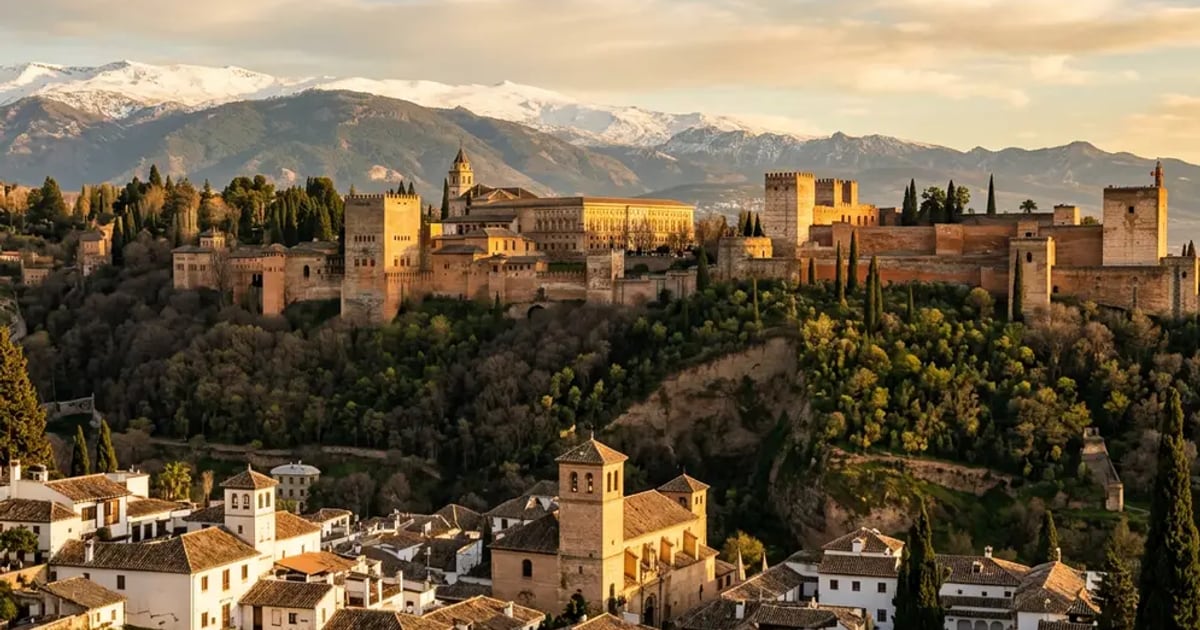
Granada's most photographed view costs nothing. Mirador de San Nicolás in the Albaicín gives you the Alhambra framed against the Sierra Nevada with no ticket required. The entire UNESCO-listed Moorish quarter behind it — cobblestone lanes, hidden plazas, walls covered in white plaster that's been re-applied for five centuries — is free to wander for as long as you want.
Viewpoints (all free)
Mirador de San Nicolás — the classic Alhambra panorama, best at sunset. Gets crowded; arrive 30 minutes early for a good position.
Mirador San Cristóbal — equally good views from higher elevation, considerably fewer people.
Mirador San Miguel Alto — Granada's highest accessible viewpoint, 360-degree city views.
Mirador del Carril de la Lona — less visited, excellent for late afternoon light.
Paseo de los Tristes — a riverside walk with ground-level Alhambra views along the Darro. Good for an early morning before crowds arrive.
Free monuments
El Bañuelo — an 11th-century Moorish bathhouse on the Darro, free entry. Small but genuinely intact, with star-cut ceiling vents that let light fall in shifting patterns.
Corral del Carbón — a 14th-century caravanserai (merchants' inn), free entry. The only surviving Nasrid-era building of its type in Spain.
Granada Cathedral — free during morning and evening worship hours. Renaissance architecture begun in 1523, worth seeing even briefly.
Royal Chapel — free during worship. Holds the tombs of Ferdinand and Isabella.
Monasterio de San Jerónimo — free for EU citizens; non-EU around €4. A 16th-century monastery with an extraordinary plateresque church interior, 10 minutes' walk from the Cathedral.
Huerta de San Vicente — García Lorca's family home museum in the Realejo. Guided visits only; book ahead. The house and garden are small but the Federico García Lorca park surrounding it is free to walk.
Neighbourhoods and free experiences
Albaicín — the Moorish quarter is free to explore entirely. Wandering uphill from Plaza Nueva through narrow lanes is the activity, not a means to reach a paid site.
Realejo — the former Jewish quarter, now a student and arts neighbourhood. Street art, small galleries, local bars with free tapas.
Carrera del Darro — the river road below the Alhambra walls. One of the most photographed streets in Andalusia, no entry required.
Free walking tours — tip-based tours depart from Plaza Nueva (typically €5–15 suggested tip). Two hours with a local guide covering Moorish history and the city layout — better value than most paid options.
Free public holidays and festivals
Día de Andalucía (28 February) — Andalusia's regional public holiday opens state museums free, including the Museo Arqueológico de Granada. The city also puts on free outdoor concerts and community Andalusian breakfasts (mollete with olive oil and tomato) around the centro. Most shops close, so stock up the day before.
Fiesta de la Virgen de las Angustias (September) — Granada's patron saint festival is entirely free. The floral offering on 15 September runs all day outside the basilica on Carrera de la Virgen; the solemn procession on the last Sunday of September covers most of central Granada. No tickets, no barriers — just the city celebrating for itself.
For more, the full things to do guide covers paid and free activities together with time and access details.
The Alhambra question
The Nasrid Palaces cost €15 if you book online in advance at the official site. At the gate, the price rises. Through GetYourGuide or Viator, you pay the same or more for the same ticket — there is no queue advantage or additional access. The full Alhambra tickets guide covers every tier in detail.
If you're on a hard budget, the Generalife gardens plus Alcazaba fortress sell as a cheaper combination without the Nasrid Palaces. You lose the most famous rooms — the Hall of the Ambassadors, the Court of the Lions — but you keep the gardens and the defensive tower views. The Dobla de Oro combination ticket bundles other Granada monuments for some savings. If you plan to visit multiple paid attractions across several days, the Granada City Card combines the Alhambra, museums, and public transport into a single pass — the value guide breaks down exactly when it saves money and when the standard tickets work out cheaper.
The external option: skip paid entry altogether. Walk the Cuesta del Rey Chico footpath up to the Alhambra walls, explore the Paseo de los Tristes and Carrera del Darro below, and go to Mirador de San Nicolás at sunset. You see the building from the outside — closer and longer than most visitors realise is possible — and save €15–22. The tradeoff is not seeing the interiors. For a first visit, most people find the palaces worth the cost. For a tight two-day budget, it's a genuine choice.
Book Alhambra slots weeks in advance
In peak season (March–October), Nasrid Palaces time slots sell out three to four weeks ahead. Arriving without a booking and hoping to buy at the gate is a strategy that regularly fails. Book at tickets.alhambra-patronato.es — the only official source. Your time slot for the Nasrid Palaces is fixed; everything else (Alcazaba, Generalife) can be visited freely within your entry window.
Free tapas: your main meal strategy
Order one drink in a traditional Granada bar and a plate of food arrives automatically, at no charge. This is not a happy-hour promotion or a tourist gimmick. It is how most of the city has always eaten in the evening. A beer or glass of wine costs €2–2.50. The tapa ranges from olives and nuts at the simpler end to tortilla, jamón, or a small bowl of stew at the better bars.
The practical upshot for budget travellers: three drinks across two or three bars over 90 minutes delivers the caloric equivalent of a sit-down dinner for €7.50–10.50. The free tapas guide has specific bars with addresses; the short version is to concentrate on Realejo, Calle Navas, and the streets around Plaza de la Trinidad. For a mapped evening circuit with a specific walking order, the self-guided tapas crawl routes you through three zones — Navas, Plaza Nueva, and Campo del Príncipe — with bar recommendations at each stop.
What to order: a caña (small draft beer) or tinto de verano (wine with lemon soda) triggers the free tapa at most bars. Soft drinks and juice also work. The bar decides what you receive — you do not choose it. Some visitors find this odd; locals treat it as the natural way things work. The quality improves as you move away from the main tourist routes.
Where the free tapas tradition breaks down
Bars directly on the Cathedral square, near the main Alhambra entrance, and along Gran Vía sometimes charge for tapas or replace them with a small bowl of crisps. This is legal but it is not what Granada's tapas culture actually is. The further you walk from the major monuments, the more reliably the tradition holds. If a bar has photos of food on a laminated menu outside, walk on.
Where to sleep for less
Hostel dorm beds run €18–28 per night. The best-located hostels are in the Albaicín (atmospheric, walkable to everything, hilly) or in Centro near Plaza Nueva (flat, central, direct access to the tapas bars). Oasis Backpackers Hostel has a rooftop terrace with Alhambra views and a social kitchen — its location is good for both the Albaicín walks and the city-centre tapas circuit. Solo travellers in particular will find Granada's free tapas bar culture makes meeting people easy; the Granada for solo travellers guide covers hostel choices, safe evening routes, and how to work the tapas bars as a solo visitor.
Budget hotels for a private double start around €45–70. Anything marketed as "boutique" in the Albaicín adds a 30–50% location surcharge; the room itself is often the same quality as a standard hotel in Centro at a lower price. If you are travelling as a pair, a €50 double in Centro often works out cheaper per person than two hostel dorms.
A hostel with a shared kitchen cuts food costs significantly. Breakfast from a market — bread, fruit, jamón from Mercado San Agustín — costs €2–3. That's €2–3 saved each morning versus a café breakfast, which adds up over three or four nights.
If you're planning a longer stay or working remotely, the Granada for digital nomads guide covers co-working spaces, monthly apartment rates, and which neighbourhoods offer the most reliable broadband — useful context if your budget calculation extends beyond a few nights.
Getting around cheaply
Most of Granada is walkable. The distance from Plaza Nueva to the Alhambra main gate is around 15 minutes on foot. From Plaza Nueva to Mirador de San Nicolás is 25 minutes uphill. The city is compact in a way that Seville or Málaga are not — you can cover the main sites in a day on foot without taking public transport at all.
When you do need a bus, a single ticket costs €1.50. A rechargeable Bono card reduces this with discounted multi-trip pricing. The bus is most useful for the Sierra Nevada (day trips for skiers or hikers) or for reaching distant viewpoints. Within the historic centre, walking is faster anyway.
Avoid tourist buses (€25–40) and commercially packaged city tours. Guided walking tours of the Albaicín run from free (tip-based, from Plaza Nueva) to around €15 for a paid group option. The free walking tour covers the same ground and is often led by someone who was born here.
Mistakes that drain your budget
Eating near the Cathedral or the Alhambra entrance. Restaurants in the tourist strip charge two to three times what you would pay two streets away for the same food. The Cathedral square specifically has some of the worst value-for-money restaurants in Granada. Walk five minutes in any direction.
Buying Alhambra tickets through GetYourGuide or Viator. These platforms sell the identical ticket you can buy yourself at tickets.alhambra-patronato.es. The markup is typically €3–7 per ticket. There is no benefit: no queue priority, no added service. Book direct.
Paying for walking tours when free ones exist. Tip-based tours from Plaza Nueva run morning and afternoon slots. A suggested tip of €5–15 is the convention; give what the tour was worth to you. You get the same history and local knowledge as a €20 paid tour.
Buying water in tourist areas. Granada's tap water is safe and good. Refill a bottle at your hostel or from public fountains. In Albaicín in July, bottled water at tourist kiosks runs €1.20–1.80 for 500ml.
Staying near the Alhambra unnecessarily. Properties within 500 metres of the Alhambra entrance carry a significant location premium. The Alhambra is a ten-minute walk from almost anywhere in the historic centre. You do not need to pay more to sleep close to it.
Thinking Granada is an expensive city. The Alhambra ticket shapes first impressions. Once you have paid for that, the city resets: a glass of wine costs €2.50 and comes with food, a city bus costs €1.50, and the most rewarding afternoon — wandering the Albaicín, watching the light change across the Alhambra from the mirador — costs nothing.
Frequently asked questions
Frequently asked questions
How much does a day in Granada cost?
A realistic backpacker day runs €25–35: hostel bed €18–28, three drinks at free tapas bars €7.50–10.50 (food included), coffee €1.50. Skip the Alhambra that day and you stay under €30. A mid-range day with the Alhambra, a restaurant lunch, and a decent hotel room costs around €60–80. Budget for at least one Alhambra day in your total trip cost; everything else in Granada is remarkably cheap.
Is the Alhambra worth €22?
Yes, if you book the full Nasrid Palaces ticket. The Nasrid Palaces — the carved stucco rooms built for the last Moorish kings — are unlike anything else in Europe. You cannot appreciate them from outside. The gardens (Generalife) and fortress (Alcazaba) are included in the full ticket. Buy online at tickets.alhambra-patronato.es for €15 base rate; the €22 figure applies to combined or peak-slot tickets. Do not buy through GetYourGuide or Viator — you pay €3–7 more for identical access.
Is free tapas with every drink still real?
Yes, in the right bars. Order any drink at a traditional Granada bar and a small plate arrives automatically, uncharged. Tourist-facing bars near the Cathedral and the main Alhambra entrance sometimes skip this tradition or serve crisps instead of real food. For genuine free tapas, head to Realejo, Calle Navas, and Plaza de la Trinidad. Three drinks across 90 minutes equals a full dinner for €7.50–10.50 per person.
Can I visit the Alhambra for free?
The Nasrid Palaces require paid entry. However, the grounds around the Alhambra walls, the Paseo de los Tristes river walk below it, and the Mirador de San Nicolás viewpoint all give you striking Alhambra views at no cost. If the €15–22 ticket is genuinely out of reach, those three locations together offer a solid substitute — you just won't see the interiors.
What's the cheapest way to sleep in Granada?
Hostels in the Albaicín or Centro area run €18–28 per night for a dorm bed. Oasis Backpackers Hostel is the most established option with a rooftop terrace. Budget hotels for private rooms start around €45–70 for a double. Avoid apartments near the Alhambra — they carry a 30–50% location premium you won't need if you're walking the city.
Reporter notebook
Insider tips
Practical observations gathered the way a local journalist would keep them: short, specific, and more useful than brochure copy.
Money tip
Three tapas bars = dinner for under €11
A drink in a traditional Granada bar costs €2–2.50 and comes with a free tapa. Move to a second bar after finishing — a different tapa comes with the next drink. Three bars over 90 minutes, three drinks each: that is dinner. The trick is staying out of tourist zones. Anything within 200 metres of the Cathedral entrance risks the watered-down version where "free" means a bowl of crisps.
Booking tip
Book Alhambra online — €5 to €7 cheaper than buying at the gate
Tickets at tickets.alhambra-patronato.es cost less than buying on arrival, and slots sell out weeks in advance in peak season (March–October). The gate price is only available when slots remain unsold. In July and August, expecting to buy on the day is unrealistic. Book two or three weeks out. The site is in Spanish and English; pick your Nasrid Palaces time slot carefully — it determines your whole itinerary that day.
Local custom
Drink water from the tap — it is safe and free
Granada's tap water comes from Sierra Nevada snowmelt and is among the cleanest municipal water in Andalusia. Fill a bottle at your hostel or from public fountains before walking out. Tourists buying 500ml bottles at €1.20 each in the Albaicín in summer can easily spend €5–8 a day on water. The city's water is cold, clear, and costs nothing.
Best time
Arrive at tapas bars at 8pm, not 10pm
Bars serving free tapas typically send out their best plates earlier in the evening — lentil stew, tortilla, raciones of potato salad. By 10pm you are more likely to get last-of-the-day food: a montadito or whatever's been sitting. Getting to Calle Navas or Realejo at 8pm means better food at the same price. The bars are also less crowded, easier to navigate, and the staff are still in the mood.