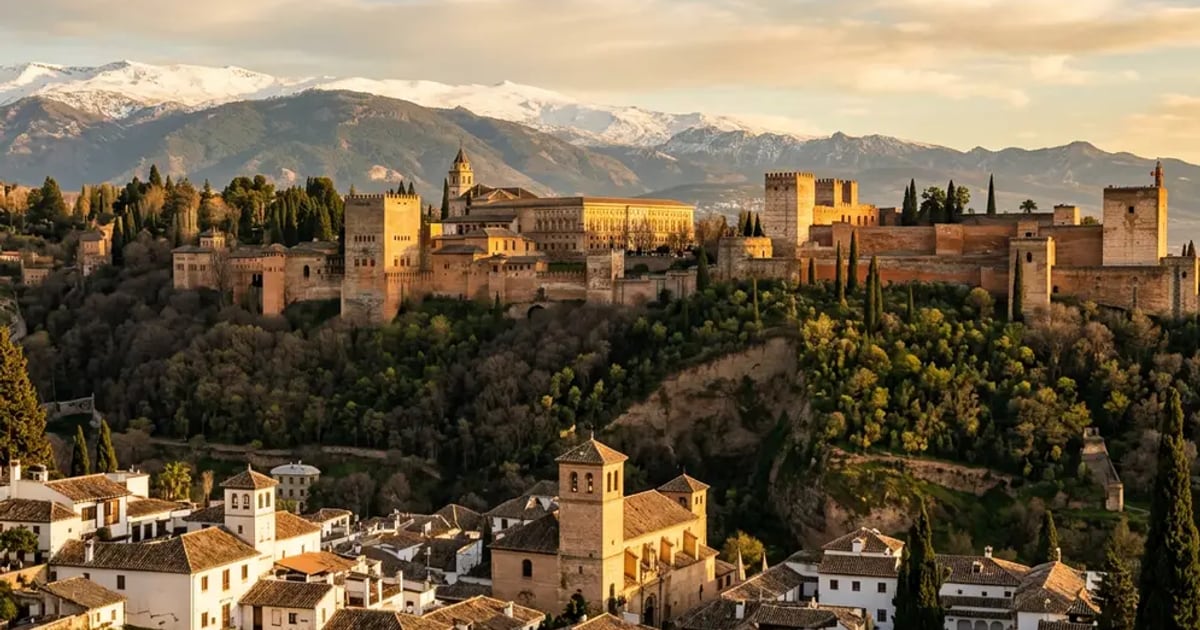
The Realejo was Granada's Jewish quarter for a thousand years before 1492. Today it is the quietest approach to the Alhambra on foot, a street-art district, and the most concentrated tapas zone in the city. This guide covers what is worth your time.
Seven years resident in Granada. Specialist in Nasrid architecture, Al-Andalus history, and Andalusian walking routes.
Published
The Realejo occupies the south-west slope of the Alhambra hill, between the city centre and the palace complex. Most visitors walk straight through it on the way up from Plaza Nueva without knowing it has its own distinct identity. That is a waste. The Realejo was Garnata al-Yahud, the Jewish quarter of medieval Granada, for over a thousand years. Samuel ibn Naghrela, the 11th-century Jewish vizier who effectively ran the Taifa caliphate, had his palace here. The Jewish population was expelled in 1492 and the quarter was renamed. What replaced it was a dense concentration of Renaissance palaces, several of which survive.
This guide covers the main reasons to spend time in the Realejo: Campo del Príncipe and its tapas bars, the Casa de los Tiros, the Corral del Carbón, the street art circuit, and the foot route from the quarter directly up to the Alhambra through the Puerta de las Granadas. For the walking route itself, the Realejo barrio walk gives a step-by-step route through the neighbourhood. For wider context on Granada's three historic neighbourhoods, see the Granada neighbourhoods guide.
The Jewish quarter and its aftermath
Granada's Jewish community occupied this slope for centuries before the Nasrid period. At its peak the quarter held more than 20,000 residents. Samuel ibn Naghrela, known as Samuel HaNagid, served as vizier to the Taifa king Habbus al-Muzaffar in the 11th century and commanded the caliphate's armies. His palace stood here, above the city. His son Yusuf ibn Naghrela succeeded him, before being assassinated in a Berber pogrom in 1066.
By the Nasrid period the community had contracted but remained legally settled and commercially active. In 1492, the same year Columbus sailed west and the Christian monarchs completed the reconquista of Granada, the Alhambra Decree expelled all Jews from the Spanish kingdoms. The quarter was handed to military use and then gradually rebuilt over the following century. The name Garnata al-Yahud disappeared and the neighbourhood became the Realejo.
The 16th and 17th centuries left the Realejo with the architecture it still largely has: fortified Renaissance palaces, narrow lanes, and a residential density that kept the street scale of the medieval quarter even as the buildings above it changed. The Moorish Granada guide covers the Nasrid city in full. The Realejo sits at the southern edge of that world, on ground where Jewish, Muslim, and Christian Granada overlapped for most of the medieval period.
Campo del Príncipe: the local square
Campo del Príncipe is the neighbourhood's main square and one of the few central Granada spaces that still runs primarily on local use rather than tourism. From about 19:00 on weekday evenings, the terrace tables fill with residents: families, university students, older couples. The bars and restaurants around the square serve a free tapa with every drink, which is Granada's standard practice, but the Campo del Príncipe version of it tends toward more substantial offerings than you get in the tourist-facing streets near the cathedral.
The square is large and mostly flat, unusual for a city built on hillsides. On the east side, the Cristo de los Favores chapel holds a 17th-century sculpture of Christ that draws a steady stream of quiet petitioners. The flowers and candles at the base of the chapel door change daily. It is a working religious site, not a heritage attraction.
The tapas scene in the Realejo centres on the streets within a five-minute walk of Campo del Príncipe. For the full picture of free tapas culture in Granada, the tapa guide covers which types of bars give the most generous portions and how the system works for visitors who are not sure what to expect.
Weekday evenings, not weekends
Saturday and Sunday bring more visitors to Campo del Príncipe. Weekday evenings from Tuesday to Thursday have the best ratio of locals to tourists and the most relaxed pace. By 21:00 on a warm evening the square is loud in a pleasant way, with competing bar terraces and no obvious boundary between them.
Casa de los Tiros
The Casa de los Tiros is the most visible of the Realejo's Renaissance palaces: a 16th-century fortified residence on Calle Pavaneras with five stone projections on the upper facade in the shape of cannon barrels. The projections give the building its name. The palace was built after 1492 on land granted to the Granadin noble family of Venegas, who had converted from Islam and sided with the Catholic Monarchs.
The building now houses the Museum of Memory of Andalusia, a regional history museum that covers Granada and Andalusia from the 15th century to the 20th through documents, objects, and personal testimonies. Entry is free for EU citizens. The collections are in Spanish; audio guides are available. Allow 45 minutes to an hour. The palace courtyard, visible from the street through the main door when the museum is open, has the proportions of a typical late-Nasrid residential space adapted for Christian use.
Hours: Tuesday to Sunday 09:00–21:00 (summer); 09:00–18:00 (winter). Closed Monday. Entry: Free for EU citizens; non-EU approximately €1.50.
Corral del Carbón
The Corral del Carbón is the only surviving Nasrid funduq in Spain and one of the best-preserved in the western Mediterranean. Built before 1336 under Sultan Yusuf I, it was originally named al-Funduq al-Jadida (the New Inn): a merchant warehouse, grain market, and lodging house combined. Traders arriving in Granada rented ground-floor bays to sell goods and slept on the upper floors. The funduq was the commercial hub of a medieval Islamic city, and this is the last one left.
The entrance portal is the detail to study. A horseshoe arch of ashlar stone frames the doorway. Above it, a band of ceramic tile and carved stucco runs to an alfiz of Arabic inscriptions. The interior courtyard rises three stories, with arcaded galleries on the upper two levels opening onto a central space that still has its original cistern. Eleven bays per floor, short balconies, stone underfoot.
After 1492 the building was used as a theatre (a corral de comedias where Golden Age drama was performed), then as a residential compound, then as a coal store, which gave it the current name. It was declared a National Monument in 1918 and restored by Leopoldo Torres Balbás, who also worked on the Alhambra. Today it houses offices for the city's International Festival of Music and Dance.
Entry is free. The courtyard is open daily until 20:00. It takes 15 to 20 minutes and is on a lane one block from the main pedestrian shopping street — and a short walk from the Alcaicería, Granada's reconstructed Moorish silk market. If you are planning a shopping circuit that includes the Alcaicería, taracea woodwork, and Fajalauza ceramics, the Granada shopping guide maps the best addresses across the city.
Best shot: turn around after entering
Walk through the entrance portal and immediately turn around. Photographing back toward the portal from inside the courtyard gives you the full horseshoe arch framed against the street beyond, with a corner of the upper gallery in frame for scale. Morning light (before 11:00) hits the portal facing east and makes the carved stucco legible.
García Lorca's family home: Huerta de San Vicente
The Huerta de San Vicente sits on the southern edge of the Realejo, now surrounded by the park that bears García Lorca's name. It was the poet's family summer house from 1926 until 1936, where he wrote some of his most significant work including Bodas de Sangre and the Romancero Gitano. The house is preserved as a museum with original furniture and photographs. Entry is guided only; visit the museum website to book a slot.
Street art circuit
The residential blocks south and west of Campo del Príncipe carry a series of large commissioned murals painted directly on building facades. The works are not concentrated in one street; they are spread through several blocks on the lower Realejo, and finding them requires walking the side streets rather than following a signposted route.
The murals vary in style and scale. Some cover entire building sides. The subjects range across portraiture, abstract pattern, and figurative scenes. Unlike the tourist art market of the Alcaicería, these are permanent works commissioned for the neighbourhood itself. The foot traffic in this part of the Realejo is mostly local, even in summer, because most visitors to Granada never reach this far south of the cathedral. For the full circuit — including the work of El Niño de las Pinturas and the wider mural map that extends across the city — the Granada street art guide covers every major wall, the artists behind them, and how to walk the route.
The Realejo barrio walk maps a route through the quarter that includes the main mural locations alongside the historical sites. Morning light on the western-facing walls is the best condition for photography.
Walking from the Realejo to the Alhambra
The Realejo is the direct foot-entry to the Alhambra for anyone who knows to use it. From Campo del Príncipe, walk uphill on Calle de los Molinos. After five minutes the street reaches the Puerta de las Granadas (Gate of the Pomegranates), the 16th-century Renaissance gateway commissioned by Charles V that marks the formal start of the Alhambra hill. From the gate, a shaded path climbs through cypress and pine to the ticket office and the Nasrid Palaces entrance. Total walking time from Campo del Príncipe to the Alhambra ticket area: around 20 minutes.
The standard tourist approach from Plaza Nueva goes up a road busy with taxis and minibuses. The Realejo route is quieter: a proper footpath, shaded in summer, with the city receding below you and the towers of the Alhambra appearing above the treeline as you climb. The path joins the main Alhambra approach above the road bottleneck, so you arrive at the ticket zone from a different angle than most of the crowd.
Book Alhambra tickets well in advance. Timed entry slots for the Nasrid Palaces sell out weeks ahead in the summer months. For current prices, booking logistics, and which slot to choose, see the Alhambra tickets guide.
The Realejo route for early-morning Alhambra visits
The earliest Nasrid Palaces entry slots are at 08:30 or 09:00. From a hotel in the Realejo, that means a 15-minute walk uphill at 08:10 through quiet streets. From the centre via Plaza Nueva, the same entry time requires a bus or taxi. The Realejo location earns its premium on early-morning Alhambra days.
Tapas in the Realejo
The streets around Campo del Príncipe form one of the most concentrated tapas zones in Granada. The practice is standard across the city: order a drink and a tapa arrives with it, at no extra charge. In the Realejo, the portions tend toward actual small plates of food rather than the token olives or crisps you get at tourist-facing bars. The bars on and around Calle Tundidores and the side streets off Campo del Príncipe are worth working through methodically.
The local practice is to move between two or three bars over the course of an evening, each drink accompanied by a different tapa. This is how residents use the square. You do not need to order food; the tapas come automatically with each drink. For the mechanics of the Granada tapa system, what to expect, and the streets with the best ratio of quality to price, the free tapas guide has the full picture.
Frequently asked questions
Frequently asked questions
Is the Realejo good for staying overnight?
The Realejo is one of the better choices for a Granada base. It sits between the city centre and the Alhambra hill, so you can walk to the Alhambra entrance in 15 minutes on foot via the Puerta de las Granadas without passing through Plaza Nueva. The streets around Campo del Príncipe have enough bars and restaurants for several evenings. It is quieter than the Albaicín (no coach groups after dark) and more walkable than the newer hotel districts further north. If you are spending more than two nights in Granada, the Realejo neighbourhood is worth considering ahead of the centre. See best hotels in Granada for options in the area.
What is the Corral del Carbón?
The Corral del Carbón is the last surviving medieval merchant inn of its kind in Spain. Built in the early 14th century, it combined a warehouse, grain market, and lodging for traders: goods stored on the ground floor, sleeping rooms above. The horseshoe-arch entrance portal is carved stucco with Arabic inscriptions above the arch frame. Walk through the portal and turn around immediately: the shot of the arch from inside the courtyard, framed against the street beyond, is the strongest photograph in the building. Entry is free. It takes 20 minutes and is open daily until 20:00. The building is a short walk from the Alcaicería market and sits on a lane most visitors bypass.
How do I walk from the Realejo to the Alhambra?
From Campo del Príncipe, walk uphill on Calle de los Molinos and follow it to the Puerta de las Granadas (Gate of the Pomegranates), the Renaissance gateway that marks the start of the Alhambra hill. The walk takes about 10 minutes from the square. From the gate, a shaded path climbs through cypress trees to the ticket office and Nasrid Palaces entrance. The total from Campo del Príncipe to the ticket office is around 20 minutes uphill. This is quieter than the standard route up from Plaza Nueva. See Alhambra tickets and booking for current prices and how to book the timed entry slots. The monument page for the Alhambra has a full overview of what to expect inside.
Does any trace of the medieval Jewish quarter survive?
Some. The medieval street plan of the Realejo is largely intact below Campo del Príncipe, with narrow lanes and the proportions of streets you would expect from a dense pre-modern residential quarter. The Palacio de los Olvidados on Calle del Agua houses a small museum with objects related to the Sephardic Jewish community of Granada before 1492. The building itself dates from the Nasrid period. Above-ground architectural remains are limited: the expulsion in 1492 was followed by extensive rebuilding in the 16th and 17th centuries, and the Renaissance palaces that define the neighbourhood today sit on earlier foundations. For the broader context of Moorish and Jewish Granada, the Moorish Granada guide covers the Nasrid period in more depth.
Is the Realejo safe at night?
Yes. The Realejo is a working residential neighbourhood and the streets around Campo del Príncipe fill with locals most evenings from around 19:00. Bar and restaurant foot traffic continues until midnight on weekends. The lanes on the upper edges of the quarter, closest to the Alhambra hill, are quieter at night but not unsafe. Use normal city awareness, as you would anywhere. The neighbourhood is considerably calmer than the Albaicín at night, with no significant tourist-party concentration.
What is the street art in the Realejo?
The Realejo has a commissioned street art circuit on residential blocks south and west of Campo del Príncipe. The murals are large-scale works, mostly painted directly on building facades, and cover a range of styles. The circuit is informal: there is no signposted route. Walk the blocks between Campo del Príncipe and Calle de los Molinos, turning into the side streets, and you will find them. Morning light on the western-facing walls is the best condition for photographs. The murals change over time as new commissions are added. Most visitors to Granada never reach this part of the quarter, so foot traffic is minimal even in summer.
Reporter notebook
Insider tips
Practical observations gathered the way a local journalist would keep them: short, specific, and more useful than brochure copy.
Money tip
Campo del Príncipe on a weekday evening: wine and a free tapa under €4
Every drink at the bars around Campo del Príncipe comes with a free tapa. On a weekday from about 19:00 the square fills with locals rather than tourists. A glass of house wine or a beer runs €2.50 to €3.50 and the tapa is included. Two rounds, two tapas, under €8 per person. The Cristo de los Favores chapel on the east side of the square has candles and flowers from that day's petitions left at the base. It is a working neighbourhood square, not a tourist set piece.
Photo spot
Street art walls are best in the morning
The commissioned mural blocks south and west of Campo del Príncipe face west, which means flat, even light in the morning and direct late sun in the afternoon. For photography, arrive before 11:00. The streets are quiet at that hour, which gives you room to back up and frame the murals without waiting for pedestrians to clear. The murals are large enough that a wide-angle lens gets the full wall. No tripod needed in morning light.
Crowd tip
Walk up to the Alhambra through the Puerta de las Granadas
The standard approach from Plaza Nueva involves a bus queue or a walk up a busy road. From Campo del Príncipe, the path through the Puerta de las Granadas is 10 minutes uphill on a shaded lane. You join the Alhambra path above the main bottleneck, with cypress trees on both sides and no road traffic. It is the same path used by the Nasrid court. Most visitors with Alhambra tickets do not know it exists.