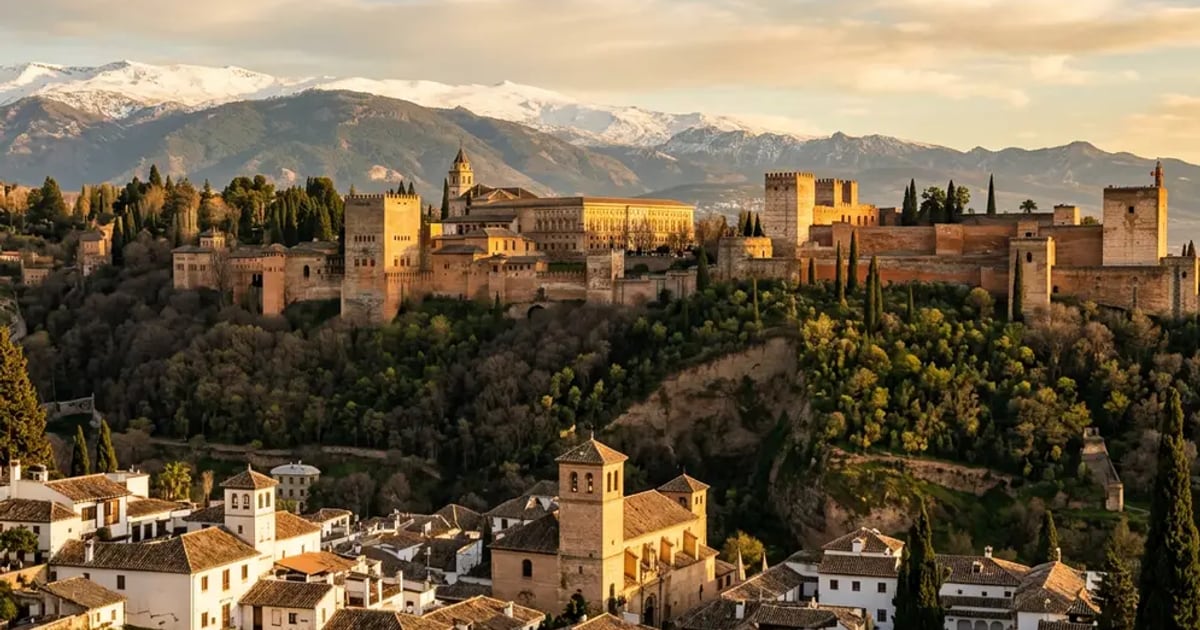
Every other quarter in Granada is defined by who lived there before 1492. Centro Histórico is defined by what happened after: the cathedrals, chapels, and commercial streets the Catholic Monarchs and their Habsburg successors built on top of the Medina. This is the city the conquerors made.
Seven years resident in Granada. Specialist in Nasrid architecture, Al-Andalus history, and Andalusian walking routes.
Published
Granada's historic centre is the most geographically compact of the city's districts and the one with the highest density of things to pay to enter. The Centro Histórico holds the Cathedral, the Royal Chapel, the Alcaicería, the Madraza, and the Corral del Carbón within a 10-minute walk of each other. Unlike the Albaicín or Sacromonte, it is flat, well signposted, and full of cafés. It is also the only one of Granada's historic quarters that was substantially rebuilt after 1492.
This guide covers what is worth your time and how to structure a visit: the Cathedral and Royal Chapel, the squares and commercial streets, and how the district fits into the wider city. For the Moorish layers of the same zone — Alcaicería, Madraza, Corral del Carbón — the Arabic quarter guide covers those in depth. For a comparison of all four historic neighbourhoods, see the Granada neighbourhoods guide.
Centro Histórico at a glance
Location
Flat zone at the foot of the Alhambra and Albaicín hills, centred on Gran Vía de Colón
Key monuments
Cathedral (1501–1704), Royal Chapel (1505–1517), Corral del Carbón, Alcaicería
Time needed
Half-day (Cathedral + Royal Chapel) or full day with squares and shopping
Entry costs
Cathedral ~€5; Royal Chapel ~€5 (separate tickets); Corral del Carbón free
Best square
Plaza Bib-Rambla — flower stalls, café terraces, local foot traffic all day
Best time
Early morning (Cathedral before crowds); avoid August midday heat
The district that replaced the Medina
When Ferdinand and Isabella took Granada in January 1492, they inherited a fully functioning Islamic city. The Alhambra became a royal residence. The mosques became churches. The Medina, the dense commercial and civic heart of the city below the palace hill, was gradually dismantled and rebuilt over the following two centuries.
The result is what you see now. The Cathedral was begun in 1501 on the site of the city's Friday mosque. The Royal Chapel, intended as the dynastic mausoleum of the Catholic Monarchs, was started in 1505. The Alcaicería, the Nasrid silk market, burned in 1843 and was replaced by a 19th-century reconstruction. Gran Vía de Colón, the broad commercial boulevard that cuts through the old urban fabric, was driven through in 1895 and required the demolition of hundreds of medieval buildings to create it.
What this means for a visitor is that the Centro Histórico is, of Granada's historic quarters, the most heavily remodelled. The Albaicín street plan has not changed since the 11th century. The Centro has been built, burned, rebuilt, and cut through with broad avenues. The buildings standing today are largely 16th to 19th century. They are worth seeing on their own terms: the Cathedral is one of the most ambitious Renaissance buildings in Spain. But they are not survivors of medieval Granada. They are the replacement.
The exceptions are the Nasrid-era buildings that survived: the Corral del Carbón, built before 1336, is the only intact medieval merchant inn in Spain; the Madraza, the Koranic university founded in 1349, stands across the square from the Royal Chapel with its Nasrid interior hidden behind a later Baroque facade. These two buildings sit within the Centro Histórico zone and are worth seeking out alongside the Christian monuments. For detail on either, the dedicated guides for Corral del Carbón and Madraza go deeper.
Granada Cathedral
The Granada Cathedral took 181 years to build, from 1501 to 1682 for the main structure, with the Baroque facade redesigned by Alonso Cano in 1667. Three architects shaped it in sequence: Enrique Egas began it on a Gothic floor plan; Diego de Siloé, who took over in 1529, shifted the design toward the Renaissance and gave it the unusual circular principal chapel that defines the interior; Alonso Cano, a Granadan painter and sculptor who came to architecture late, designed the two-towered Baroque west facade that faces Plaza de las Pasiegas. The building spans the full history of Spanish 16th-century architecture within one structure.
The interior is large. Five naves, varying heights, the principal chapel at the east end with its circular drum and blue dome decorated with gold stars. Effigies of Isabella and Ferdinand by Pedro de Mena flank the high altar. The twin organs from the early 18th century are original. The Cathedral covers more ground than it appears to from outside; the light in the central nave changes considerably depending on the time of day.
A viewpoint terrace at 56 metres was under preparation at the time of writing, with an opening scheduled for mid-2026. If it has opened by the time you visit, the tower access gives a view down Gran Vía and across the Albaicín that no other accessible point in the centre provides. Worth checking before you go.
Practical details
Entrance: Plaza de las Pasiegas (the square off Gran Vía, not the main Gran Vía facade itself)
Hours: Monday to Saturday 10:00–18:30, Sunday 15:00–18:00 (extended in summer; check the official site)
Entry: ~€5. Combined audio guide available
Time needed: 45 minutes for a thorough visit; 25 minutes if you focus on the principal chapel and the effigies
Visit the Cathedral before the Royal Chapel
Most visitors enter the Royal Chapel first because it is smaller and seems less daunting. Do it the other way round. The Cathedral gives you the full scale of what the Catholic Monarchs and Habsburgs were building. Then the intimacy of the Royal Chapel next door, with its low stone sarcophagi and the Flemish altarpiece, reads differently when you understand the context of the larger ambition around it.
Royal Chapel: the tomb of the Catholic Monarchs
The Royal Chapel was begun in 1505 and completed in 1517, twelve years that produced one of the most concentrated expressions of Isabelline Gothic architecture in Spain. Enrique Egas, the same architect who started the Cathedral, designed it as the burial place of Isabella I and Ferdinand II. Isabella died in 1504; the chapel was built to receive her remains, which were held at the Alhambra until the building was ready.
The central transept holds four sarcophagi. The larger pair, by Florentine sculptor Domenico Fancelli, contains Isabella and Ferdinand; the smaller pair, by Bartolomé Ordóñez, contains their daughter Joanna I and her husband Philip I. The effigies lie side by side, carved in white Carrara marble, with the heads slightly elevated — the greater the tilt, historians have noted, the higher the rank attributed by convention. Beside the sarcophagi, a carved marble screen by Bartolomé de Jaén separates the tomb area from the public nave.
The adjacent sacristy museum holds the collection assembled by Isabella herself: paintings by Juan de Flandes, Hans Memling, Sandro Botticelli, Rogier van der Weyden. Isabella's personal crown, sceptre, and missal are in a display case. The crown is small. Simpler than you might expect from the woman who funded Columbus and completed the Reconquista. That contrast between the scale of the historical moment and the physical smallness of the objects is what most visitors take away from this room.
Practical details
Entrance: Calle Oficios (the lane alongside the Cathedral, not Plaza de las Pasiegas)
Hours: Monday to Saturday 10:15–18:30, Sunday 11:00–18:30. Last admission 30 minutes before closing
Entry: ~€5. Book online — walk-up queues in summer and Holy Week are significant
Photography: Not permitted inside the chapel. Allowed in the courtyard outside
Time needed: 40–50 minutes
Plaza Bib-Rambla and the main squares
Plaza Bib-Rambla is a two-minute walk south of the Cathedral and has been the civic square of Granada for longer than the Cathedral has existed. The name comes from the Arabic Bab al-Rambla — the gate of the rambla — and the square was the main plaza of the Nasrid Medina: the place for markets, public announcements, jousting, and religious processions. The Reconquista changed the ownership but not the function. Christian Granada held bullfights here, Corpus Christi processions here, and autos de fe here. It still works as a main square.
The centerpiece is the Neptune Fountain, a 17th-century gray stone fountain known locally as the Gigantones for the humanoid figures at its base. Flower stalls set up around the fountain each morning; café tables fill the perimeter from lunchtime. In the afternoon and evening the square handles both local and tourist foot traffic without becoming either a theme park or an exclusively residential space. This balance is rarer in Granada's centre than you might expect.
Plaza de las Pasiegas
The small square directly in front of the Cathedral's west facade. Narrow on its north and south sides, it gives a compressed but full view of Alonso Cano's Baroque towers. Morning light arrives from the east; by midday the towers are in partial shade. This is where tour buses discharge passengers — it fills fast from 10:00 onward.
Plaza de la Madraza
The square in front of the Royal Chapel entrance, also called Plaza de Isabel la Católica on some maps. The Madraza building, now part of the University of Granada, faces the Royal Chapel across this square. Quiet in the early morning; busy by mid-morning when both monuments open their doors. The contrast between the Baroque Royal Chapel facade and the Madraza's plainer exterior, which conceals a Nasrid interior, is legible from standing here.
Bib-Rambla for breakfast
The cafés on the south and west sides of Plaza Bib-Rambla are better value than those on the Gran Vía. Churros and hot chocolate at one of the standing café counters inside the Alcaicería lanes cost around €3; the terrace tables on the square are €4 to €5. The flower stalls set up by 8:00 and the light on the facades is at its cleanest before 9:30.
Zacatín, Gran Vía, and the commercial streets
The commercial life of the Centro Histórico is organised around two main axes. Zacatín is a narrow, partly covered shopping street that connects Bib-Rambla to Puerta Real, the southern gateway square. The name comes from the Arabic for a market selling second-hand clothes; today it is a standard pedestrian shopping street of modest width, with a mixture of international chains and local shops. The proportions are medieval even if the contents are not.
Gran Vía de Colón runs north-south above Zacatín, connecting Puerta Real to the Jardines del Triunfo. It was carved through the city in the 1890s in the style of Haussmann's Paris: a wide boulevard lined with banks, offices, and commercial buildings in eclectic 19th-century styles. The demolitions required to build it destroyed a significant portion of the medieval urban fabric. The buildings at the north end, near the junction with Calle Elvira, are handsome; but Gran Vía is fundamentally a product of 19th-century city planning ambition, not medieval survival.
Calle San Jerónimo, running east from the Cathedral area toward the university district, is quieter and better for walking. Several of the city's best churrerías and independent cafés are on the lanes off San Jerónimo. The Mercado San Agustín, a covered market just north of the Cathedral on Calle San Agustín, has a food hall on the upper floor with seating and views down into the stalls below. Worth knowing as a lunch option.
The Alcaicería
The covered bazaar lanes between the Cathedral and Bib-Rambla are on the site of the Nasrid silk market. The original burned in 1843 and the current structure is a 19th-century reconstruction. It sells ceramics, leather goods, metalwork, spices, and tourist items. Prices are mildly negotiable on handicrafts. For the history of the site and what the medieval Alcaicería looked like, the Alcaicería guide covers it in full.
The lanes themselves are pleasant to walk through even if you are not buying anything: cool in summer, well lit, and short enough that you cannot get genuinely lost. For taracea woodwork (the inlaid geometric marquetry specific to Granada) and Fajalauza ceramics, the Alcaicería is a reasonable starting point.
How Centro Histórico differs from the other quarters
Granada's four historic quarters are each defined by a different phase of the city's past. Understanding the distinction helps you spend your time where it fits what you are looking for.
The Albaicín is the medieval Islamic city, its street plan intact since the 11th century: steep lanes, whitewashed walls, private gardens. Centro Histórico is the Christian replacement, rebuilt across two centuries after 1492. The Albaicín rewards unplanned wandering. Centro rewards scheduled visits to specific monuments. They are five minutes apart on foot; most visitors do both.
The Realejo (the old Jewish quarter) is south of Centro, between the city centre and the Alhambra hill. It is quieter, more residential, and has the Campo del Príncipe tapas zone and a street art circuit. Centro is the commercial and monument core; Realejo is the neighbourhood alternative where locals actually eat in the evening.
Centro Histórico vs Sacromonte
Sacromonte, east of the Albaicín, is the cave-house district: troglodyte dwellings cut into the hillside, associated with Granada's Romani population and with zambra flamenco. It is emphatically not a city centre. Centro and Sacromonte are on opposite ends of Granada's character spectrum. If you are trying to decide between them for an evening, the Sacromonte guide has the logistics for a flamenco visit.
Centro Histórico is the right place to be if you want to see the major Christian monuments in one visit, shop for local crafts, and eat at mid-range restaurants with reliable food. It is busier and more tourist-facing than the other quarters. That is the trade-off. The monuments justify the trade.
Where to stay: Centro vs the other quarters
Centro hotels are the most practical base for first-time visitors: walking distance from the Cathedral, Royal Chapel, and bus stops for the Alhambra. For a quieter base with more local character, the Realejo is a 10-minute walk from the same monuments. For Alhambra access on foot at 8:30, see the Realejo's route through the Puerta de las Granadas in the Realejo guide.
Practical logistics
The Centro Histórico is compact and entirely walkable. From Plaza Nueva at the northern edge of the district to Puerta Real at the south is about 600 metres. The Cathedral is at the centre of that axis.
Getting there
Gran Vía de Colón is the main bus drop-off point for the centre. Buses from the bus station and from the Alhambra stop here. The airport bus (Alsa line 245) ends on Gran Vía, passing the Cathedral and Puerta Real en route from the station. From the main train station (Granada Estación), taxis take about 10 minutes; there is no direct metro to the historic centre.
Getting to the Alhambra from Centro
The Alhambra minibuses depart from Gran Vía and take about 10 minutes to the ticket area. Walking takes 20 to 25 minutes uphill from Plaza Nueva: straight up Cuesta de Gomérez, through the Puerta de las Granadas, then along a shaded path through pine trees to the palaces entrance. The Realejo alternative (Campo del Príncipe, then Cuesta de los Molinos) is equally shaded and avoids the main Cuesta de Gomérez road traffic.
Street safety and crowds
The main streets of Centro — Gran Vía, Zacatín, the area around the Cathedral — are well-lit and busy until late evening. The main concern in the area is pickpocketing in crowds, particularly around Bib-Rambla and in the Alcaicería lanes. Keep bags closed and across the body in the busy market area. The streets calm considerably after 21:00 as the tourist traffic drops; the bars around Calle Navas stay active until midnight or later.
Street food and coffee
Churros are sold at dedicated churrerías — the type served in Granada is thicker and shorter than Madrid's version, fried to order and eaten with thick hot chocolate. Mazapán, the almond paste confection that Granada claims as its own, is sold in the cake shops and confiterías around Bib-Rambla and in the streets near the Cathedral. The best versions come from the convents, not the tourist shops; Convento de San Bernardo on Calle Gloria sells theirs through a turning wheel in the door.
Frequently asked questions
Frequently asked questions
Do I need to book tickets for the Cathedral and Royal Chapel in advance?
The Granada Cathedral can usually be entered on the day, but in peak summer months (July and August) queues form quickly at the box office on Plaza de las Pasiegas. The Royal Chapel is smaller and fills faster. Both can be booked online in advance at no premium. During Semana Santa (Holy Week) the Royal Chapel closes for liturgical use on certain days; check the official website before visiting. The two buildings have separate tickets and separate opening hours.
What are the opening hours for the Cathedral and Royal Chapel?
The Cathedral is generally open Monday to Saturday 10:00–18:30 and Sunday 15:00–18:00, with extended hours in summer. The Royal Chapel opens Monday to Saturday 10:15–18:30 and Sunday 11:00–18:30, closing for midday on some days in winter. Both take their last admission 30 minutes before closing. Hours shift seasonally; check the official Capilla Real website closer to your visit.
Is the Alcaicería the original Nasrid silk market?
No. The medieval Alcaicería burned down in 1843. The current covered bazaar is a 19th-century reconstruction in a broadly Moorish style, built on the same footprint. It sells ceramics, leather goods, spices, and tourist items. For more on its history and what to buy there, the Alcaicería guide has the full picture. The Corral del Carbón, 70 metres away, is a genuine 14th-century Nasrid survival.
Where is the best place to eat near the Cathedral?
The streets immediately around the Cathedral are tourist-facing. Walk two blocks south to Calle Navas or the streets around Plaza Bib-Rambla for better value. The bars around Navas serve a free tapa with every drink. For a full survey of where to eat in this part of Granada, the free tapas guide maps the best options by neighbourhood zone.
How long should I spend in Centro Histórico?
The Cathedral takes 45 minutes to see properly. The Royal Chapel is smaller but denser in content; allow 45 minutes there too. Walking the Alcaicería, Corral del Carbón, and Bib-Rambla without rushing takes another 30 to 45 minutes. A morning covering all of these, plus a lunch stop in the streets south of Bib-Rambla, runs about 4 hours. If you are also visiting the full range of historic-centre monuments including the Madraza, add another 30 minutes.
How does Centro Histórico compare to the Albaicín for a visitor?
They are two different experiences and the comparison is useful. The Albaicín is a hillside residential quarter: narrow medieval lanes, Moorish urban structure, no major monuments you pay to enter. Centro Histórico is a flat, commercial city centre with paid monuments, busy pedestrian streets, and grand 16th-century civic architecture. The Albaicín rewards wandering with no plan. Centro rewards structured visits to specific buildings. Most visitors who stay 2 or more days do both.
Reporter notebook
Insider tips
Practical observations gathered the way a local journalist would keep them: short, specific, and more useful than brochure copy.
Best time
Visit the Cathedral before 10am
The Cathedral opens at 10:00. If you queue up five minutes before, you will have the main nave to yourself for the first 15 minutes before the tour groups arrive. The circular principal chapel (the large domed space at the east end) has a different quality at that hour: the light through the high windows, no recorded commentary, no shuffling crowd. By 10:30 the volume inside is considerable.
Crowd tip
Buy Royal Chapel tickets the day before
The Royal Chapel is genuinely small. In summer and Holy Week, walk-up queues can mean a 45-minute wait in the sun. Booking online the evening before costs no premium and means you go straight in. The tomb of Isabella and Ferdinand, the Flemish altarpiece, and the crown and sword collection are worth seeing without the wait.
Photo spot
The best angle on the Cathedral is from Calle Gran Vía corner
The official "photo of the Cathedral" is taken from Plaza de las Pasiegas, which gives you the Baroque facade head-on. The better photograph is from the corner of Gran Vía de Colón and Calle Marqués de Gerona, looking southeast: the full length of the north flank of the Cathedral, the Baroque lantern above it, and the Royal Chapel bell tower beside it. Morning light, before 10:00, hits this elevation cleanly.