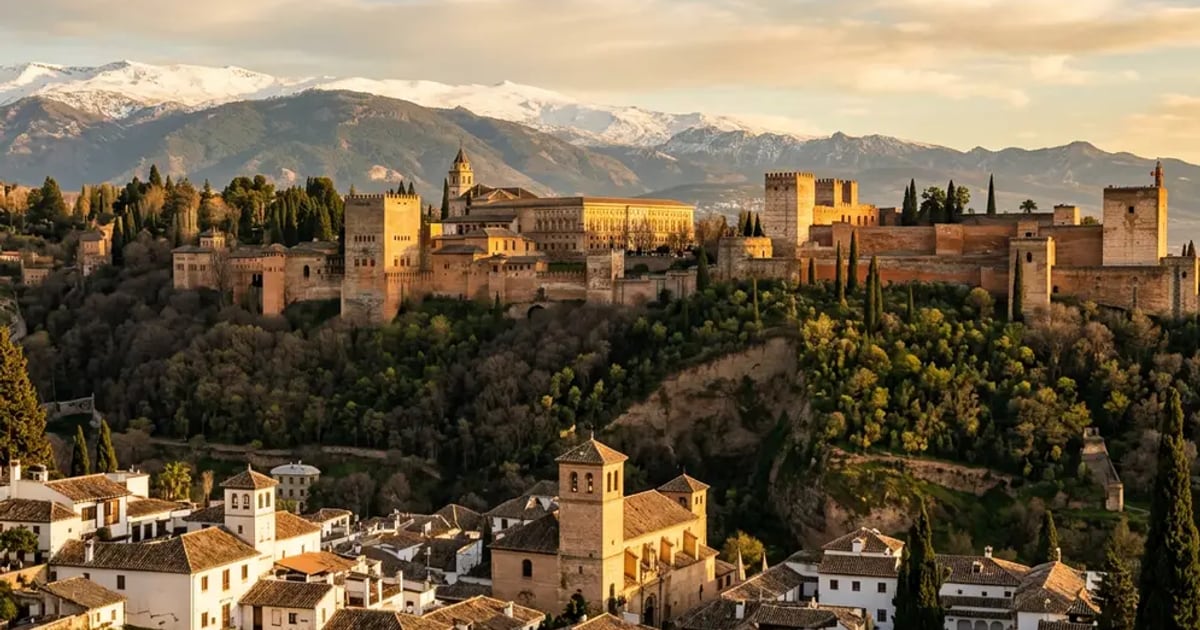
Spain's only medieval Islamic college, founded in 1349. Its Baroque street facade hides a 14th-century Nasrid prayer hall that most visitors to Granada never find. Free entry, five minutes from the Cathedral.
Seven years resident in Granada. Specialist in Nasrid architecture, Al-Andalus history, and Andalusian walking routes.
Published
The Madraza de Granada sits on Calle Oficios directly opposite the Royal Chapel entrance, its 17th-century Baroque facade indistinguishable from the surrounding street. Behind it is a 14th-century Nasrid prayer hall with stucco work, a muqarnas cornice, and a mihrab niche — one of the few surviving secular Nasrid interiors outside the Alhambra, and one of the most consistently overlooked rooms in the city.
This guide covers the Madraza's founding under Yusuf I, what survives from the original structure, what happened to the building after 1492, and how to visit. For the wider cluster of monuments in the same streets, see the guides to the Alcaicería and the Corral del Carbón, both a two-minute walk away.
Yusuf I's Islamic college, 1349
The Madraza was founded in 1349 by Sultan Yusuf I, the same Nasrid ruler who built the Comares Tower and the Comares Palace at the Alhambra. It was the only major Islamic college — a madrasa — built anywhere in al-Andalus, which makes it unusual even by the standards of Nasrid cultural production. Most Andalusian cities had Quranic schools attached to mosques; a purpose-built institution for higher learning was a different order of investment.
The curriculum covered Quranic studies, Islamic jurisprudence, grammar, and theology — the full programme of a medieval Islamic university, equivalent in scope to the European cathedral schools of the same period. Scholars from across the western Mediterranean came to study here in the century and a half before the Christian conquest.
The location was not accidental. The Madraza stood next to the Great Mosque of Granada, which occupied the site where the Cathedral now stands. Across the street was the gateway to the Alcaicería, the royal silk market Yusuf I had also formalised. The Corral del Carbón merchant inn was 200 metres west. The Madraza sat at the convergence of the religious, commercial, and intellectual life of the Nasrid capital.
The prayer hall: what survived from the 14th century
The main reason to visit the Madraza is the Nasrid oratory — a prayer hall from the original 14th-century structure, hidden behind a false ceiling until restoration work in the early 20th century uncovered it. The room is small by Alhambra standards, perhaps eight metres across, but the decoration is of the same quality.
The walls carry stucco panels with Arabic calligraphic inscriptions in kufic script, geometric tracery, and vegetal ornament arranged in the characteristic Nasrid layered composition: a tilework dado at the base, a stucco frieze above it, then calligraphic bands, then muqarnas work at the cornice. A horseshoe arch frames the mihrab niche that indicates the direction of Mecca. The wooden ceiling above the mihrab carries painted geometric work.
If you visit the Alhambra and the Madraza on the same day, the decorative relationship between the two becomes clear. The Nasrid aesthetic is not just a style; it is a precise visual vocabulary — specific proportions, specific calligraphic forms, specific combinations of geometric motifs — and seeing it in two settings makes it legible in a way that one visit alone cannot.
Ask at the entrance for the prayer hall
Many visitors walk through the main courtyard and leave without finding the oratory, which is tucked to one side and not always clearly signposted. The entrance staff will direct you — it takes 30 seconds to ask.
From Islamic college to city hall
After the Catholic Monarchs took Granada in 1492, Ferdinand II donated the Madraza to the city council in 1500, which converted it into Granada's first town hall. The library was destroyed on the orders of Cardinal Cisneros, who had the books burned in Plaza de Bib-Rambla. The collection reportedly covered theology, law, philosophy, and natural science — one of the major cultural losses of the early modern period in Spain.
The building served civic functions for two centuries. In the early 18th century the University of Granada's predecessor institution added the Baroque street facade visible today — a deliberate overwriting of the Islamic exterior with a European institutional one. A Gothic council chamber from the period of civic use also survives inside, giving the building three distinct architectural layers: 14th-century Nasrid, 15th/16th-century Gothic, and 17th/18th-century Baroque.
The building was transferred to the University of Granada in 1976, which uses it for lectures, exhibitions, and events. The Royal Academy of Fine Arts of Our Lady of Sorrows also maintains a presence here. The building is still in active institutional use.
The Madraza and the Columbus connection
The years 1491 to 1492 were the decisive period for both the end of Nasrid Granada and the beginning of Spanish Atlantic expansion. Ferdinand and Isabella were in Granada overseeing the final stages of the siege. The decision to fund Columbus's voyage west was formally made at Santa Fe, the military camp the Catholic Monarchs built on the plain west of Granada during the siege. The documents were signed there in April 1492.
But the court spent most of 1491 and early 1492 in Granada itself, using the buildings of the former Nasrid administration — including the spaces adjacent to the Madraza — as working facilities while the siege progressed. Columbus had been lobbying the court for years and was present in the city during this period. The practical deliberations over his proposal, the negotiations over terms, and the initial planning all happened here, in buildings that had been Islamic institutions months before.
The Madraza did not directly host these negotiations, but it represents the type of space — repurposed Islamic civic infrastructure — that the Catholic court occupied during the months when the New World expedition was being planned. The Royal Chapel across the street, where Ferdinand and Isabella are buried, gives the most direct physical connection to that moment.
How to visit the Madraza today
Entry to the ground floor is free. The Nasrid prayer hall is the primary reason to visit — allow 15 to 20 minutes. The building is compact and the visit does not require more time than that unless there is a temporary exhibition worth seeing on an upper floor.
Opening hours: Monday to Friday 08:00–20:00, Saturday 09:00–14:00. Closed Sunday. Hours may vary during university events, examination periods, and public holidays. It is worth a quick check before visiting if your schedule is tight.
The Madraza is most naturally combined with the Royal Chapel (directly opposite, entry fee applies), the Alcaicería (two minutes south), and the Corral del Carbón (three minutes west). The three Nasrid monuments together — Madraza, Alcaicería, Corral del Carbón — give a rounded picture of 14th-century commercial and civic life in Granada, as distinct from the palace life documented at the Alhambra.
Practical details
Address: Calle Oficios 14, 18001 Granada. Free entry to ground floor. Hours: Mon–Fri 08:00–20:00, Sat 09:00–14:00. Closed Sunday. Five minutes' walk from the Alhambra ticket office.
Frequently asked questions
Frequently asked questions
What is the Madraza de Granada?
The Madraza was the only major Islamic college (madrasa) built in al-Andalus. Founded in 1349 by the Nasrid sultan Yusuf I, it trained scholars in Quranic studies, Islamic jurisprudence, grammar, and theology — the equivalent of a medieval university. After the Christian conquest of 1492, Ferdinand II donated the building to the city council, which used it as Granada's first town hall. It now belongs to the University of Granada.
Is entry to the Madraza free?
The ground floor, including the Nasrid prayer hall, is generally free and open during university business hours. Temporary exhibitions on upper floors may charge a small fee. Opening hours are Monday to Friday 08:00 to 20:00, Saturday 09:00 to 14:00, closed Sunday. Hours may vary during university examination periods and public holidays.
What can you see inside the Madraza?
The main reason to visit is the Nasrid oratory, a 14th-century prayer hall with stucco decoration, a muqarnas cornice, and a mihrab niche indicating Mecca. The decorative vocabulary — calligraphic bands, geometric tracery, horseshoe arches — is closely related to the Alhambra's interiors. The building also has a Gothic council chamber from the period when it served as the city hall, and a Baroque street facade added in the 17th century.
How does the Madraza compare to the Alhambra?
The Madraza's oratory uses the same decorative language as the Nasrid palaces but on a much smaller scale. Sultan Yusuf I, who founded the Madraza in 1349, also built the Comares Tower and Comares Palace at the Alhambra. Visiting both in the same day makes the Nasrid aesthetic readable — the Alhambra overwhelms with scale; the Madraza gives you the same vocabulary at close range, unhurried.
Where exactly is the Madraza de Granada?
The Madraza is at Calle Oficios 14, directly opposite the entrance to the Royal Chapel and next to the Cathedral. It is a two-minute walk from the Alcaicería market and three minutes from the Corral del Carbón. The Baroque facade blends into the street so well that most visitors walk past without realising it is there.
Is the Madraza open on weekends?
Saturday morning only — 09:00 to 14:00. Closed Sunday. It is a working university building, so the most reliable access is on weekday mornings. If your Granada visit is concentrated on a weekend, prioritise the Saturday morning window before 13:00.
Reporter notebook
Insider tips
Practical observations gathered the way a local journalist would keep them: short, specific, and more useful than brochure copy.
Crowd tip
The prayer hall fits about 20 people — often empty midweek
The Nasrid oratory is a small room. On a quiet weekday morning it is sometimes completely empty for 10 to 15 minutes at a stretch, which makes looking at the stucco work properly possible. The room fills briefly when a guided tour passes through, then empties again. Midweek between 09:30 and 11:00 is the best window.
Photo spot
The muqarnas ceiling in the prayer hall
The muqarnas cornice is the most photographable element — a honeycomb of carved plaster cells that catches light differently depending on where you stand. Use a phone braced against a column for stabilisation, or bring a small gorilla tripod. The room is not large enough for a wide-angle to work well; a normal or slightly telephoto framing picks out the geometric detail more clearly.
Local custom
This is still a working university building
The University of Granada uses the Madraza for lectures, examinations, and faculty meetings. During exam periods in January, June, and September, access to parts of the building may be limited. At other times the staff are welcoming — but dress and behave accordingly. This is not a monument in the museum sense; it is an institution that happens to have a 14th-century prayer hall.