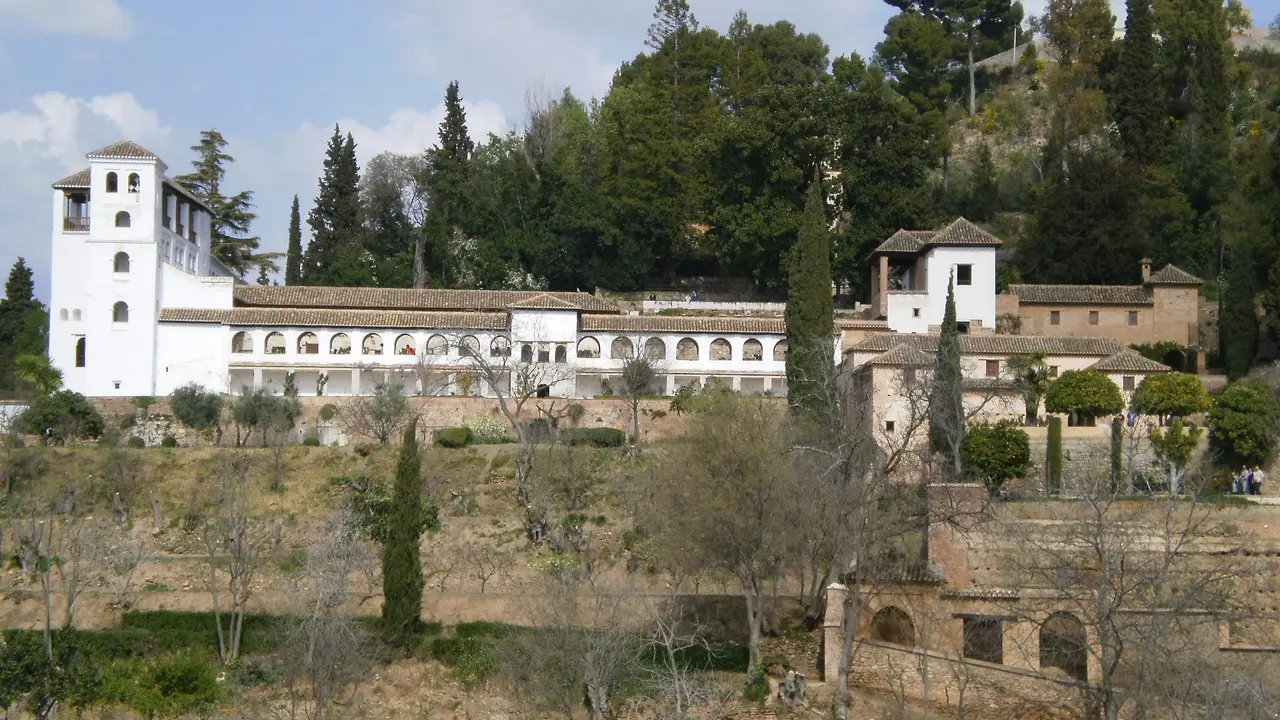
Dappled light through the elm and oak canopy of the Bosque de la Alhambra, Granada, with the Pilar de Carlos V fountain on the cobbled path
Nature Moderate Free

Bosque Alhambra Forest Walk

The shaded forest path from Puerta de las Granadas to the Alhambra. Holm oaks, elms, the 1545 Pilar de Carlos V fountain. Free access. 25–35 min uphill.

At a Glance

Distance
1.5 km one-way (approx. 1.9 km via Cuesta de los Chinos return)
Duration
25–35 minutes one-way
Stops
5 stops
Route type
Point to point

Best time to walk

Before 09:00 in summer for an empty forest and cooler air. Late afternoon in spring and autumn when the light filters low through the canopy. The Pilar de Carlos V is best in mid-morning when the sun catches the carved stonework.

Accessibility

Paved and cobbled throughout on the main Cuesta Empedrada. Steady uphill gradient of 130–150m elevation gain over 1.5 km. Manageable for most fitness levels; allow extra time for slower walkers. The Cuesta de los Chinos side path has uneven sections. Not suitable for wheelchairs.

On this page

Route Map

Loading map…

Click on any marker to see stop details. Numbered markers follow the suggested route order.

Stop-by-Stop Route

  1. 1

    Puerta de las Granadas

    Monument 10 min

    Renaissance triumphal arch built in 1536, designed by Pedro Machuca on the orders of Charles V. Carved pomegranates and the Imperial eagle mark the formal boundary between the city and the Alhambra hill. The moment you pass through, the city noise stops.

    Tip: The carvings on the arch reward a close look — most visitors walk straight through. The arch faces east; morning light hits the stonework cleanly.

  2. 2

    Bosque de la Alhambra

    Landmark 5 min

    The Alhambra forest: holm oaks, elms, and poplars covering the Sabika hill. The main canopy was established after Wellington's troops replanted the hillside in 1812, following damage during the Napoleonic occupation. Dense enough in summer to drop the apparent temperature by ten degrees or more.

    Tip: The shade begins within thirty metres of the Puerta de las Granadas. In summer, start walking by 09:00 if you want the forest to yourself before the tour buses unload at the top.

  3. 3

    Pilar de Carlos V

    Landmark 10 min

    Renaissance fountain completed in 1545, designed by Pedro Machuca and carved by Niccolò da Corte. Three carved heads — representing Granada's rivers, the Darro, Beiro, and Genil — project from the main face. The water still runs. A practical rest stop and the best photography point on the route.

    Tip: Bring a refillable bottle. The water is drinkable and the stone basin is cool even in high summer. Shoot from the left side of the fountain with the carved heads in profile against the dark forest behind.

  4. 4

    Cuesta Empedrada / Cuesta de los Chinos

    Landmark 10 min

    Two parallel cobbled paths lead through the upper forest to the Alhambra gates. The Cuesta Empedrada is the main route; the Cuesta de los Chinos runs slightly south through quieter woodland, adding 200 metres but losing most other walkers. Both paths converge at the Puerta de la Justicia.

    Tip: If you took the main Cuesta Empedrada up, use the Cuesta de los Chinos on the way back down. Different light, different quiet, and you get to see the forest from a slightly different angle.

  5. 5
    Puerta de la Justicia
    Monument 10 min

    Horseshoe-arch gateway built in 1348 under Sultan Yusuf I. An open hand is carved into the outer keystone; a key is carved into the inner arch. The historical main entrance to the Alhambra and the end of the forest walk. The ticket area and palace complex begin on the other side.

    Tip: The archway itself and the ramp below it are free. You need a pre-booked ticket to pass through into the palace complex. Even without one, the exterior of the gate and the views back over the forest from the ramp are worth the walk.

The forest that belonged to Wellington's soldiers

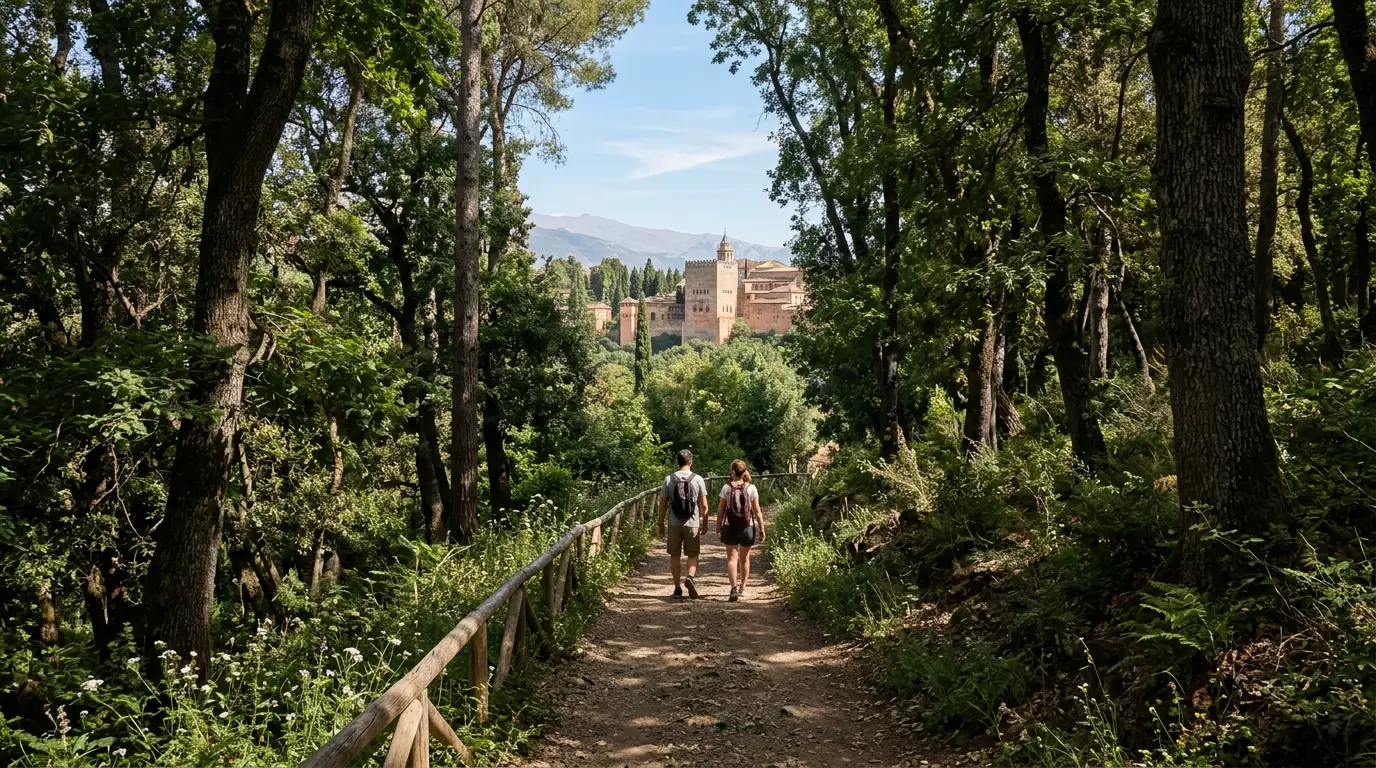
Pass through the Puerta de las Granadas — Pedro Machuca's 1536 Renaissance arch at the top of Cuesta de Gomérez — and the city drops away almost immediately. The traffic noise from Plaza Nueva is gone within thirty metres. What replaces it is the sound of your own feet on packed earth, the occasional drip of a stone channel, and birdsong from somewhere in the canopy above.

The Bosque de la Alhambra is a managed forest of holm oaks, elms, and poplars covering the Sabika hill. It was replanted in earnest by Wellington's troops in 1812, after Napoleonic forces damaged and deforested the hillside during the French occupation. The mature specimens overhead — the thick-trunked elms throwing deep shade across the Cuesta de los Chinos — were started by British soldiers who would not live to see them full grown. That fact sits quietly in the back of your mind as you walk.

Pilar de Carlos V: a fountain worth stopping at

About 400 metres into the forest, the path widens at a small plaza. The Pilar de Carlos V stands here: a Renaissance fountain completed in 1545, designed by Pedro Machuca and carved by Niccolò da Corte. Three stone heads project from the main face, traditionally identified as the three rivers of Granada — the Darro, Beiro, and Genil — each adorned with ears of grain, fruit, and flowers. The water still runs. Fill a bottle if you have one.

Most people pass it at a walk. Spend five minutes here instead. The fountain is shaded from above; the stone stays cool. In July and August, when the temperature in Granada's lower streets hits 35°C, this stretch of the Bosque can feel fifteen degrees cooler — the elm canopy is that dense. The Pilar is also your best photography stop on the route: shoot from the left side, with the carved heads in profile against the dark forest behind.

The path to Puerta de la Justicia

From the Pilar, the Cuesta Empedrada — the main cobbled path — continues northeast, climbing steadily through the pines and oaks toward the Alhambra gates. A parallel track, the Cuesta de los Chinos, runs slightly to the south through quieter woodland; it adds perhaps 200 metres but loses most of the other walkers. Both paths arrive at the same place.

The Puerta de la Justicia appears at the top: a horseshoe-arch gateway built in 1348 under Sultan Yusuf I, its keystone carved with an open hand (said to represent the five pillars of Islam) and a key carved into the arch above. This is the historical main entrance to the Alhambra and the end of the forest walk. Through the gate, the ticket area and the rest of the complex begin. The walk itself — Puerta de las Granadas to Puerta de la Justicia — is free at any hour. What lies beyond requires a pre-booked Alhambra ticket.

The forest walk is worth doing independently of any palace visit. Combine it with the Granada hiking guide for a longer day on the hill. If you want to extend the walk, the path past the Torres Bermejas — the red towers visible on the western spur — branches south-west from the Puerta de las Granadas and gives a different angle on the forest and the city below.
Reporter notebook

Insider tips

Practical observations gathered the way a local journalist would keep them: short, specific, and more useful than brochure copy.

Best time

Walk by 08:30 in summer

The forest path is cool and empty before 09:00. After that, the minibus from Plaza Nueva starts delivering groups to the ticket office, and they spill back down the path. In July and August the temperature difference between the shaded forest and the city streets below is obvious — but only if you go early enough to walk at a pace that lets you feel it.

What to bring

Bring a refillable water bottle for the Pilar de Carlos V

The Pilar de Carlos V is a working fountain with drinkable water roughly 400 metres into the forest. In summer this is genuinely useful — there are no drinking fountains between Plaza Nueva and the Alhambra ticket area. Fill up here. The stone basin stays cold even in August.

Photo spot

The carved heads at the Pilar de Carlos V

Shoot the Pilar de Carlos V from the left side, with the three carved river-heads in profile against the dark tree line behind. The fountain is in dappled shade for most of the day; overcast conditions actually work better than direct sun here. Mid-morning gives the most even light on the stone. Do not shoot straight-on from the front — the heads flatten out and you lose the relief carving.

Bosque Alhambra Forest Walk FAQ

Is the Bosque Alhambra forest walk free?

Yes. The forest path from Puerta de las Granadas to Puerta de la Justicia is free to walk at any time. The Pilar de Carlos V fountain and the exterior of the Puerta de la Justicia gate are also free. You only need a ticket once you pass through the gate into the Alhambra palace complex itself.

Is there a shorter route from Plaza Nueva to the Alhambra ticket office?

The minibus (Line C3) runs from Plaza Nueva directly to the ticket area and takes about 10 minutes — that is the fastest option if you are short on time. The forest walk from the Puerta de las Granadas takes 25–35 minutes and adds around 130m of elevation. Most visitors who arrive early enough walk up; those with a tight timed entry slot for the Nasrid Palaces take the bus.

Can I walk back down to Plaza Nueva through the forest?

Yes, and it is worth doing. The descent from Puerta de la Justicia back through the forest to Puerta de las Granadas takes 15–20 minutes. If you came up via the Cuesta Empedrada, take the Cuesta de los Chinos on the way down for a different experience through quieter woodland. Both paths return to Puerta de las Granadas, from where Cuesta de Gomérez leads back down to Plaza Nueva.

Further reading

Sources

More Walking Tours