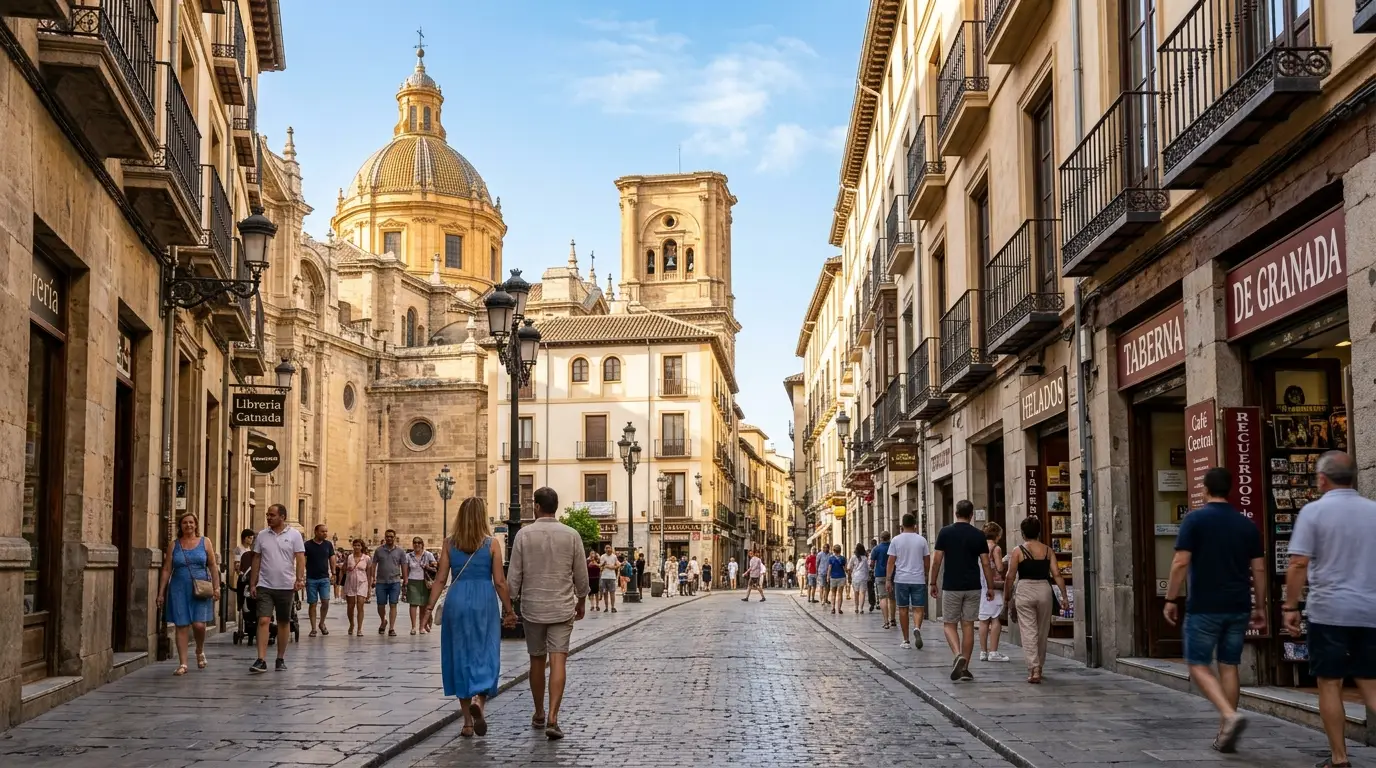
Granada Cathedral facade on Gran Vía de Colón with pedestrians crossing in front
History Easy Free

Centro Histórico Self-Guided Walk

Flat walking circuit through Granada's historic core: the Cathedral facade, Royal Chapel, Alcaicería bazaar, Corral del Carbón, and Bibarrambla square.

At a Glance

Distance
2.1 km
Duration
2 hours
Stops
8 stops
Route type
Circular

Best time to walk

Weekday mornings (09:00–11:00) for the quietest Cathedral visit. Late afternoon for Bibarrambla market stalls and tapas at Plaza de las Pasiegas bars.

Accessibility

Flat terrain throughout. The historic centre has pedestrianised streets and even pavements. Suitable for wheelchairs and pushchairs on main routes. The Alcaicería is cobblestoned and slightly uneven.

On this page

Route Map

Loading map…

Click on any marker to see stop details. Numbered markers follow the suggested route order.

Stop-by-Stop Route

  1. 1

    Plaza Isabel la Católica

    Landmark 10 min

    Flat central plaza at the junction of Gran Vía de Colón and Calle Reyes Católicos. The Columbus monument commemorates the signing of the commission for the 1492 voyage. Start and end point of the circuit.

    Tip: The square is quieter before 09:30. The cafés on Reyes Católicos are open early for breakfast.

  2. 2

    Cathedral facade on Gran Vía de Colón

    Monument 10 min

    The Baroque entrance facade facing Gran Vía, with two unfinished towers that were never completed. Best photographed from the opposite pavement looking south-east along the boulevard.

    Tip: Cross to the north pavement to get both towers in frame without distortion. Morning light hits the facade cleanly before 11:00.

  3. 3

    Diego de Siloé's Renaissance basilica, built from 1528 on the site of the main Nasrid mosque. The Capilla Mayor has stained-glass windows and a gilded retablo. Entry €5, allow 45 minutes.

    Tip: Buy tickets at the door — queues are short on weekday mornings. The light in the Capilla Mayor is best between 10:00 and 12:00.

  4. 4

    Capilla Real (Royal Chapel)

    Monument 30 min

    The mausoleum of Ferdinand and Isabella, attached to the Cathedral. The sacristía holds Isabella's personal collection of Flemish paintings. Tombs in the crypt. Entry €5. No photography inside.

    Tip: The wrought-iron screen (reja) by Maestro Bartolomé is worth looking at closely — some of the finest Renaissance metalwork in Spain. Easy to rush past.

  5. 5

    Alcaicería

    Landmark 15 min

    The former Nasrid silk market, now a reconstructed 19th-century bazaar after the original burned in 1843. Dense lanes of spice stalls, ceramics, silk scarves, and leather goods. 15 minutes is enough.

    Tip: The spice stalls near the centre entrance are genuine; the souvenir shops on the perimeter lanes are interchangeable. The smell of cumin and cedar drifts through the whole quarter.

  6. 6

    Corral del Carbón

    Monument 20 min

    14th-century Moorish alhóndiga (warehouse-inn), the only surviving example of this building type in Spain. Free entry. The horseshoe-arched entrance leads into a three-storey courtyard with a well and wooden gallery balconies.

    Tip: Most visitors walk straight past without noticing the entrance. Look for the horseshoe arch set slightly back from Calle Mariana Pineda. Free, uncrowded, and genuinely old.

  7. 7

    Plaza de Bib-Rambla

    Landmark 20 min

    Former jousting ground and public square of Nasrid Granada. Now has flower stalls around the Neptune fountain and café terraces that fill from mid-morning. Central stop for coffee.

    Tip: The flower stalls are best early. By noon the square is busy with tour groups; go before 11:00 if you want a table in quiet.

  8. 8

    Plaza de las Pasiegas

    Landmark 15 min

    Small square on the south side of the Cathedral, with a different view of the building from the Gran Vía entrance. Bars open for tapas from 13:00. Return point to Plaza Isabel la Católica.

    Tip: The south facade of the cathedral is quieter than the Gran Vía entrance and worth the extra five minutes to compare both elevations.

The walk that doesn't punish your legs

Most Granada walks come with a health warning: bring water, wear proper shoes, accept that your calves will hurt tomorrow. This one doesn't. The centro histórico circuit is entirely flat, entirely paved, and entirely doable in trainers — which makes it the sensible counterpart to the Albaicín climb and the Alhambra queues. Two kilometres through the commercial and ceremonial heart of the city, past the two buildings that define Granada's layered past more clearly than anything else.

Start at Plaza Isabel la Católica, where the Columbus monument stands at the junction of Gran Vía and Calle Reyes Católicos. Ferdinand and Isabella signed Columbus's commission here — or near enough that Granada claims it. The cathedral facade rises two blocks north on Gran Vía. Diego de Siloé began the building in 1528, converting what had been the main mosque of Nasrid Granada into a Renaissance basilica. The conversion took two centuries. Inside, the Capilla Mayor is all pale stone and coloured glass, the light coming down at angles that change through the morning. Five euros gets you in; allow 45 minutes if you want the interior properly rather than a quick circuit.

What the Alcaicería used to be

The lanes behind the Cathedral smell of cumin and cedar. The Alcaicería was the Nasrid silk market — an enclosed, gated bazaar that operated under Nasrid regulation, with workshops for silk merchants and stalls licensed by the Sultanate. In 1843 it burned almost entirely. What replaced it is a 19th-century reconstruction: narrower lanes, neo-Moorish arches, the same dense commercial energy but none of the originals. Tourists buy ceramics and leather. The spice stalls are real enough. Give it 15 minutes and don't pretend it's ancient.

Two minutes south, the Corral del Carbón is the genuine article. Built in the 14th century as an alhóndiga — a Moorish warehouse-inn where merchants stored goods and lodged overnight — it's the only surviving example of this building type in Spain. The horseshoe arch at the entrance is the first thing you see; step through it into a three-storey courtyard with a well at the centre and wooden gallery balconies above. Entry is free. In the 16th century it became a theatre, then a coal depot (hence the name). Now it's a cultural centre. Nobody crowds it. You can stand in the middle of that courtyard and hear the city outside and feel the afternoon cool off the stone.

Bibarrambla and the south facade

The route ends — or pauses — at Plaza de Bib-Rambla, where flower stalls cluster around the Neptune fountain and café terraces fill out by mid-morning. Bib-Rambla was the main public square of Nasrid Granada, used for markets, jousting, and public executions. The Inquisition burned books here after 1492. The café terraces are a better use of the space. The walk loops back via Plaza de las Pasiegas, which gives you the south facade of the cathedral — a different composition from the Gran Vía entrance, and a quieter one. The bars on Pasiegas open for tapas from 13:00.

For a deeper focus on what you are seeing architecturally, the Granada Baroque and Renaissance architecture walk extends this circuit west to La Cartuja and places each building within the three-century post-Reconquest building campaign. The Granada architecture walk guide provides the planning context for the full route.
Reporter notebook

Insider tips

Practical observations gathered the way a local journalist would keep them: short, specific, and more useful than brochure copy.

Crowd tip

Cathedral before 10:00

The Cathedral gets its first tour groups around 10:30. Before that, the Capilla Mayor is genuinely quiet — you can stand in the middle of the nave and hear the building rather than a guide's microphone. Doors open at 10:00 on weekdays; be there when they unlock.

Photo spot

Corral del Carbón courtyard

Almost nobody photographs the interior courtyard of the Corral del Carbón, which makes it one of the most publishable shots in central Granada. Stand at the well and shoot upward through the three tiers of wooden balconies. The light is soft and even through most of the day.

Money tip

Skip the Cathedral gift shop prices

The Alcaicería sells the same postcards and prints sold inside the Cathedral at a fraction of the price. If you're buying anything other than the official guidebook, wait until you're back in the bazaar lanes.

Centro Histórico Self-Guided Walk FAQ

Is the Centro Histórico walk suitable for families?

Yes. The 2.1 km route is flat throughout on paved pedestrian streets, with no steps or significant gradients. The Alcaicería has uneven cobblestones but can be avoided. The walk takes around 2 hours at a comfortable pace, longer if you enter the Cathedral (45 min) and Capilla Real (30 min).

How much does the walk cost?

The walk itself is free. The two paid stops are Granada Cathedral (€5) and the Capilla Real (€5). The Corral del Carbón is free to enter. Combined Cathedral and Royal Chapel tickets are available at €10 and save a small amount on the door prices.

Is the Centro Histórico walk flat?

Yes, entirely. Unlike the Albaicín or the route to the Alhambra, the historic centre circuit runs on flat pedestrianised streets and even pavements throughout. It's the most accessible walk in central Granada and the best option for anyone avoiding hills.

More Walking Tours