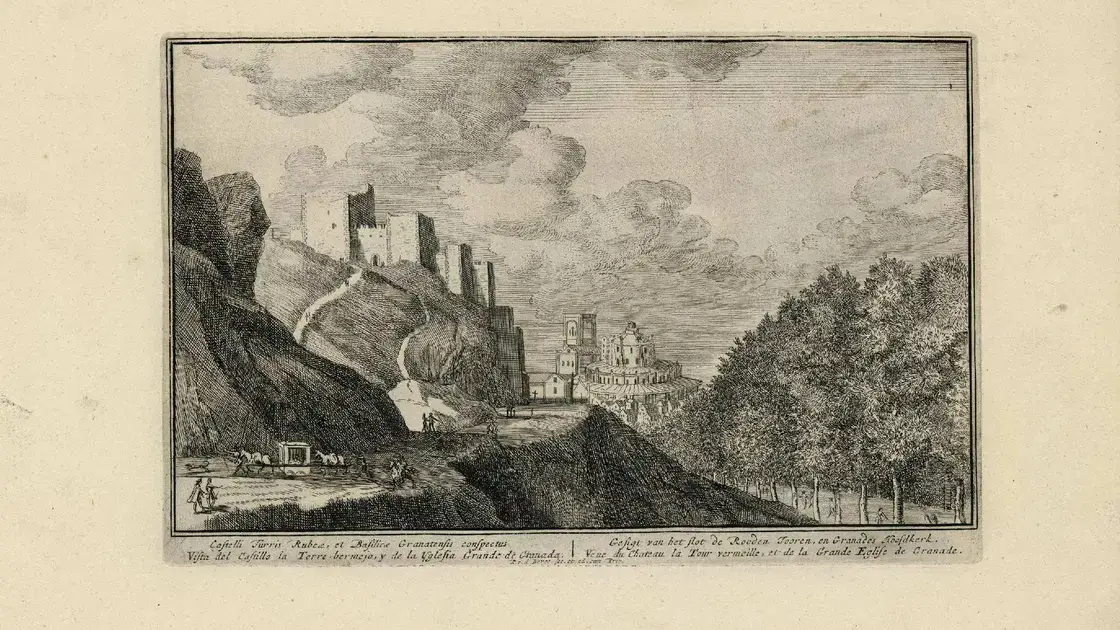
Most visitors to the Alhambra leave without noticing the towers that predated it. The Torres Bermejas — Vermillion Towers — rise from the south face of the Alhambra hill above the Realejo, their reddish sandstone catching the afternoon light in a way the main palace complex, built of lighter stone, simply does not. That colour is not decorative. It comes from the iron content in the local stone, the same material the city's earliest Muslim rulers used when they first fortified this hill in the 11th century — two hundred years before Abd al-Rahman's successors began what would become the Alhambra itself.
The three main towers formed part of the outer defensive curtain wall linking the Alhambra complex to the lower city. They rise roughly 15 metres, square-plan construction with a solidity that speaks to military purpose rather than palatial display. Washington Irving passed them on his way up to the Alhambra in 1829 and noted them in Tales of the Alhambra (1832), which is more than most contemporary guidebooks manage. At the time they were still connected to the broader wall system; the intervening centuries and development have isolated them somewhat, making them feel more like a ruin than they actually are.
Standing below them in the Realejo, the scale registers differently than from above. The neighbourhood below was the Jewish quarter of Nasrid Granada — the judería — before 1492. The towers looked down on a dense urban fabric that has since been replaced several times over, but the topography is unchanged: the towers command the approach from the south and the west, which is exactly what they were built to do. The Cuesta Rodrigo del Campo is the clearest angle for taking them in without craning your neck.
Interior access is not possible for visitors — the towers are managed as part of the broader Alhambra defensive circuit — but this is a smaller loss than it sounds. The exterior reading, seen from the lanes of the Realejo, is the more interesting one. Walk up from the Plaza del Campillo through the Cuesta de los Chinos and the towers appear above the roofline progressively, the reddish stone contrasting with the white plaster of the houses below. If you are ending a walk through the Realejo, this is the natural endpoint. The Alhambra's main entrance is fifteen minutes further up the hill.