The Cuarto Real de Santo Domingo is the oldest surviving Nasrid palace structure in Granada — older than anything inside the Alhambra itself. Muhammad II built it between 1273 and 1302, and dendrochronological dating of the wooden ceiling puts construction after 1283. The qubba at its core uses the same muqarnas vaulting technique as the Alhambra's Hall of Ambassadors — the same dynasty, the same craftsmen's vocabulary, sixty years earlier, and you'll pay €2 rather than €20 to stand inside it. Most visitors to Granada never find it. That suits the people who have.
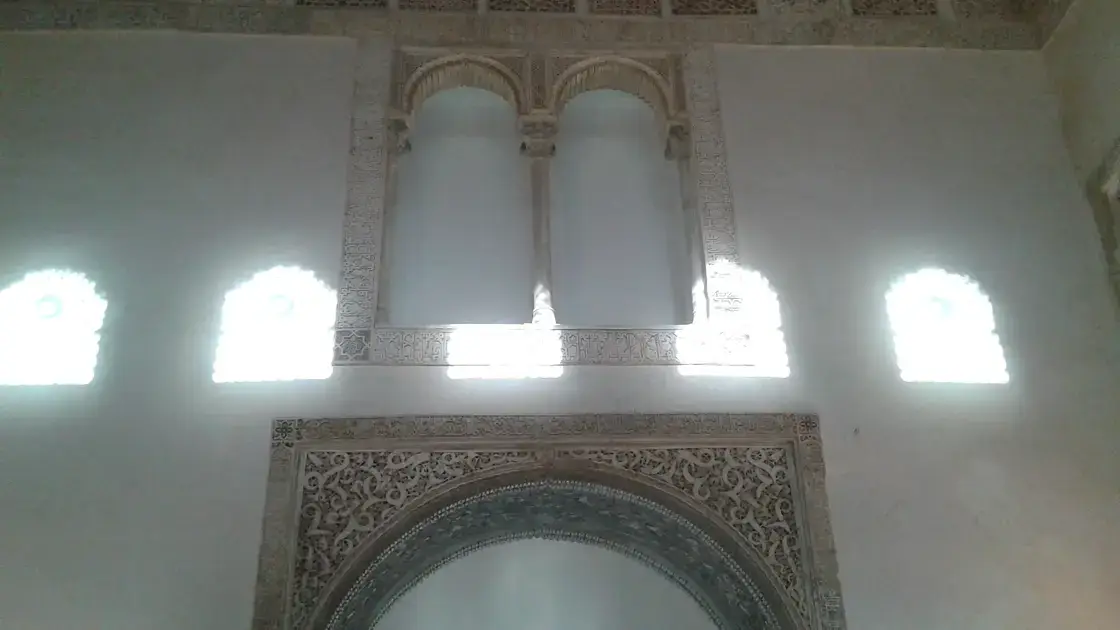
The qubba itself is a square chamber roughly seven metres on each side, double-height, with an entrance arch cut in muqarnas — that dense honeycomb carving that turns a structural arch into something closer to geometry than stone. Twin windows sit above the arch, and wooden balconies project from the side openings. The lower walls are lined with glazed tiles in deep greens and blues, and the plasterwork above them carries Kufic inscriptions at the threshold: "God is unique," followed by Qur'anic verses. It is not decorative calligraphy. In Nasrid palace design, religious text at the entrance threshold turns the act of entering a room into a formal crossing. The building was originally called Dar al-Manjara al-Kubra (House of the Great Wooden Wheel) and functioned as a royal country estate on the city's defensive wall above what is now the Realejo.
In January 1492, the Nasrid sultanate ended. The Catholic Monarchs acquired the property — sold by Aixa, the sultan's mother — and donated it to the Dominican Order, establishing the Convent of Santa Cruz la Real. Tomás de Torquemada, Spain's first Grand Inquisitor, took up residence here during this period. The throne room that had received Nasrid royalty now served an institution whose purpose was doctrinal enforcement. The qubba became the Royal Hall of Santo Domingo. The palace did not change; the use of it did, entirely.
The City of Granada acquired the building in 1990 and commissioned a restoration under archaeologists Antonio Almagro Gorbea and Antonio Orihuela, who removed later additions and stabilised the Nasrid-era structure. It has been a Bien de Interés Cultural since 1919. Today it opens Tuesday through Saturday from 9:30 to 13:30 and again 17:30 to 21:00, Sundays 9:30 to 13:30, closed Mondays. Admission is €2 (€1 children, free Sundays). A 30-minute visit is enough to read the inscriptions, absorb the tiled lower walls, and look out over the plaza. Walk down through the Realejo afterwards and stop at the Casa de los Tiros, the Renaissance palace five minutes away that now holds a museum of Granada's history — together they give you the full arc of what happened to this city in 1492.