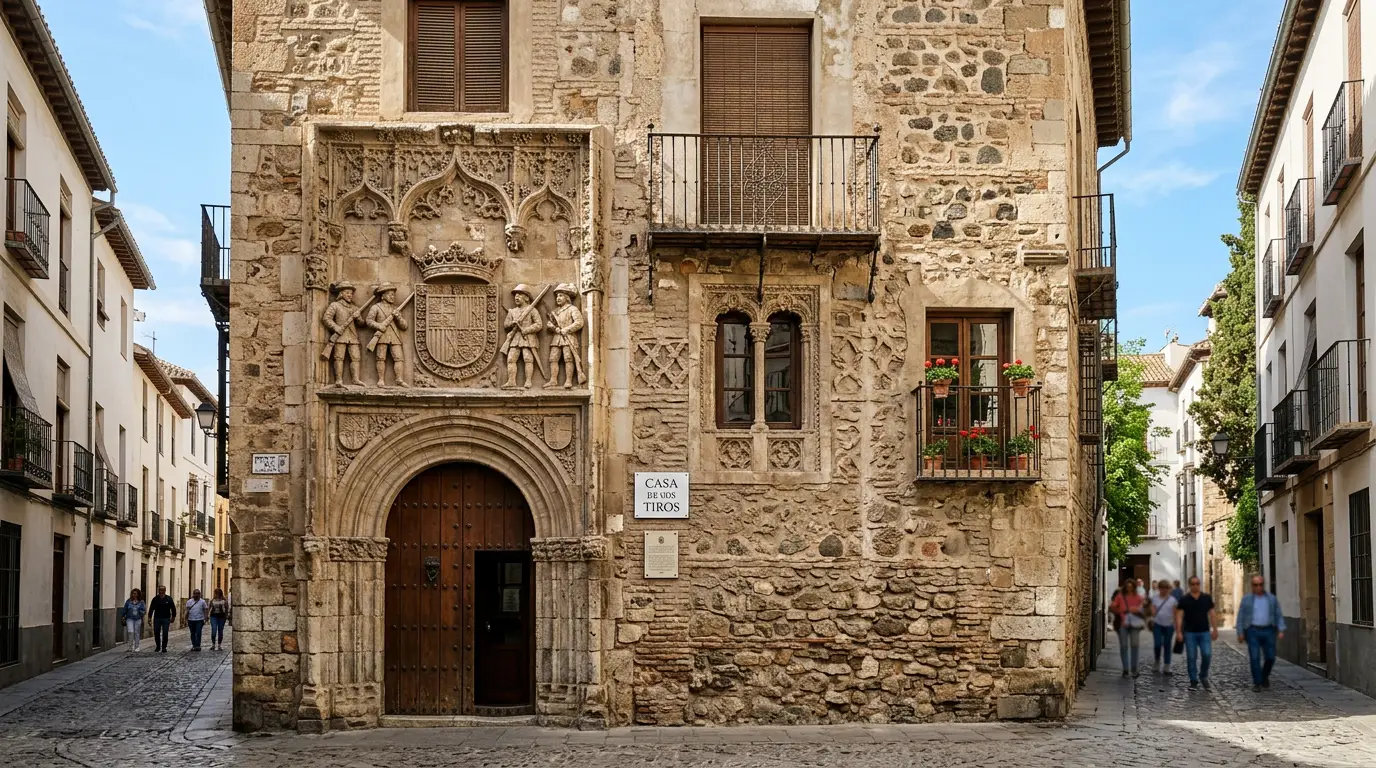

Stand on Calle Pavaneras and look up at the tower. Five musket barrels protrude from the battlements, the detail that gave this place its name: House of Shots. Below them, carved in stone across the façade, five figures in Roman armour stare back: Hercules, Theseus, Mercury, Jason, and Hector. The effect is deliberately odd, deliberately commanding. This is a building that wants you to take it seriously — and once you know who built it, that makes complete sense.
The Venegas family commissioned the palace between 1530 and 1540, a generation after the Christian conquest of Granada. They were descended from Nasrid royalty, the same dynasty that had built the Alhambra, and had converted and served the new Crown. The Casa de los Tiros is their architectural argument: we are ancient, we are noble, we are not going anywhere. The motto carved into the stone, El corazón manda (The heart commands), reinforces the point. The Gothic-Mudéjar structure with its Renaissance ornamentation sits a few hundred metres from the Realejo, the old Jewish quarter, in a part of the city that layered one history on top of another without ever quite erasing what came before.
The interior splits between two registers. On the ground floor, the collections cover Granada's post-conquest centuries: Fajalauza ceramics with their characteristic blue-and-green peacock motifs, Alpujarran woven textiles, Corpus Christi festival materials, and an archive of 19th-century local newspapers. Upstairs, the tone shifts. The museum holds one of Spain's better collections of Romantic-era travel imagery — prints, drawings, and paintings by the European and American artists who descended on Granada in the 1800s, Washington Irving among them, spinning the city into myth. Their vision of the Alhambra as a lost oriental paradise shaped how the outside world still imagines Granada. Seeing those images here, in the city itself, gives them a different quality — you can weigh the romance against the reality a few streets away. The crown of the building is the Golden Room (Cuadra Dorada), a reception hall whose polychrome carved wooden ceiling is the finest secular interior of its period in the city. The colours have faded from their original intensity but the geometry holds, and the room is cool and quiet in a way that rewards slow looking.
This is the only major 16th-century nobleman's palace from the post-conquest period open to the public in Granada — a gap in most visitors' itineraries that is entirely undeserved. The crowds that queue at the Alhambra rarely find their way here. Allow an hour, more if you read Spanish well enough to work through the newspaper archive. For the fuller picture of how Granada got from 1492 to the present, pair the visit with the Granada history guide before you go.