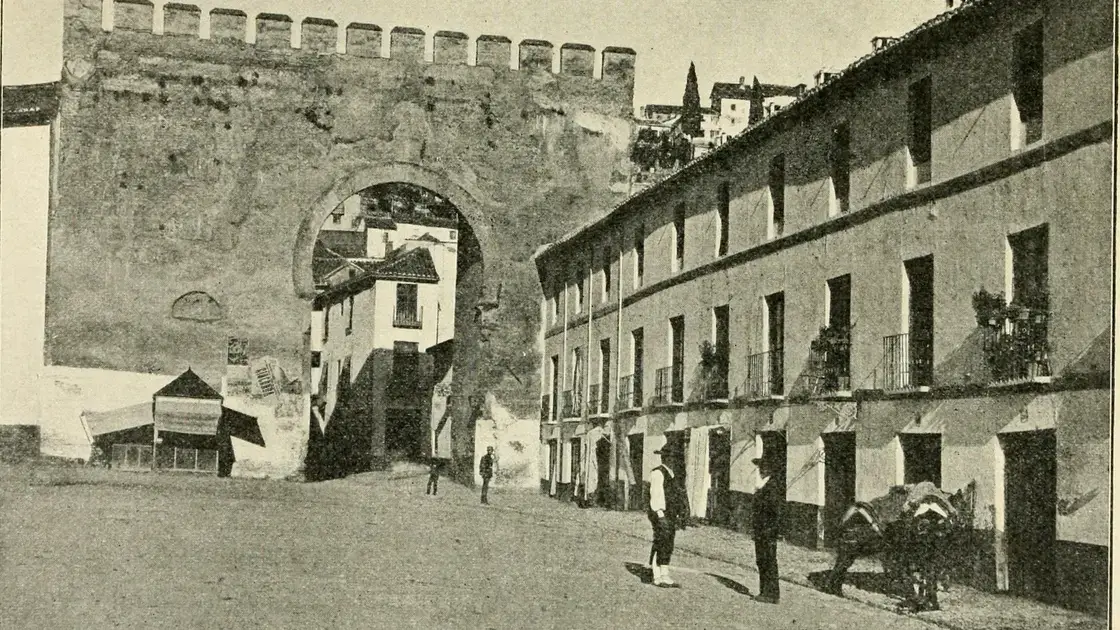
At the bottom of Calle Elvira, where the street widens and the Albaicín begins, the Puerta de Elvira has been standing since the 11th century — two hundred years before anyone laid the first stone of the Alhambra. Most visitors walk straight past it on their way somewhere else. That's their loss. The gate is the oldest surviving piece of Granada's Islamic city walls, and it has a story that most monuments in this city don't: you can read two distinct eras of Islamic rule in its stonework, stacked on top of each other, without needing a guidebook to tell you they're different.
The Zirid sultans built it in the early 11th century as part of the fortifications around what was then called Medina Elvira — the name the gate still carries, translated into Arabic as Bāb Ilbīra. The original structure was a functional military gateway at the western approach to the city. In the 14th century, Yusuf I of the Nasrid dynasty — the same ruler who built much of the Alhambra's palatial interior — ordered its reconstruction as an autonomous fortress: four towers, three gatehouses, two separate doors connecting to the slope of the Alhacaba. The Nasrid arch visible today, with its characteristic horseshoe proportions, dates from that 14th-century expansion. Partial demolition in 1612, and again during French occupation in the 19th century, reduced the complex from its original scale, but the arch and flanking towers survived. The Spanish government declared it a Bien de Interés Cultural in 1896.
Today the gate sits at street level on the edge of the Albaicín quarter, pedestrians moving around and under it without breaking stride. The Nasrid arch is the thing to look at closely: the proportions are tighter than Romanesque arches of the same era, the voussoirs cut from local stone that has gone ochre with age. The towers on either side are solid masonry, built for weight and permanence rather than decoration. There is no interior access; the gate is an outdoor monument, no admission, no hours. The exterior reading is enough. Stand across the street on Calle Acera Merced in the morning, before the market traffic starts, and the stonework is clear. From the gate, Calle Elvira runs straight into the lower Albaicín, with the neighbourhood's characteristic white-rendered walls and narrow uphill lanes beginning almost immediately.
The Albaicín is the natural continuation from here. Walk up through Calle Elvira and bear left toward the Zirid walls — a section of 11th-century rampart survives along the high ridge of the quarter, and the Puerta de Elvira was its western anchor. Early morning is the best time: the light is flat and even before 09:00, which makes the stonework photograph cleanly, and Calle Elvira's tea shops haven't yet opened for the day's trade. The gate is a ten-minute walk from the Gran Vía cathedral end and five minutes from Plaza Nueva. There is no entrance to manage, no queue, no ticket to book.