Granada has a coastline. Most visitors don't think about it, but the Costa Tropical runs 80 kilometres along the province's southern edge, and the Port of Motril sends fish to Granada city the same morning it's landed. The boquerón (fresh anchovy) is the clearest expression of that supply chain. It arrives in restaurants within hours of leaving the water.
The anchovy is a small fish with an outsized reputation for polarising people. The problem is usually the tinned or jarred version, which can be aggressively salty. Fresh boquerones from Almuñécar or Motril are something else: delicate, clean, with a faint sweetness that disappears fast if the fish isn't handled well. What you get in a good Granada tapas bar bears almost no resemblance to what comes out of a tin.
Two preparations, one fish
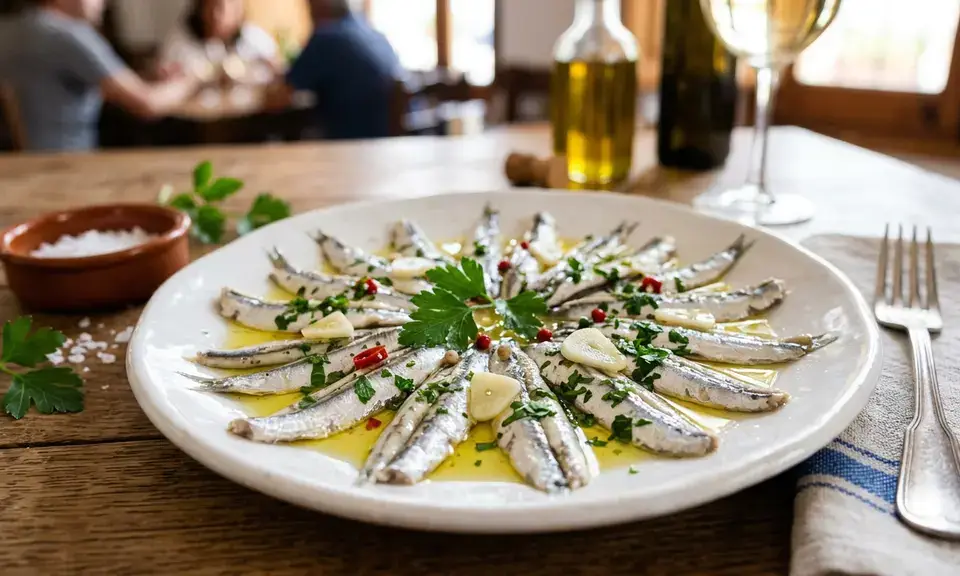
Boquerones en vinagre are served cold. The raw anchovies cure in white wine vinegar for several hours, which firms the flesh and turns it opaque white. A drizzle of olive oil, chopped garlic, and flat-leaf parsley finish them. Granada's version uses white wine vinegar. This matters. Málaga, just down the coast, uses red vinegar, which gives a sharper, more assertive result. The white vinegar version is gentler: the fish comes forward rather than the acid.
Boquerones fritos are the fried version, the pescaíto frito tradition that runs along all of Andalusia's coast. The anchovies are lightly dusted in flour, dropped into very hot olive oil for less than two minutes, and served immediately. They should be crisp to the point of crackling, with the flesh still moist inside. Eat them whole (head and tail included if they're small enough) with half a lemon squeezed over. A cold beer or a glass of local white wine alongside.
The Motril supply chain
The Costa Tropical day trip from Granada takes 45 minutes by car. The road climbs out of the Sierra Nevada's southern foothills and drops fast into subtropical heat, past avocado and mango plantations. Motril's fishing harbour is modest but active, and the fish landed here (anchovies, sardines, fresh tuna in season) moves directly up the mountain to city restaurants by mid-morning.
This matters because the window for truly fresh boquerones is narrow. Peak season runs April through early June, when the fish run in good numbers and the water temperature is still cool enough to keep quality high. You'll find them year-round, but the spring catch is noticeably better: firmer, less watery, with more flavour per bite.
Espichás: the dried version
Less known outside the coast, espichás are sun-dried anchovies specific to this stretch of water between Almuñécar and La Herradura. The drying concentrates the flavour considerably. They're stronger than the marinated version and closer to the intensity of a good boquerón en salazón from the north. Coastal bars near the marina in Almuñécar serve them as a tapa with bread, but you'll occasionally spot them on menus in Granada city at restaurants that maintain direct supplier relationships.
Where to eat them in Granada
For the fried version, look for bars in the Granada food guide that list pescaíto frito as a house speciality. The Albaicín neighbourhood has several old tapas bars where the coastal supply shows up on the daily menu. For the marinated version, almost any bar with a serious free tapas tradition will include boquerones en vinagre in their rotation.
Price in Granada city: around €3–5 as a paid tapa, or included with a beer at free-tapa bars. Either way, it's one of the cheaper pleasures the city offers.