Salmorejo originated in Córdoba, where 19th-century cooks developed it as a way to use stale bread during the hottest months. Granada adopted it early and made it its own: the local version, sometimes called Salmorejo Granadino, leans more heavily on wine vinegar and uses jamón de Trevélez as the principal garnish rather than standard serrano ham.
The difference between salmorejo and gazpacho matters more than most food writing suggests. Gazpacho is thin, liquid, and includes cucumber, pepper, and onion. Salmorejo uses only tomatoes, bread, garlic, olive oil, and vinegar. The bread — specifically stale bread, never fresh — dissolves into the tomatoes during blending and creates a thick, creamy consistency without any dairy. The ratio of bread to tomato is what makes it opaque and almost velvety.
When and how to eat it
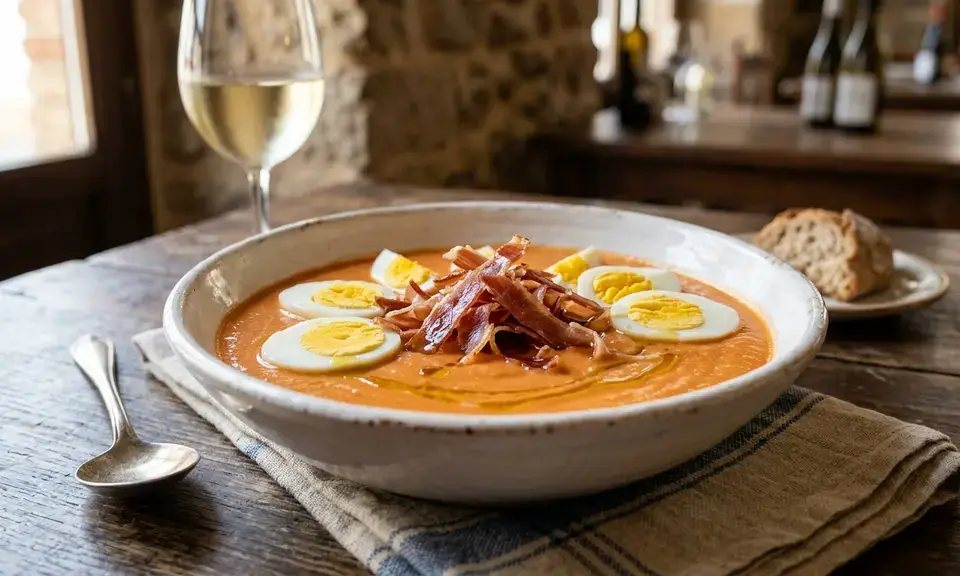
Salmorejo is a summer dish. Made with out-of-season tomatoes, it is pale, bland, and not worth ordering. The correct window is June through September, when Andalusian tomatoes are fully ripe and the flavour has the concentration the dish needs. Granada locals tend to eat it at midday as a starter, chilled from the refrigerator, with garnishes of chopped hard-boiled egg and diced jamón arranged on top.
The standard drink pairing is Tinto de Verano — red wine mixed with gaseosa (lemon soda) over ice. The combination of cold tomato soup and cold wine spritzer is the quintessential Granada summer meal, eaten standing at a bar or on a shaded terrace.
Where to find the best version in Granada
In the Albaicín, Jardines de Zoraya serves a salmorejo granadino in a courtyard setting, often with the salmorejo arriving already garnished and chilled properly. The bars around Plaza Larga and Calle Calderería Nueva also tend to get it right in summer.
In the city centre, the tapas bars around Calle Navas and Pescadería serve salmorejo as a free tapa with drinks — a Granada custom that applies to most drinks orders. You may not choose which tapa you receive, but in summer, salmorejo comes up frequently.
Avoid the tourist menus on Gran Vía. Most of those kitchens use under-ripe tomatoes year-round and the result shows.
Making it at home
The recipe has no cooking step. Blend ripe tomatoes with the bread, garlic, olive oil, and a splash of sherry vinegar until smooth. Refrigerate for at least two hours before serving. The bread should be at least a day old — fresh bread turns gluey and ruins the texture. Taste for salt and vinegar just before serving, then top with diced jamón de Trevélez and chopped hard-boiled egg.
The difficulty is in the tomatoes. A good salmorejo requires tomatoes at their peak. Everything else is technique.
For a broader sense of Granada's food culture, salmorejo pairs naturally with tortilla del Sacromonte as an introduction to the city's traditional dishes — one cold, one hot, both rooted in resourceful Andalusian cooking.