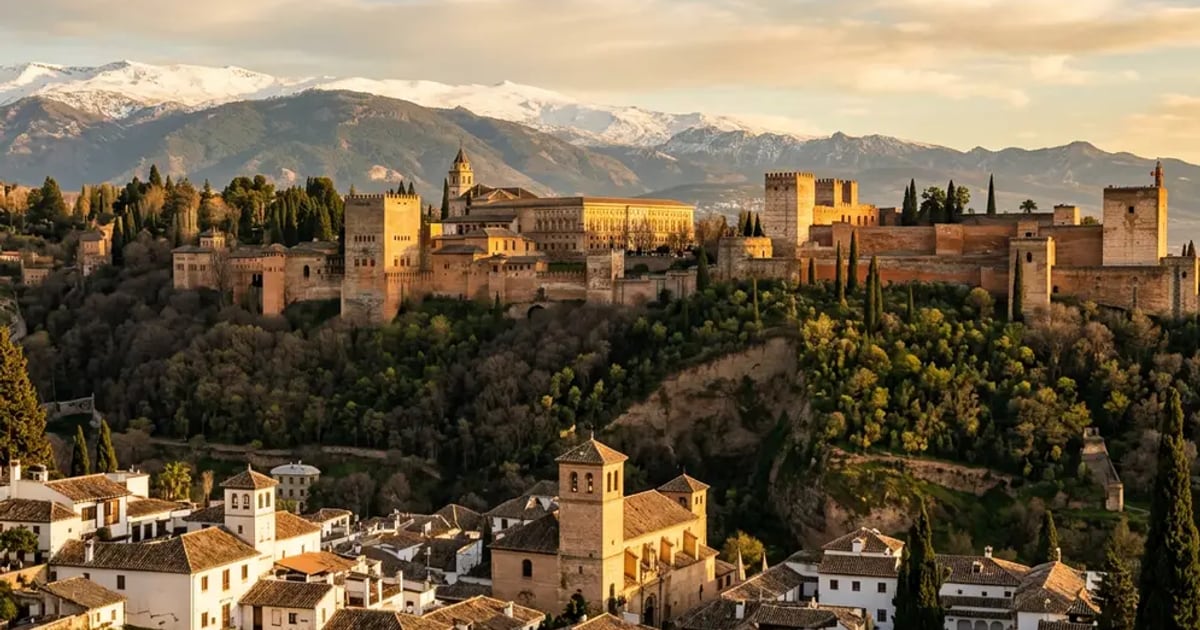
Generalife gardens in bloom in spring, Granada, with wisteria and roses against the Alhambra walls
Spring guide

Granada in spring

Mild days, the Generalife in bloom, and Semana Santa processions through Albaicín alleys. March to May is when the city earns its reputation.

Spring is the version of Granada most people imagine before they arrive. Temperatures between 15°C and 22°C in April and May. The Generalife Gardens at peak bloom, wisteria hanging over the terrace walks and roses around the central pool. The Alhambra with the Sierra Nevada still white behind it, a view you lose by July when the snowline retreats. And Semana Santa: intimate, atmospheric, the cofradías carrying their floats through Albaicín alleys too narrow for a car.

March is the roughest month of the three. Highs of 16°C but lows still dropping to 8°C at night, and a real chance of rain on three to five days. April finds its footing: mild, clear mornings, the gardens starting to open up. May is close to perfect. Warm enough for shirtsleeves by midday, cool enough for walking, and the first tourists of summer not yet arrived in numbers.

The one thing spring does not give you is ease. Alhambra tickets still need booking weeks ahead. Semana Santa week turns the city into high season. The best time to visit depends on what you want from the trip. This guide covers what spring specifically offers and what it costs you.

Month by month: March, April, May

Spring in Granada spans a wide range. The difference between a cold March morning and a warm May afternoon is roughly 15°C, two different wardrobes, and two different cities.

March

8–16°C

Still cool. Rain risk is highest of the three months, with three to five days of showers on average. Snow is gone from the city but the Sierra Nevada is in full ski season. Lighter crowds at the Alhambra.

April

11–19°C

Spring proper. Semana Santa falls here (or late March). The Generalife starts blooming. Some rain early in the month; May-like weather by the last week. Crowds spike for Easter week.

May

15–23°C

The best month. Warm days, cool evenings, the gardens at their peak, and summer crowds still two weeks away. Cruces de Mayo on 3 May brings the city out into its squares.

Accommodation prices follow the same curve. March and early April are the cheapest weeks of the year after January and February. Semana Santa (typically late March or the first two weeks of April) jumps to summer rates. May settles into a middle band: lower than summer, higher than February.

Cruces de Mayo (3 May)

On 3 May, neighbourhoods across Granada put flower-covered crosses in their squares and doorways. No tickets, no tourist infrastructure, entirely free. The competition between neighbourhoods for the most elaborate cross means you find genuine craft in unexpected corners: a side street in the Albaicín, a courtyard off Calle Elvira. The Cruces de Mayo event page has the best areas to explore.

It is one of the few spring events in Granada with an entirely local audience. Arrive without a plan, walk the Albaicín, and follow the floral scent.

Ski season overlaps with spring

March is still full ski season at Sierra Nevada resort (2,100 m base). In a good snow year, the pistes run into April. This means you can ski in the morning and sit in a Granada bar in shirtsleeves by the afternoon. The resort is 32 km from the city centre. The skiing guide has transport details and season dates.

Semana Santa in Granada

Everyone mentions Seville when Holy Week comes up, and the comparison sticks for a reason: Seville's processions are vast, choreographed, and built to be witnessed by tens of thousands. Granada's are built for its own streets. The cofradías move through lanes where the float barely fits, and the effect is something closer to something you stumble into than a spectacle you watch from a distance.

What makes it different

The cofradías (brotherhoods) in Granada carry their floats through alleys built for medieval foot traffic, not modern processions. On some routes the float (a heavy gilded platform bearing a life-size figure) passes close enough to touch, the bearers' feet visible beneath the skirt, the collective effort audible as laboured breath. There is no grandstand. No best seat. You simply stand where the lane is widest and the procession comes to you.

The routes pass through the Albaicín, around the Royal Chapel where Ferdinand and Isabella are buried, and along the main streets of the centre. The Madrugada, the early hours of Good Friday (roughly 1:00 AM to dawn), is the peak: lanterns, drums, and the smell of incense in cold night air.

Practical logistics

  • Dates: varies by year. Check the Semana Santa event page for the current year's schedule.
  • Hotels: book two to three months ahead for Semana Santa week. Prices double. Hostels fill. Mid-range options around the centre sell out fastest.
  • Alhambra tickets: if your trip overlaps with Easter week, book the Alhambra the moment you confirm your flights. That week sells out faster than any summer weekend.
  • Viewing the Madrugada: position yourself in the Albaicín by 12:30 AM. The best streets are narrow ones above Calle Calderería. The cold is real. Bring a proper jacket, not a spring layer.
  • Restaurants: many close Thursday and Friday of Holy Week, particularly in the centre. Book ahead or expect the hotel bar.

The full guide to route maps, brotherhood schedules, and the religious calendar is at the Semana Santa Granada guide.

The Alhambra and Generalife in spring

The Alhambra is worth visiting in any season. In spring it is worth visiting specifically for the gardens. The Generalife is the summer palace of the Nasrid sultans, and the gardens surrounding it have been tended continuously since the 13th century. From late April through May, they are in their best condition of the year.

The Generalife in bloom

The wisteria on the upper terraces flowers from mid-April. The rose beds around the Acequia del Generalife (the long water channel flanked by hedges) reach their peak roughly ten days later. The hedged corridors, walls of clipped cypress and myrtle, are at their thickest and greenest in May. The garden's layered terraces mean you pass from one micro-environment to another: a pergola heavy with jasmine, then an open terrace with the Sierra Nevada visible to the south, then a shaded walkway where the air smells of box.

In July, those same gardens are sun-bleached. The roses are long gone. The hedges are dry at the tips. The fountains run, but the lushness that makes the Generalife exceptional (the sense of engineered abundance in a dry landscape) is specifically a spring thing.

The Nasrid Palaces in spring light

The Nasrid Palaces (the Mexuar, Comares, and the Palacio de los Leones) are unchanged by season on the inside. What changes is the light. In spring the sun comes in at a lower angle than summer, which means the carved plasterwork on the walls of the Sala de los Abencerrajes catches shadow differently. The Patio de los Leones in late April light at 9 AM is cooler and quieter than any summer equivalent.

Spring also gives you walking conditions between buildings. The Alhambra complex covers 13 hectares; to reach the Generalife from the Nasrid Palaces involves a ten-minute uphill walk on open paths. In August that walk becomes a problem. In April it is pleasant.

Tickets: book well in advance

Spring is not the quiet season it used to be. April and May slots for the Nasrid Palaces sell out three to four weeks ahead. Semana Santa week sells out in under 24 hours of going on sale. The full booking guide explains the timed entry system, the difference between ticket types, and what to do if everything shows as unavailable.

Spring hiking in the Sierra Nevada

The Sierra Nevada in spring is two different mountains depending on the month. In March and early April, the high routes above 2,500 m are still under snow and require crampons and experience. Below 2,000 m, the lower trails through the Parque Nacional Sierra Nevada are clear, the wildflowers starting, and the mountain essentially empty of other walkers.

April: lower trails open, snow still visible above

By mid-April, trails up to roughly 2,200 m are snow-free in most years. The Vereda de la Estrella, a valley walk through the Rio Genil gorge starting from the village of Güéjar Sierra, is the most accessible spring route. It gains about 700 m over 12 km one-way, follows a river through mixed forest, and ends near the Charca Verde pools. No technical equipment needed. The trailhead is 20 minutes from Granada by bus.

Higher routes like the ascent to the Veleta summit (3,396 m) are still snowy at the top in April. Possible for experienced mountaineers, but not a casual day hike.

May: the best hiking month

Snow has retreated above 2,800 m by mid-May in most years, opening up the mid-mountain routes. Wildflowers, including over 60 endemic species found nowhere else in Europe, are at peak bloom on the lower slopes from late April through May. The air at 2,000 m is cool and clear, the sky that particular deep blue that high altitude brings.

The Sierra Nevada day trip guide covers transport from Granada, recommended trails by difficulty level, and what to pack for a full mountain day.

The ski-and-hike combination

In March, the ski resort at 2,100 m is fully operational while the lower valleys are green and warm. It is entirely possible to ski a morning run at Sierra Nevada resort and be drinking a beer on a Granada terrace by 3 PM. The resort is 32 km from the city and the road climbs 1,900 m in altitude; the temperature difference on a warm March day can be 15°C between the slopes and the city. See the skiing guide for current season dates and lift pass prices.

Practical tips

Spring in Granada rewards preparation on three fronts: tickets, layers, and the rain window.

Booking timing

  • Alhambra (Nasrid Palaces slot): four to six weeks ahead for April and May; immediately for Semana Santa week.
  • Hotels during Semana Santa: two to three months ahead. The rest of spring: two to three weeks is usually sufficient for mid-range options.
  • Restaurants: spring weekends at popular spots benefit from a day-ahead booking, but walk-ins work Monday to Thursday outside Easter week.

What to pack

  • Layers, not a single jacket: the day-night swing in March and early April can reach 10°C. A lightweight down layer or fleece for evenings, a breathable shirt for midday walks.
  • A compact waterproof: not a full rain mac, but something that packs into a pocket. March and April showers are short and sharp. The Albaicín's stone paths are slippery when wet.
  • Comfortable walking shoes with grip: not flip-flops or smooth-soled sneakers. The climb to the Alhambra from the city involves cobbles, steep gradients, and occasional wet stone.
  • Sun protection from April onwards: the spring sun at Granada's altitude (738 m) is stronger than it feels. SPF 30 minimum for full days outdoors in April and May.

Rain strategy

If it rains, the obvious move is the Alhambra. The Nasrid Palaces are largely covered and the interior spaces are at their atmospheric best in overcast light. The Royal Chapel and Granada Cathedral are an hour's circuit under cover. The Arab Baths (Baños Árabes) in the Albaicín are open daily and work well as a rainy-afternoon plan. Markets, covered passages, and the city's many neighbourhood bars fill the rest. A rainy day in Granada is rarely a wasted day.

Explore each spring month in detail

  • Granada in March — the shoulder start: cooler weather, lighter crowds, Sierra Nevada ski season still running, variable rain.
  • Granada in April — spring proper: the Generalife beginning to bloom, Semana Santa in full force if Easter falls here, temperatures climbing to 19°C.

Frequently asked questions

Frequently asked questions

Is spring the best time to visit Granada?

For most visitors, yes. March through May gives you mild temperatures (8–23°C depending on the month), the Alhambra at lower occupancy than summer, and the Generalife Gardens in full bloom. The one complication is Semana Santa, which falls in March or April and pushes hotels to summer prices for the week. Outside that week, spring is consistently the most comfortable season to be here. See the full best time to visit guide for a seasonal comparison.

How busy is the Alhambra in spring?

Noticeably quieter than July and August, but still not easy to book on short notice. Spring slots start selling out three to four weeks ahead in April and May, and Semana Santa week sells out months in advance. Book at least four weeks before your visit; for Easter week, book the moment you confirm your travel dates. The Alhambra tickets guide covers the booking system, timed entry slots, and what to do if everything shows as sold out.

What is Semana Santa like in Granada?

Smaller and more intimate than Seville or Málaga. The cofradías (brotherhoods) carry their floats through alleys barely wide enough for two people to pass, which means you are close to the processions in a way that Seville's wide boulevards don't allow. The Madrugada, the processions in the early hours of Good Friday, is the most atmospheric moment: lantern light on the Albaicín stone, drums in narrow lanes. See the Semana Santa Granada page and the full Semana Santa guide for route details and viewing tips.

Does it rain much in spring in Granada?

March and April bring three to five rainy days per month on average. Rain usually comes in short bursts rather than all-day grey drizzle. May is drier. Pack a compact waterproof jacket; the Albaicín's steep streets are slippery when wet and there is almost no shelter between viewpoints. Mornings after rain are often the best time to visit the Alhambra: clear air, lower crowds, and the Sierra Nevada in clean snow above the walls.

What is Cruces de Mayo?

On 3 May each year, neighbourhoods across Granada compete to build the most elaborate flower-covered cross. The crosses appear in squares, doorways, and courtyards throughout the city. Entirely free, no tickets, no advance planning. The Albaicín and the Realejo tend to have the most elaborate displays. It is a genuinely local event with almost no tourist infrastructure, which is what makes it worth seeking out. See the Cruces de Mayo event page for dates and the best locations.

Reporter notebook

Insider tips

Practical observations gathered the way a local journalist would keep them: short, specific, and more useful than brochure copy.

Best time

The Generalife is at its best in late April

The wisteria tunnels on the upper terraces and the rose beds around the central pools hit peak bloom between roughly 20 April and 10 May, depending on the year. By late May the roses are fading. If you have any flexibility in your dates, target the last week of April. The hedged garden corridors are at their thickest, the light is warm but not yet harsh, and the queues at the Alhambra are shorter than in July by a factor of three.

Local custom

Semana Santa viewing: pick the Albaicín, not the cathedral square

Most visitors head for the Cathedral and Gran Vía, where the processions are visible but the crowds are dense and the atmosphere is conventional. Walk up into the Albaicín instead and find a corner on Calle Calderería Nueva or the streets below the Mirador de San Nicolás. The cofradías pass within arm's reach, the narrow walls amplify the drums, and you will have maybe thirty other people around you instead of three hundred. For the Madrugada, be in position by 1:00 AM. The processions start in the early hours of Good Friday and move through until dawn.

Crowd tip

Book Alhambra tickets the day you confirm your trip

Spring is not summer, but April and May still sell out. The timed Nasrid Palaces slots go first, sometimes four to five weeks before the date. The general Alhambra ticket (Alcazaba and Generalife only, without the Palaces) stays available longer but is a significantly reduced experience. Semana Santa week sells out two to three months ahead. The safest approach: open the Alhambra booking site the same evening you buy your flights and claim the earliest available Nasrid Palaces slot for your preferred morning.

What to bring

A layer for evenings and a waterproof for mornings

Spring temperatures in Granada swing 10°C or more between midday and 10 PM. The evenings in March can drop to 7–8°C once the sun is gone, and the stone streets in the Albaicín hold the cold. A light down jacket or a wool mid-layer covers the evening gap without taking up much bag space. For rain, a compact packable shell is enough. Spring rain in Granada rarely lasts more than a couple of hours, and a full umbrella is a liability on the narrow uphill paths to the Alhambra.