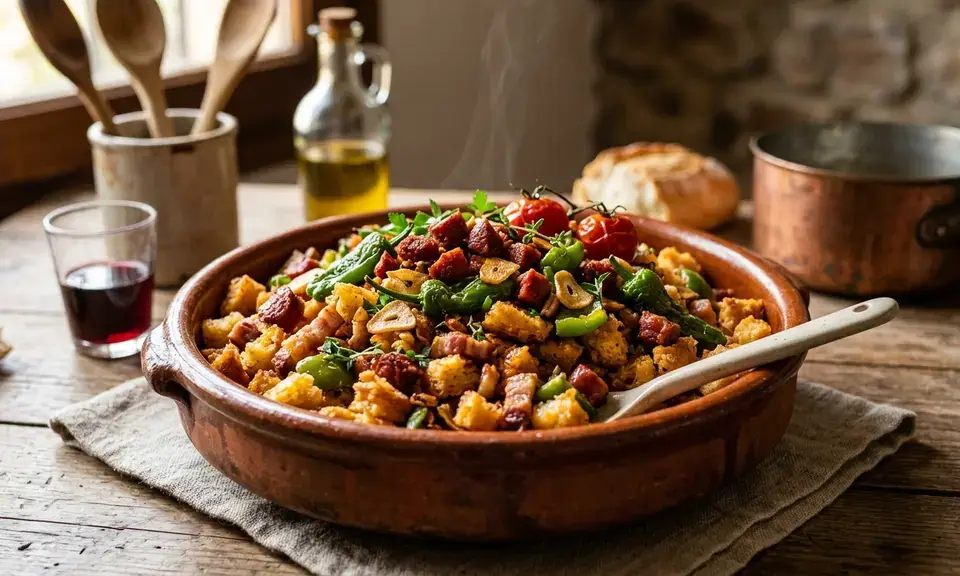
Migas granadinas starts with bread that nobody wants. Three or four days old, hard enough to crumble, the kind a baker would bin. Torn into rough chunks and soaked overnight with salted water and garlic, then fried slowly in good olive oil until the outside crisps and the inside stays faintly chewy — this is the principle. What gets added to the pan is where households diverge.
The basic version uses garlic, chorizo, bacon (panceta), and green peppers. Some families add morcilla. Others fry a dried ñora pepper in the oil first, then remove it before the bread goes in. A grandmother in Capileira will insist you need a splash of water from the original soaking pan to get the right texture. Her neighbour will tell you that is completely wrong. Both versions are good.
This is the distinction that matters if you're comparing migas across Andalusia: the Granada variety is migas de pan, made from bread. The version you'll find in Extremadura, Murcia, and parts of Castile is made from fine flour — lighter, more uniform, different in texture and character. Granada cooks largely ignore the flour version.
The summer variant
Migas is winter food by nature, but the warmer months produce a counter-tradition. In summer and early autumn, the dish gets served with grapes, melon, and a cold glass of gazpacho alongside. The sweetness of the fruit cuts through the richness of the fried bread and chorizo in a way that makes no intuitive sense until you taste it. Village bars in the Alpujarras often serve this combination in August when the local grapes ripen.
The pairing is not a modern restaurant invention — it's documented in 19th-century Andalusian cookbooks and almost certainly older. Shepherds and olive-harvest workers who made migas outdoors in clay pots would eat whatever fruit was nearby. The sweet-salty combination was practical before it became traditional.
Origins in the Sierra Nevada villages
Migas granadinas belongs to the Alpujarras — the string of white villages along the southern Sierra Nevada, from Lanjarón east to Ugíjar, that survived on subsistence farming for centuries. The dish makes sense in that context: stale bread is not waste, olive oil is the cooking fat, cured pork is winter protein. Nothing is bought that could be produced at home.
The family recipe tradition runs deep here. A father in Trevélez fries his chorizo cut thicker than the bar down the hill. His daughter soaks the bread for six hours; he soaks it for twelve. These are not small variations — they produce noticeably different results. For a deeper look at how this food culture connects to the landscape, the Granada food guide covers the full picture.
Where to eat migas in Granada
In Granada city, migas granadinas appears on the menus of bars and tabernas that lean toward mountain food rather than coastal cuisine. The dish is rarely on standard tourist menus; it signals a place with a regional rather than generic Andalusian identity.
Look for it at Bodegas Castañeda, where it appears as a tapa in cold months, and at Los Manueles, the Calle Reyes Católicos taberna that has been feeding locals since 1917. In the Albaicín, a few bars on Calderería Vieja serve it on weekend mornings — the locals' version of brunch.
For the real thing, take the bus to Lanjarón or Pampaneira. In a village bar in winter, migas arrives in the same clay pan it was cooked in, still sizzling, with a basket of bread and a glass of red wine from the Contraviesa slopes. That version does not travel well to the city.