
How the free tapa system actually works
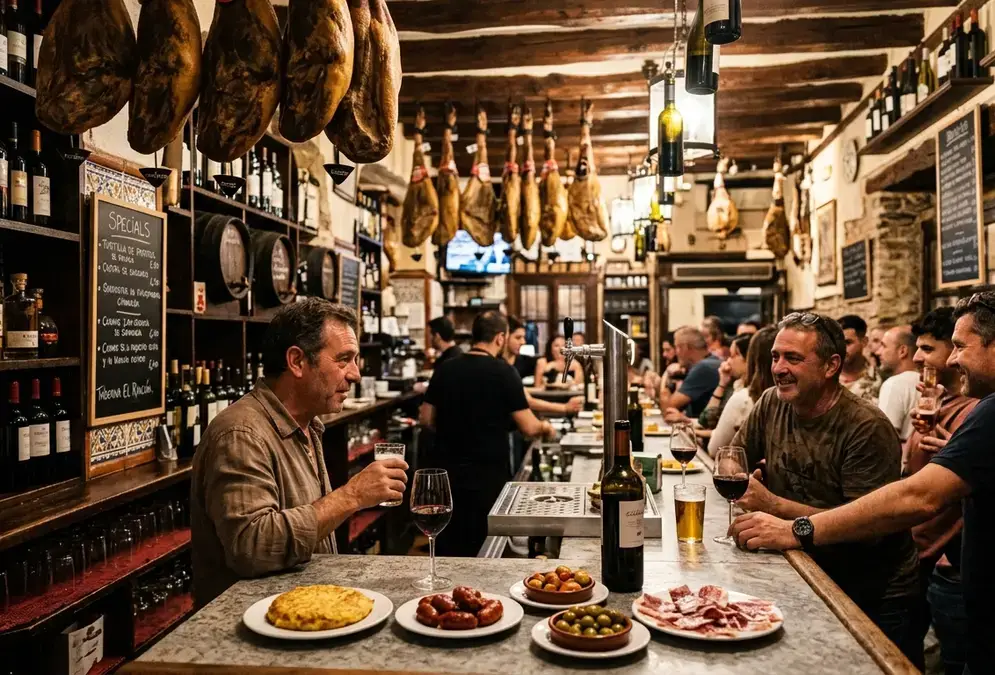
The mechanism is straightforward. Walk into a traditional Granada bar, order any drink — a caña (small beer), a tinto de verano, a glass of house wine, even a soft drink — and the bar staff bring you a small plate of food. You did not order it. You do not pay for it separately. It comes with the drink.
The plate is the bar's choice, not yours. At most traditional bars, the kitchen rotates through a daily roster of preparations: jamón ibérico, salmorejo, albóndigas en salsa, croquetas, a montadito with cheese and tomato, boquerones en vinagre. You get what they give you, and the tapa usually changes with each round. Order a second drink and a different plate arrives. This is not an accident; bars use it deliberately to show range.
The price of the drink does not reliably affect tapa quality at well-run bars. A €2.50 caña at [Bodegas Castañeda](/bar/bodegas-castaneda) comes with food that many restaurants in other cities would charge four euros for on its own. What matters is whether the bar is the kind that takes the tradition seriously. Many tourist-facing bars on Calle Navas and around Plaza Nueva have quietly abandoned genuine tapas in favour of a small plate of crisps. The custom survives intact in neighbourhood bars, in university-quarter bodegas, and in the places where locals actually drink.
The drinks menu is worth understanding. **Tinto de verano** — red wine and lemon soda — is Granada's default summer drink and cheaper than beer at most bars. A **caña** is roughly 200ml of draught beer, the standard measure. **Vino de la tierra** refers to local wines from the Contraviesa zone south of Granada, a small high-altitude area whose wines rarely leave the province. At the right bar, asking for vino de la tierra rather than a brand name is the move that marks you as someone who knows what they are doing.
The system creates a particular rhythm to an evening. Locals do not stay at one bar for hours; they move. Two drinks here, two there, covering a circuit of four or five bars across an evening. Each stop brings new food, new company at the bar, a different corner of the neighbourhood. This is **tapeo** — the act of bar-hopping through Granada — and the free tapa is the mechanism that makes it economically logical to keep moving. You have already eaten. You go to the next bar for the drink and the company, and the food just appears.
Where the tradition came from
The etymology is the most credible starting point. The word **tapa** means lid or cover.[^1] The dominant historical explanation is functional: Andalusian bartenders covered wine glasses with a piece of bread or a small plate to keep flies and dust out, particularly in the hot months when insects were an active problem. The cover became the convention, and the convention became food. Salt-cured jamón or cheese placed on top of the cover increased customers' thirst, which sold more drinks. The economic logic aligned neatly with the hygienic one, and the practice spread.
The second theory involves **Alfonso X of Castile**, called El Sabio (The Wise), who ruled in the 13th century. According to the most popular version, he decreed that taverns in Castile must serve food with every alcoholic drink to prevent drunkards from causing disorder — having something in your stomach slowed the alcohol.[^2] This story is repeated with great confidence across Andalusia, appears in tourist literature about Granada, and is what your barman will tell you if you ask. The problem is that no one has found the original decree. Historians have been looking since at least the 1980s. The document does not appear to exist. Alfonso X did produce an enormous volume of legal, scientific, and literary work — the *Siete Partidas* codified Castilian law; the *Cantigas de Santa María* documented Marian miracles — but no tapas law.
The absence of evidence does not mean the story is entirely invented. Medieval tavern regulations often went unarchived or were lost. The story persists because it is internally coherent: linking the tradition to a named monarch with a specific social rationale is more satisfying than attributing it to flies. Granada locals who are otherwise perfectly precise about historical matters will cite Alfonso X without hesitation. The story carries social truth even if it lacks documentary backing.
A third thread traces the tradition to **Moorish Granada** under the Nasrid dynasty. The argument is cultural rather than documentary: in the palace kitchens of the Alhambra and in the markets of the medina below it, the custom of hospitality that required offering food alongside drink was well established. After the Reconquista, Castilian institutions took over but the social customs persisted in the bars and households of the city. This theory is the least documented of the three, but it does explain something the other theories don't: why free tapas survived specifically in Granada and not in Seville or Córdoba, both of which had centuries of Moorish rule and both of which charge for food today.
Explore nearby · Monument
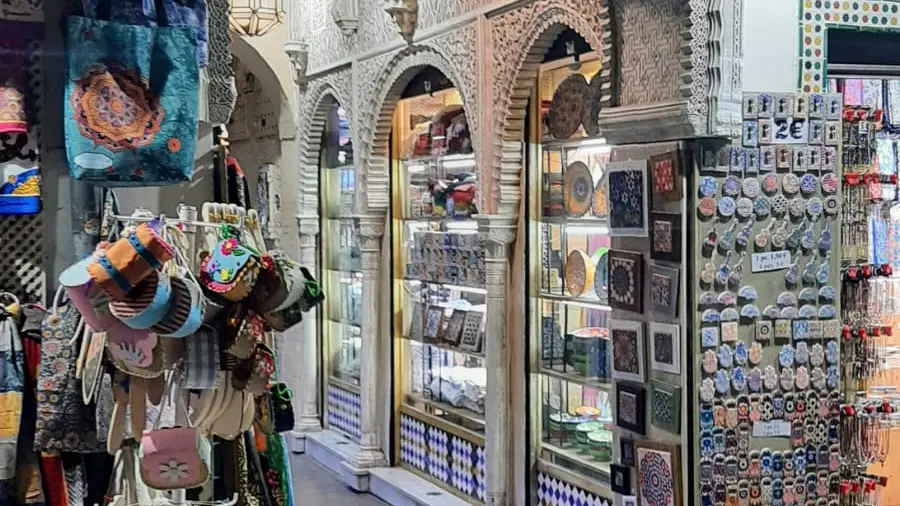
Alcaicería
Granada's historic silk market, rebuilt after 1843 in Neo-Moorish style. Small shops sell ceramics, taracea woodwork, spices, and leather goods. Free to enter.
The honest answer is probably that all three explanations contributed to different degrees in different periods, and that the tradition survived in Granada because the city's bar culture reinforced it economically and socially for long enough that abandoning it became unthinkable. Once enough bars were doing it, any bar that stopped was simply the bar with worse value. The tradition became self-sustaining.
The unwritten rules every visitor should know
The free tapa is a gift, and gifts come with social protocols. Understanding them does not make you a local, but it keeps you from being the table of tourists who complain about what arrived on their plate.
The most important rule is about where you sit. Sit at the bar counter and you will receive better tapas, faster service, and occasional conversation with the staff. Table service at a traditional Granada bar is slower, less attentive, and sometimes produces smaller plates. The bar counter is where the action is. It is also where you can see what other customers are eating, which is the best menu research available. If the plate arriving two spots down looks better than what you got, make a note for the next round.
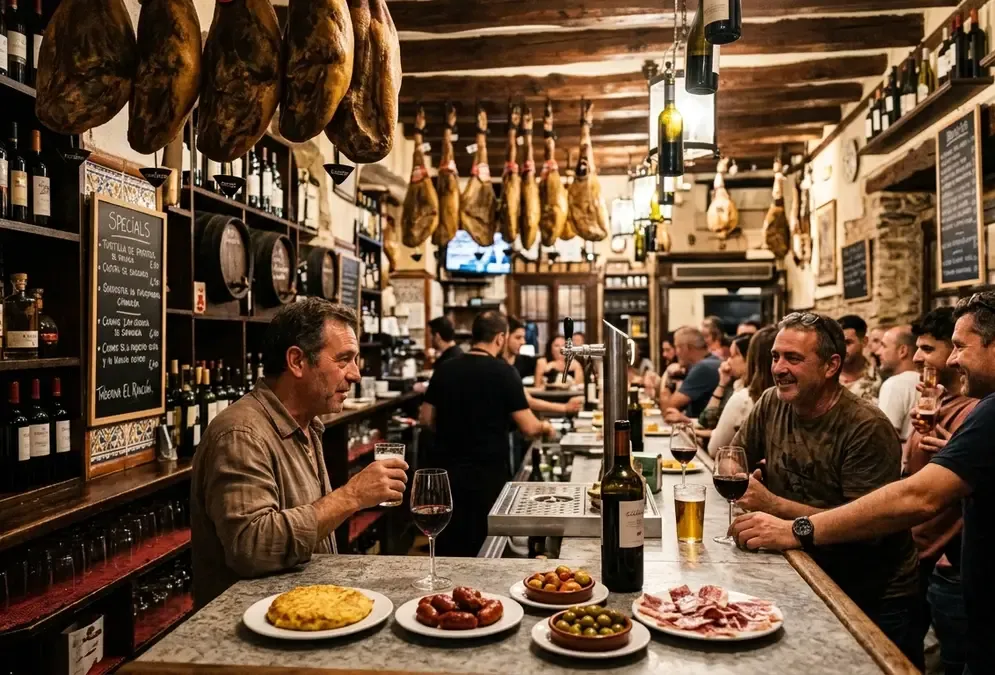
Bar counter at a traditional Granada tapas bar — rows of jamón legs hanging from ceiling, wine barrels serving as tables, free tapa plates lined up for customers, warm amber lighting
Declare allergies before you order. Once the tapa arrives, sending it back because of an ingredient you did not mention is rude in a way that is difficult to recover from at a small bar. Most Granada bar kitchens use **jamón** and **gluten** in the majority of their preparations; vegetarian tapas exist but are not the default. Tell the staff before the first round and they will work around it.
Do not request a specific tapa. The bar chose it for you. This is not a system where you direct what appears. Some tourists spend several minutes trying to negotiate what they want and the bar staff, who may not speak fluent English and who are managing ten other orders, find this exhausting. Accept what arrives, eat it, form an opinion, and decide whether to come back based on that.
**Best hours** for serious tapas are 14:00 to 15:30 for the lunch service and 21:00 onward for the evening. These are when the kitchen is running at full capacity and the plates are freshest. Arriving at 19:30 or 20:00 — when many northern European visitors want to eat — puts you in the transition gap between lunch and dinner when some bars are restocking and kitchen throughput is low.
The tourist-bar problem is worth flagging directly. Calle Navas is the most-photographed tapas street in Granada and one of the worst places to test free tapas. Most bars there charge separately. The same applies to the bars immediately around the Alhambra ticket offices. The tradition is most reliably intact in the streets around the university — Calle Pedro Antonio de Alarcón and its side streets — and in the older sections of [Realejo](/neighborhood/realejo) and [Albaicín](/neighborhood/albaicin).
The bars worth knowing, and what to order there
Three bars appear in almost every serious account of Granada's free tapa tradition, and each represents a different version of what the system looks like in practice.
**Bodegas Castañeda**, at Calle Almireceros 1-3, is the one that looks like a film set of an Andalusian bodega but actually is the real thing. Jamón legs hang from the ceiling in rows. Barrels line the walls and serve as standing tables on busy nights. The wine list leans toward Andalusian sherries and local whites. Order a glass of house wine or a caña and **albóndigas en salsa de tomate** arrive on a small plate — meatballs in slow-cooked tomato sauce, soft inside, served hot. The bar dates its current form to around 1870, which makes the décor genuinely old rather than nostalgic. Arrive just after 13:30 or after 15:30 to find space at the bar. By 14:00 it is standing room only and the noise level makes conversation a project.
**Los Manueles** has been serving the same area since 1917 and is known in Granada for one thing above most others: its **croquetas**. The croqueta at Los Manueles is large, properly béchamel-centred, and arrives hot with a crust that holds. At some bars croquetas are advance preparation, warmed rather than fried to order; Los Manueles fries fresh. The free tapas here tend toward more substantial portions than the city average, and the bar fills with office workers and university staff rather than tourists during weekday lunch. Calle Manuel Reyes Católicos 37.
For atmosphere that is harder to find elsewhere, the cave bars of the Sacromonte district are worth a detour. Bars like **Bar El Pibe** occupy cave spaces carved into the hillside above the Darro valley, with rough whitewashed walls and views toward the Alhambra through low windows. The tapas here are simpler — jamón on bread, a piece of cheese, Russian salad — but the setting is the point. Arriving at dusk, when the Alhambra lights start coming on above the valley, and eating jamón ibérico in a space that has been serving the neighbourhood for generations is the kind of Granada experience that requires no planning beyond showing up and ordering a drink.
For visitors who want structured navigation through all of this, the [Granada Tapas Tour](/activity/granada-tapas-tour) operated by Granada Tapas Tours (group maximum 8 people, from €60) covers bars that do not appear in guidebooks, explains the history while you eat, and handles the ordering logistics so you can focus on what arrives. Useful particularly for the first night, when the city's geography and bar culture are still unfamiliar.
Read next — Activity
Granada Tapas Tour
Guided 2.5-3 hour walk through Granada's authentic tapas bars. 10-12 tapas samples and 4-5 local drinks per person. Small groups, max 8 people. From €60.
Why Granada kept the tradition when other cities didn't
Seville, Málaga, and Córdoba charge for tapas. Granada does not, or at least not at the bars that take the tradition seriously. The cities are a few hours apart by road and share the same Andalusian food culture. So why did the free tapa survive here?
One argument is economic. Granada lacks a major port and the industrial economy that followed it. Seville has the port; Málaga has the coastal resort economy. Granada's economy through most of the 19th and 20th centuries was small-scale, university-anchored, and oriented toward the local rather than the external. A bar culture that incentivised repeat visits through complimentary food was useful in a city where the same customers came back most nights and word of mouth was the only marketing available.
Another argument is structural. The university district creates a captive population of students and academics who drink regularly, have modest budgets, and respond rationally to value. A bar offering a free tapa with every drink attracts and retains this population more effectively than one that charges. The custom became ingrained in the university quarter first and spread outward. Granada's University of Granada was founded in 1531,[^3] and the area around it has had a dense bar culture for centuries.
There is also what might be called the Alhambra effect. Tourism in Granada has always centred on the Alhambra, one of the most-visited monuments in Europe. Visitors arrive in quantity and leave quickly, often staying only one or two nights. The city's restaurant economy has historically depended less on tourist spend at dinner tables and more on the constant churn of short-stay visitors using bars. The free tapa kept locals drinking and spending on rounds; tourists found the custom novel and talked about it, which brought more of them.
The comparison with Almería and Jaén is instructive.[^4] Both are Andalusian provincial capitals that also maintain a free tapa tradition, and both share economic characteristics with Granada: not wealthy by national standards, university presence, bar culture weighted toward locals rather than tourists. The cities where free tapas disappeared — Seville, Málaga, Córdoba — all experienced significant tourism or export-economy growth that shifted the bar economics toward higher covers, table service, and the more profitable model of charging separately for food. Granada's tourism growth has been substantial but the bar culture's inertia was stronger.
| City | Free tapas? | Main bar economy |
|---|---|---|
| Granada | Yes — at traditional bars | University district, local regulars |
| Almería | Yes — strongest tradition | Local-facing, modest tourism |
| Jaén | Yes — provincial tradition | Olive oil economy, local bars |
| Seville | No — tapas are charged | Major tourism, restaurant culture |
| Málaga | No — tapas are charged | Coastal tourism, high covers |
| Córdoba | No — tapas are charged | Heritage tourism, restaurant focus |