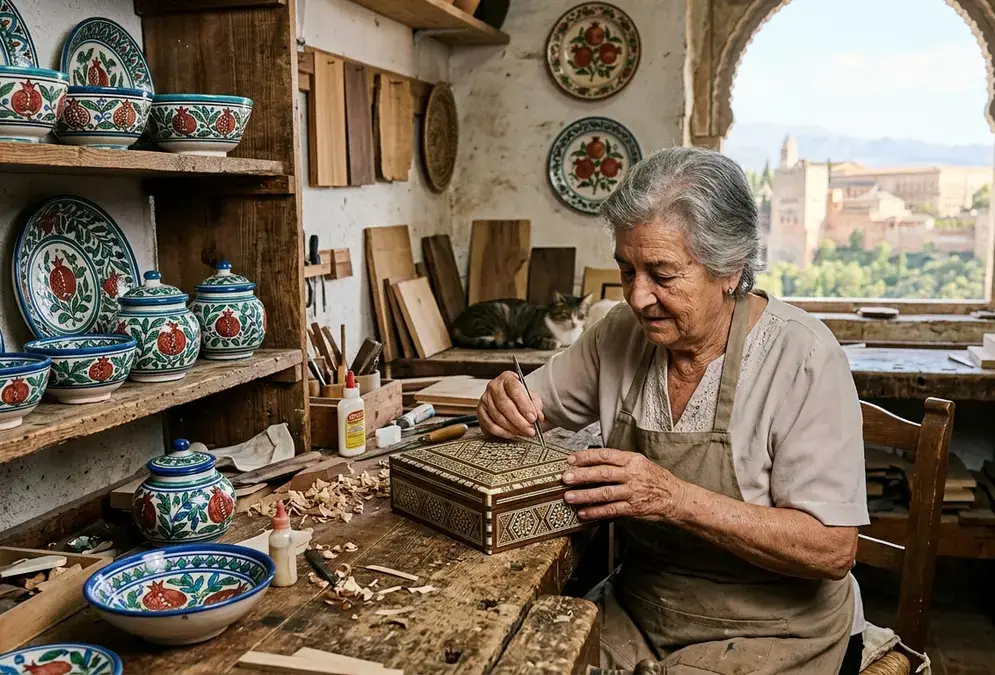

Taracea: eight centuries of geometric inlay
The word taracea comes from the Arabic *tarsi*, meaning to incrust. The craft arrived in the Iberian Peninsula with Arab craftsmen during the Umayyad period and reached what historians consider its technical peak during Granada's Nasrid Kingdom (1230–1492). The ceiling of the Chamber of the Ambassadors in the [Alhambra](/monument/alhambra) is taracea at its most ambitious — cedar panels cut and fitted into interlocking star polygons derived from Islamic geometric mathematics, with no adhesive visible at the joints.
The technique works by building rods: long columns of contrasting materials — walnut, ebony, mahogany, mother-of-pearl, bone, brass — joined lengthwise according to a geometric template. The craftsman slices the rod crosswise to produce identical star-shaped pieces, which are then set into furniture, boxes, or boards. The pattern repeats precisely because every slice from the same rod is structurally identical. Getting the rod geometry right in the first place is where the skill lives.
Read next — Monument
Alhambra
Granada's UNESCO fortress-palace on the Sabika hill. Nasrid Palace tickets sell out weeks ahead and daily entry is capped. Book via the Patronato website.
After the Reconquista, the craft survived by adapting: Nasrid geometric patterns gave way to Renaissance and Baroque motifs, and taracea was applied to new furniture forms. A revival came during the 19th-century Orientalist movement, when European collectors sought Moorish decorative objects and Granada's workshops responded to the demand. The craft contracted significantly in the 20th century as plastic and machine-made imports undercut handmade production. Granada is now the only place in Spain where taracea is still made by hand.
The **Laguna family workshop** on Calle Real de la Alhambra represents the longest continuously operating taracea operation in the city, now spanning four generations. **Artesanía del Árbol**, across from the Alhambra Palace hotel, and **Artesanía González** on Cuesta Gomerez near Plaza Nueva are two other workshops that produce rather than just sell. Small pieces — a box or frame — start at around €30–50 for genuine handmade work. Chess sets and backgammon boards run €80–200. Furniture is priced individually and can reach several hundred euros.
To identify authentic taracea: hold the piece at an angle to the light. Genuine inlay work catches the light unevenly — each material has a different reflective surface, and the slight variations between hand-cut pieces make the pattern shimmer. Printed or photographically reproduced fake taracea looks flat and uniform from every angle. Run a fingernail across the surface: hand-fitted pieces have micro-ridges at each join; printed surfaces are completely smooth. Genuine workshops put a stamp or maker's label on the underside of every piece.
Fajalauza ceramics: the pomegranate pottery of the Albaicín
The first documented reference to Fajalauza pottery appears in a 1517 tax complaint filed by a potter working near the [Albaicín](/neighborhood/albaicin) city wall. The name itself comes from the Fajalauza Gate, one of six historic entrances in the Albaicín's Nasrid-era walls, built in the mid-14th century. Workshops clustered around that gate through the 19th century, forming Granada's main ceramics district.
Read next — Neighborhood
Albaicín
Granada's oldest neighbourhood: the Albaicín holds a UNESCO-listed maze of whitewashed lanes, Moorish cármenes, and the finest Alhambra views in the city.
Fajalauza is a tin-glazed earthenware tradition — the same broad family as Italian majolica and Dutch Delftware, but with a distinct local palette and motif set. The defining colours are cobalt blue and copper green on a cream or off-white ground. The standard decorative vocabulary draws from Moorish geometric patterns, Andalusian floral forms, birds, and above all the pomegranate — *granada* in Spanish, the city's own symbol, which appears on virtually every piece. Traditional potters sourced clay from the Beiro River and fuelled their kilns with rosemary and broom shrubs from the surrounding hills.
The ceramic tradition has faced steady erosion. Industrial dyes introduced from the 1970s onward shifted the colour palette from the original muted, slightly uneven tones to saturated, photogenic hues designed to catch tourist eyes. Most historic Fajalauza factories have since closed. The major exception is the **Cecilio Morales** workshop in the Albaicín, the only remaining producer still using traditional techniques — including hand-throwing, hand-painting individual motifs, and traditional glazing processes. In 2021 the Cecilio Morales Foundation established a training programme to pass the techniques to a new generation of ceramicists.
Fajalauza tiles replaced the original tile work in the Patio de los Arrayanes in the Alhambra's Nasrid Palaces at some point during the 20th century, which gives the tradition an unusual claim: its products are inside one of the world's most visited monuments.
Authentic Fajalauza carries visible brushstroke variation — each bird or pomegranate is slightly different from the one beside it, because every motif is painted freehand. Machine-applied or stamped designs have identical repetition across all units on the shelf. The glaze on genuine pieces thins toward the rim; uniform glaze edge-to-edge indicates dipping by machine. Pieces from the Cecilio Morales workshop bear a workshop mark. Prices from Albaicín workshops run €15–50 for plates and bowls; tourist reproductions in the Alcaicería sell for €5–25 and are easy to distinguish once you have seen the real thing.
Leather, silk, and metalwork in the Alcaicería
The [Alcaicería](/monument/alcaiceria) was founded in the 14th century by Muhammad V as a closed royal market for taxing and trading silk. At its height in the 16th century it contained nearly 200 small shops operating under lock and key — access was controlled by the crown, which collected duties on the highest-value goods traded in the Nasrid economy. An arson attack in the 1840s destroyed most of the original structure; what stands now is a 19th-century reconstruction covering less than a quarter of the original market's footprint. The narrow arcaded lanes remain, but the silk trade is long gone. What survives is leather, metalwork, textiles, and ceramics in varying degrees of authenticity.
Read next — Monument
Alcaicería
Granada's historic silk market, rebuilt after 1843 in Neo-Moorish style. Small shops sell ceramics, taracea woodwork, spices, and leather goods. Free to enter.
Granada's leather tradition predates the Nasrid period and flourished because the city sat at the intersection of North African tanning techniques and Iberian hide supply. The Alcaicería and Calle Elvira are where leather goods concentrate today. **Hand-tooled pieces with embossed Moorish geometric patterns** are the category worth pursuing. The test for genuine leather is blunt: real hide has a distinctive smell — hide, tanning agents, and lanolin — that synthetic bonded leather does not replicate. Hand-stitched seams on authentic pieces are slightly irregular at close inspection; machine-stitched seams are perfectly uniform. Wallets from genuine leather artisans run €15–50; belts €25–80. Anything below those prices at a tourist stall is almost certainly bonded leather or synthetic.
Silk is where the history outpaces the present. Granada's silk industry dominated Mediterranean trade from the 11th through 15th centuries. The Alpujarra villages south of Granada — Cástaras, Trevélez, Pitres, Juviles, and others — operated more than 4,000 looms at the industry's peak, producing a distinctive reddish silk that Italian merchants marketed internationally as "the Country of Silk." The Moors' expulsion after 1492, combined with deliberate destruction of mulberry plantations by Castilian authorities, destroyed the industry within a generation. The Alcaicería stalls still sell silk textiles, but most are imports. Genuine hand-embroidered silk pieces exist: the test is tactile — run a fingertip across the design, and raised thread means hand embroidery; a flat surface means printed reproduction.
For copper and brass work, Calderería Nueva is the main concentration, where hand-hammered lamps, tea sets, and trays appear alongside mass-produced Moroccan imports. Genuine hand-hammered metalwork is heavy and shows irregular hammer marks across the surface — visible irregularities that catch light differently at different angles. Pierced copper lamps throw complex, asymmetric shadow patterns; stamped versions produce flat, mechanically repetitive ones. Authentic medium lamps from working artisans run €60–200.
Granada's guitar-making tradition
Granada has a documentary record of luthiers — then called *violeros* — producing stringed instruments within the city limits from at least the 16th century. The classical and flamenco guitar traditions that developed here over the following four centuries produced what became known internationally as the Granada school: a construction philosophy that prioritises resonance and projection over visual elaboration, built with Spanish cedar necks, spruce or cedar tops, and rosewood or cypress backs and sides.
Cuesta de Gomérez, the cobbled lane connecting Plaza Nueva to the Alhambra gates, has been associated with guitar making and music since at least the 19th century. Several luthier workshops still operate on or immediately off the street, alongside shops selling instruments, strings, and sheet music. **Óscar Muñoz** at his workshop on Cuesta de Gomérez is one of the active luthiers who still builds instruments by hand in Granada using traditional Spanish methods. **Daniel Gil de Avalle**, recognised by the Homo Faber craft preservation network, represents a younger generation continuing the technique.
Buying a handmade Granada guitar is a different proposition from buying taracea or ceramics. Entry-level instruments from working luthiers start at around €500–800 for student-grade classical guitars; professional instruments run into the thousands. The European Institute of Guitar Making has been based in Granada province for more than a decade, offering month-long construction courses. The Professional Association of Guitarists of Granada maintains quality standards for instruments carrying a Granada provenance designation.
For visitors not in the market for an instrument, the guitar workshops on Cuesta de Gomérez are still worth a slow walk. The workshops are generally open to brief visits, and watching a luthier plane a soundboard or fit frets is the kind of craft process — quiet, precise, unhurried — that makes the finished object legible in a way a shop display does not.
How to find authentic work: a practical guide
The general principle holds across every craft type: handmade objects are imperfect in ways that machine-made objects are not. Slight variation, individual character, evidence of tool marks, the smell of natural materials — these are what you pay for when you buy genuine workshop pieces, and they are what make those pieces worth keeping.
**Ask where it was made.** Workshops selling genuine Granada-produced work almost always know the specific answer: a family name, a neighbourhood, a workshop address. Shops selling imports give vague answers or change the subject. If the salesperson cannot tell you which workshop made the piece, the answer is almost certainly that it was not made locally.
**Look for maker's marks.** Genuine taracea workshops stamp or label every piece. Fajalauza ceramics from the Cecilio Morales workshop carry a studio mark. Guitar luthiers sign the inside of the soundhole. The absence of any identifying mark is a signal.
Read next — Monument
museo-de-la-alhambra
**Compare before buying.** The Alhambra Museum within the palace complex holds historic taracea panels, Fajalauza ceramics, and Nasrid metalwork from the 13th–15th centuries. Visiting before the market trail gives a calibration point: you will know what the geometric patterns look like when they are right. The gap between that and tourist-grade imports becomes immediately apparent in the market.
**Know the geography.** The Alcaicería's central lanes have the highest concentration of import shops. Better-quality work is more reliably found in workshops up Cuesta Gomerez, in the streets around the Alhambra (Calle Real de la Alhambra for taracea, Calle Pavaneras for silverwork), and in the Albaicín (Fajalauza ceramics from the Cecilio Morales workshop). The workshop trail — Alcaicería for orientation, Calle Elvira for leather and textiles, Albaicín for ceramics, Cuesta Gomerez for guitars and taracea — takes two to three hours at a reasonable pace.
**Take your time.** Authentic craft shops rarely push a sale. The workshop model depends on customers who understand what they are looking at; a hard sell is the wrong signal. Workshops with craftsmen visibly at work — a taracea artisan cutting pieces at a bench, a ceramicist painting bisqueware — are the right places to slow down and look properly.
When to go and what to expect
The majority of craft workshops in Granada follow a split schedule: open 10:00–14:00, then again 17:00–19:00, Monday through Saturday. Saturdays see higher tourist foot traffic and some of the smaller workshops close by early afternoon. Coming on a weekday morning between 10:00 and 13:00 is the window where you are most likely to find craftsmen at work rather than just finished stock on display. The Alcaicería runs longer hours — typically 10:00–21:00 on weekdays — but this is the retail end of the market, not the production end.
Most taracea and ceramics workshops can arrange brief demonstrations on request, particularly outside summer peak season (July–August). The [Granada artisan crafts trail activity](/activity/granada-artisan-crafts) covers the workshop circuit in two to three hours, with a guide who can navigate introductions to individual craftspeople. This is useful on a first visit when the city's geography is unfamiliar and the distinction between tourist stalls and working workshops is not yet obvious from the street.
Read next — Activity
Granada Artisan Crafts: Taracea, Fajalauza and the Workshop Trail
Granada's Nasrid craft heritage lives on in its old-city workshops. Taracea marquetry, Fajalauza ceramics and hand-tooled leather: how to find the real thing.
Budget realism matters. Genuine handmade taracea costs more than the machine-made versions because it takes longer to produce. A small box from the Laguna workshop costs more than a visually similar box from an Alcaicería stall because the Laguna box was made by a person who trained for years to cut pieces at millimetre precision. The price gap between authentic and tourist-grade work is not markup; it is the cost of the skill.
For serious buyers, contacting workshops directly before visiting — particularly the Laguna family for taracea and Cecilio Morales for ceramics — allows you to confirm opening times and discuss whether larger or custom pieces are available. Both workshops have accommodated international collectors who arrive knowing what they want. The craft is under genuine pressure from import competition, and the people who sustain it are generally glad to talk about it with visitors who are paying attention.