Granada has a problem other cities would kill for. The crafts sold in its markets descend from techniques refined in the Alhambra workshops during the Nasrid Kingdom (1230–1492). Geometric wood marquetry, hand-painted pomegranate pottery, copper lamps pierced to throw shadow patterns — these are not tourist inventions. They are what this city actually made. The problem is that the tourist market has buried the genuine article under imports from Morocco and China, and most visitors leave with the wrong version.
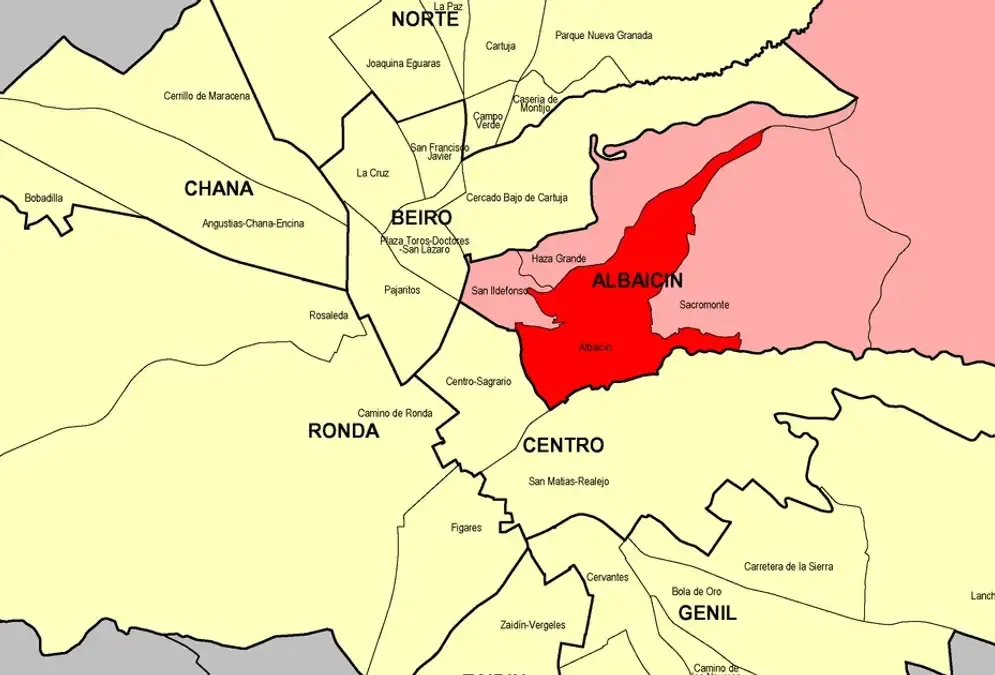
The workshop trail takes two to three hours. It runs from the Alcaicería (the old silk market adjacent to the Cathedral), up through Calle Elvira and into the Albaicín. Every craft type is available in tourist grade and artisan grade. Knowing the difference saves money and means what you carry home is worth carrying.
Taracea: Granada's marquetry art
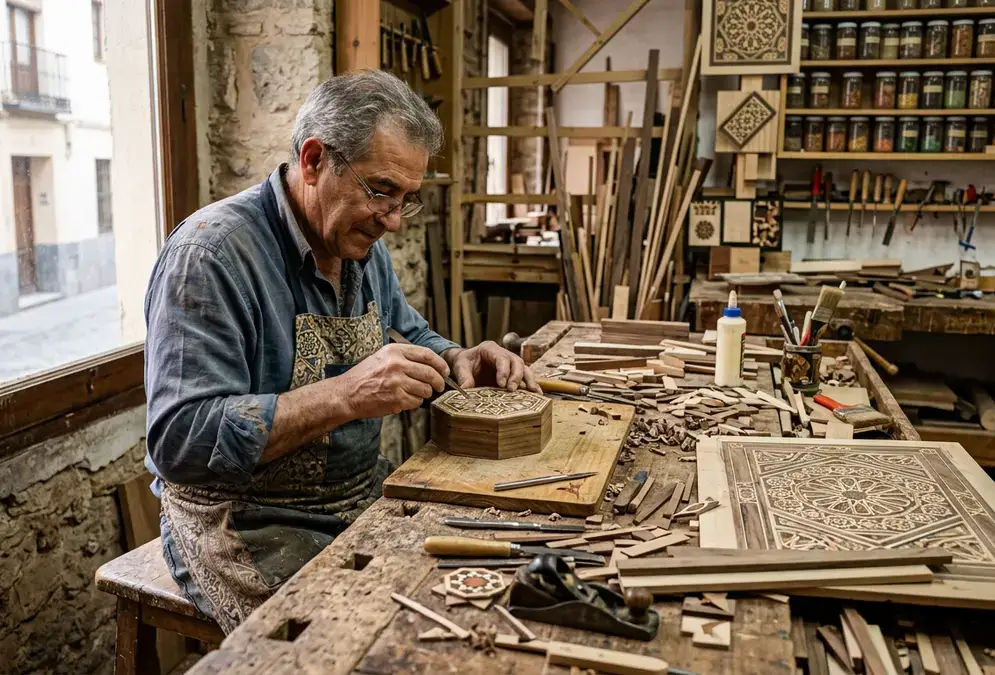
The word comes from the Arabic tarsi, meaning inlay. Introduced to Spain by Arab craftsmen, the technique reached its peak in 12th-century Córdoba before the Nasrid court in Granada developed it into something more exacting. The principle is simple: thin geometric pieces of contrasting materials (walnut, ebony, mahogany, mother-of-pearl, bone, brass) are cut and fitted together into repeating Islamic star patterns with no adhesive visible between them. The complexity is in the mathematics. The patterns are based on the same geometric principles that govern the tilework and plasterwork in the Alhambra palaces.
The Laguna family workshop on Calle Real de la Alhambra has been producing taracea for four generations. The workshop is worth visiting for the process alone: craftsmen use hand tools to cut pieces measured in millimetres, assembling panels that will go into boxes, backgammon sets, chess boards, and furniture. Small boxes start around €50–150 for genuine handmade pieces; larger furniture runs to €300–2,000. Tourist-grade taracea from the Alcaicería stalls sells for €10–50 and is manufactured industrially, often overseas.
To tell them apart: authentic taracea has no visible gaps between pieces, complex star or polygon patterns, and slight individual variation between items. Mass-produced pieces have misaligned joints, simple repetitive patterns, and a plasticky sheen where synthetic materials have replaced mother-of-pearl. Run your thumbnail along the edge of a piece — hand-finished work will feel smooth and distinct at each boundary; cheap work feels rough or slightly raised where glue has been used.
Fajalauza ceramics: the pomegranate pottery
Fajalauza is Granada's own ceramic tradition, documented since 1517 when a potter filed a tax complaint in the Albaicín neighbourhood. The name comes from the Fajalauza Gate, around which the pottery workshops clustered through the 19th century. The style is immediately recognisable: a low-tin glaze in blue-grey or green tones, decorated with hand-painted pomegranates, birds, and floral motifs. The pomegranate is Granada's city symbol — granada in Spanish — and it appears on virtually every piece.
The craft's history is one of slow erosion. After 1975, industrial dyes changed the colour palette, replacing the traditional muted tones with brighter artificial blues. Most of the historic Fajalauza factories have since closed or converted to industrial production. One exception: the Cecilio Morales workshop in the Albaicín, which continues to produce using traditional techniques. Small plates and bowls from Cecilio Morales run €20–60; tourist reproductions in the Alcaicería sell for €5–25 and are easy to distinguish — the colours are too bright and the brushwork too mechanical.
The authentic pieces have softer, slightly uneven colour and visible brushstroke variation in the painted motifs. Each bird or pomegranate is slightly different from the next. On mass-produced pieces, the designs are printed or applied by stamp, and the colour saturation is uniform across every item on the shelf. Pick up a plate and look at the glaze edge — hand-glazed work thins slightly toward the rim; machine-dipped pieces are uniform throughout.
Leather, silk and metalwork
Granada's leather tradition predates the Nasrid Kingdom. The Alcaicería itself was originally the silk market, but leather artisans worked the surrounding streets throughout the medieval period. Today, leather goods in the Alcaicería range from machine-made tourist items to hand-tooled pieces with Moorish geometric patterns embossed by hand. The tell is the smell: real leather has a distinctive hide scent; bonded leather smells synthetic. Hand-stitched seams are slightly irregular — if every stitch is perfectly uniform, it was done by machine. Authentic wallets run €15–50; belts €25–80.
Silk declined after 1492 when the Reconquista disrupted Granada's position on the Mediterranean silk route. The Alcaicería stalls still sell silk textiles, though most are imports. To distinguish hand-embroidery from print: run a fingertip across the design. Raised thread means hand-embroidered; a flat surface means printed. Authentic hand-woven pieces show slight variation in thread tension — consistent machine-woven textiles do not.
For copper and brass, Calderería Nueva is the main concentration. The tea houses and craft shops there sell hand-hammered lamps, tea sets, and trays. Authentic metalwork is heavy and shows hammer marks on the surface — visible irregularities in the beaten metal that catch the light differently from different angles. Pierced copper lamps cast complex shadow patterns; machine-stamped versions cast flat, repetitive ones. Medium lamps from genuine artisans run €60–200; tourist versions €10–50.
How to spot authentic handmade pieces
The general principle across all craft types: handmade objects are imperfect in ways that mass-produced objects are not. Slight variation, individual character, evidence of tool marks, the smell of natural materials — these are what you are paying for, and they are what give pieces value over time.
Practical rules for the Alcaicería: take your time. Compare the same item across three stalls before buying. Ask where it was made — shops selling genuine Granada-made work usually know, and the answer is specific (a family name, a neighbourhood). Shops selling imports usually give vague answers or change the subject. Pieces without any maker's mark or workshop identification are almost certainly imported.
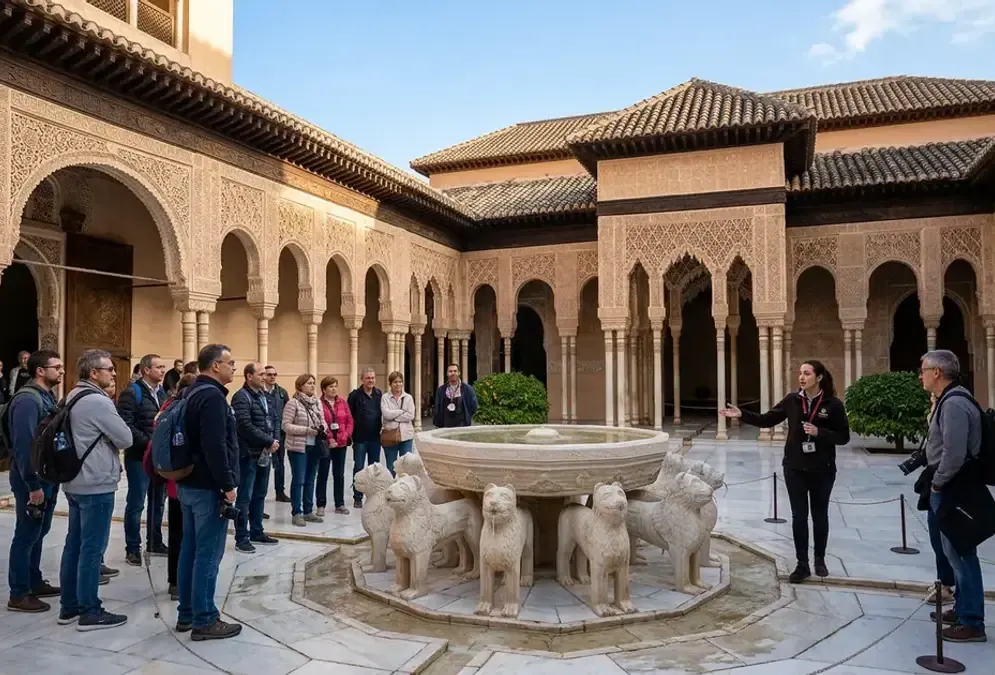
The Alhambra Museum within the palace complex displays historic taracea panels, Fajalauza ceramics, and Nasrid metalwork from the 13th–15th centuries. Visiting before the market trail gives you a calibration point — you will know what the geometric patterns are supposed to look like at their best, which makes the gap between authentic workshop pieces and tourist-grade imports immediately obvious.
Budget around two to three hours for the full trail: start at the Alcaicería for orientation, walk Calle Elvira for leather and textiles, then head up into the Albaicín for the Cecilio Morales pottery workshop and the Laguna family's taracea on Calle Real de la Alhambra. Most workshops are open Monday to Friday 10:00–19:00 with a lunch break around 14:00–17:00. Come on a weekday if you want to see craftsmen working; Saturdays are busier and some workshops are closed by early afternoon.