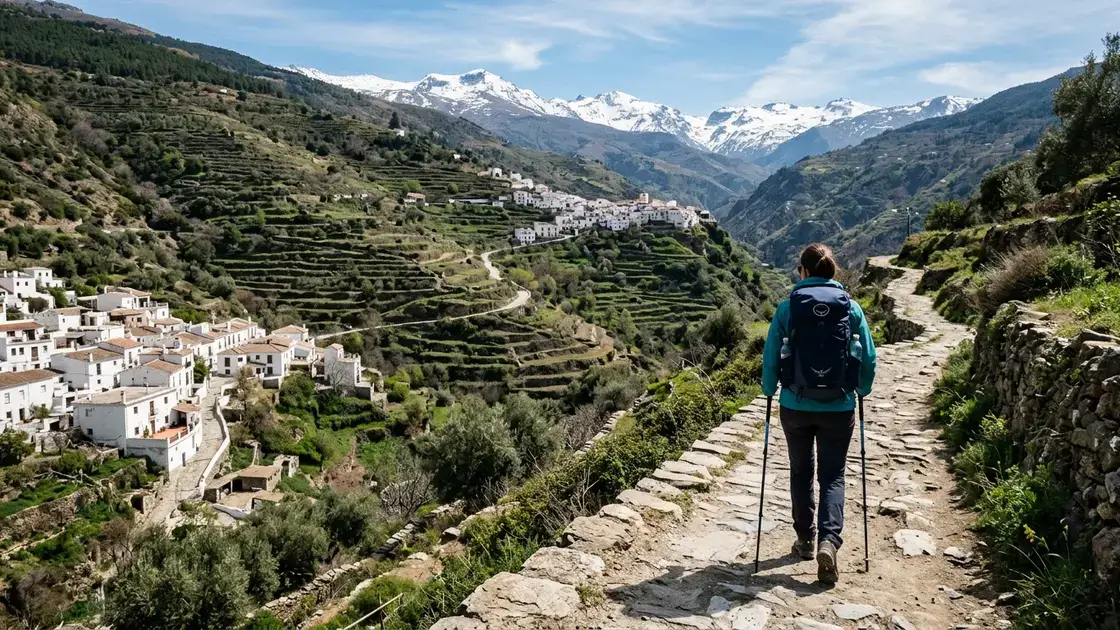
Hiker on a stone path between the white village of Pampaneira and Capileira in the Poqueira gorge, Alpujarras, with terraced hillsides and Sierra Nevada peaks behind
Guided Tour

Alpujarras Day Hike: The Poqueira Gorge and White Village Loop

Full day, 8–10 hours from Granada including transport
Guided tours: available daily or most days April–October; check operators for current schedule. Self-guided: year-round, start by 09:00 at weekends.
Granada city centre pickup point confirmed at booking. Self-guided: Pampaneira village car park.
All activities

The Poqueira gorge cuts into the southern Sierra Nevada and holds three white villages stacked on its walls: Pampaneira at roughly 1,050 metres, Bubión in the middle, Capileira at 1,440 metres. The path connecting them runs along irrigation channels that Moorish farmers cut before the Reconquista. This is not a hike you do for the terrain alone. The villages, the craft shops, the local markets, and the views back down the gorge toward the coast make it as much a cultural excursion as an outdoor one.

The Poqueira loop: what the walk covers

Most guided day trips from Granada follow a version of the same core loop: arrive in Pampaneira by mid-morning, walk the gorge path north and upward to Capileira, stop for lunch in one of the upper villages, and return via a different trail or by road. The walk between Pampaneira and Capileira covers roughly 8 km of mostly ascending path, with altitude gains of around 400 metres across the two villages. The terrain is dry dirt and stone, occasionally paved through village streets, with open views across the Barranco de Poqueira on the descent sections.

Pampaneira is the first stop and the most visited of the three. Its main square holds a small crafts market most weekends where you'll find jarapa (the handwoven striped rugs the Alpujarras have produced since the Moorish period). The dye colours are local: earthy reds and ochres for much of the year, brighter wool in tourist season. Bubión, the middle village, is quieter. Capileira, the highest, rewards the extra climb with views toward Mulhacén (3,479 metres, the highest peak in mainland Spain) on clear days.

The paths between the villages are part of the GR-7 long-distance route, the same trail system that crosses from Tarifa to Greece. You won't feel you're on a long-distance path, but the waymarking is consistent.

What's included on a guided trip

Guided day trips from Granada typically cost €45–70 per person and include return transport from Granada city centre, a guide for the walking section, and a cultural stop at one or more of the villages. Lunch is usually not included; guides direct groups to local restaurants in Capileira or Bubión where the menú del día runs around €12–15.

The format varies by operator. Some tours add a stop in Órgiva, the largest market town in the western Alpujarras, for a weekly market visit (Thursdays are the main market day). Others focus purely on the walking loop between the three Poqueira villages. If you want the jarapa craft context and the market atmosphere, ask specifically before booking.

For groups with mixed fitness levels, the day structure usually means the walk is optional. You can take the road between villages or wait in Pampaneira while stronger walkers push to Capileira. Guides accommodate this without making it a problem.

Going self-guided: logistics by car

If you drive, the Alpujarras are straightforward to reach from Granada. Take the A-44 south toward Motril, then the A-348 east into the valley. Pampaneira is 68 km from Granada city centre, around 75 minutes by car. Parking in the village is limited; arrive before 10:00 at weekends in spring and summer.

Self-guided walkers can follow the same Poqueira loop without a guide. The GR-7 signage through the gorge is adequate for anyone with basic navigation confidence. The route is clear in good weather. Carry water from Granada or Pampaneira; there are no reliable water points on the gorge trail itself. Budget 4–5 hours for the full loop to Capileira and back, or one way if you arrange a pickup in the upper village.

Horse riding in the Alpujarras operators based near Lanjarón cover different parts of the valley on bridle paths, worth considering if your group includes people who can't manage the walking loop.

When to go and what to expect

Spring (mid-March to May) and autumn (September to October) are the right seasons. In April and early May the terraced fields below the villages are green, the almond trees are finished blooming but the air still carries some of that coolness, and the Sierra Nevada snowpack is visible above Capileira on most mornings. September brings clear skies and dry trails after summer.

Summer is hot at the lower altitudes, but the gorge itself stays relatively cool in the mornings. Start early if you go in July or August; by midday the exposed sections of the path between villages get uncomfortable. Winter hiking in the lower Poqueira is possible, though snow closes the upper paths and Pampaneira and Bubión can feel very quiet outside of weekends.

In Trevélez, further east along the valley, the jamón serrano cured at altitude is worth the detour on any Alpujarras day out. The jamon serrano Trevélez guide covers which producers to visit and what to look for. Trevélez sits above 1,470 metres, and the altitude curing produces a different texture and salt level than lowland ham.
Highlights

  • Poqueira gorge loop linking Pampaneira, Bubión and Capileira: three white villages stacked up a single gorge
  • Ancient Moorish irrigation paths (part of the GR-7 route) with 400 metres of altitude gain between villages
  • Jarapa handwoven rug markets in Pampaneira, a craft tradition dating to the Moorish period
  • Views toward Mulhacén (3,479 m, mainland Spain's highest peak) from Capileira on clear days
  • Optional stop in Órgiva for the Thursday market, the main commercial town of the western Alpujarras
  • Guided day trips from €45 including transport from Granada; self-guided option for drivers

Included

  • Return transport from Granada city centre (guided tours)
  • Professional hiking guide for the gorge section
  • Cultural stops at one or more of the Poqueira villages
  • Basic cultural orientation to the villages and Moorish heritage

Not included

  • Lunch (menú del día in the villages runs around €12–15)
  • Water and snacks (buy in Pampaneira or bring from Granada)
  • Personal travel insurance
  • Jarapa rugs or artisan purchases

Practical information

Availability

Year-round. Best mid-March to May and September to October. Upper gorge paths can be snow-closed December to March.

Languages

Spanish, English

Group size

Guided tours typically 8–14 people; private tours available on request

Good to know before booking

  • Moderate fitness: 8 km of mostly ascending trail with 400 m elevation gain to Capileira
  • Hiking boots or trail shoes with grip (dry dirt and stone paths, occasionally steep)
  • Bring at least 2 litres of water; no reliable water points on the gorge trail
  • Suitable for children aged 10 and over who are comfortable with sustained uphill walking
  • Guided tours accommodate mixed fitness; slower walkers can remain in the lower village while others hike up
  • Not suitable for pushchairs or people with significant mobility limitations on the gorge path

Prices & Booking

From €45

Guided tours: available daily or most days April–October; check operators for current schedule. Self-guided: year-round, start by 09:00 at weekends.

Tags

hiking alpujarras white villages poqueira day trip outdoor cultural sierra nevada moorish heritage trekking

Frequently asked questions

How difficult is the Alpujarras hiking day trip?

Moderate. The main Poqueira loop between Pampaneira and Capileira covers around 8 km with roughly 400 metres of altitude gain. The paths are dirt and stone, occasionally steep but not technical. Hiking boots or trail shoes with grip are needed. Most reasonably fit adults manage it comfortably in 4–5 hours of walking. Guided tours are structured to accommodate mixed fitness levels, with the option to stay in the lower village if the climb to Capileira is too much.

How much does an Alpujarras hiking day trip from Granada cost?

Guided day trips typically run €45–70 per person, including return transport from Granada and a guide for the walking section. Lunch is not included; expect to pay €12–15 for a menú del día in one of the villages. Self-guided trips by car cost nothing beyond fuel, parking (free in the villages), and lunch. The gorge trail itself has no entry fee.

How do you get from Granada to the Alpujarras?

By car, take the A-44 south toward Motril and then the A-348 east. Pampaneira is about 68 km from Granada, roughly 75 minutes. ALSA buses run from Granada bus station to Órgiva and occasionally to the Poqueira villages, but the schedule is limited and does not always align with hiking start times. For the day-trip format, guided tours with included transport or a rental car are the practical options.

What is the best time of year for an Alpujarras day hike?

Spring (mid-March to May) and autumn (September to October) are the best seasons. In April and May the terraced farmland below the villages is green, temperatures on the trail are manageable, and snow is still visible on the peaks above. September and October bring clear air and cooler afternoons. Summer works if you start early: the gorge stays cooler than the surrounding plains in the morning. Winter hiking is possible in the lower Poqueira but snow can close the upper paths.

Can I visit the Alpujarras white villages without hiking?

Yes. Pampaneira, Bubión, and Capileira are all accessible by road, and many visitors drive between them rather than walk the gorge trail. The villages have craft shops, local restaurants, and jarapa rug markets that are worth visiting regardless of whether you walk. Some guided day trips are structured to include both a short walk and village time, so you see the landscape without committing to the full gorge loop. The Órgiva Thursday market is another day-trip option that requires no hiking.

Further reading

Sources