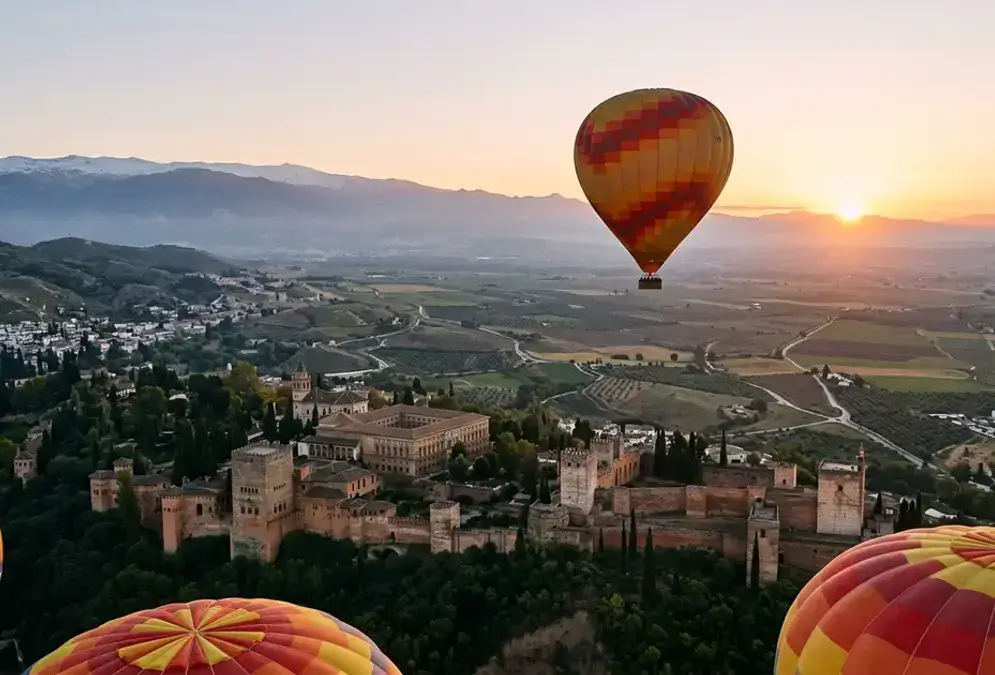
The Alhambra looks different from 600 metres. The red towers shrink against the Sierra Nevada behind them, the Albaicín becomes a dense patchwork of white across the hillside, and the city's streets, so narrow and confusing on foot, resolve into a legible grid. From a hot air balloon at dawn, Granada makes a kind of sense it doesn't on the ground.
The flight itself
Glovento Sur has been running balloon flights out of the Vega de Granada since 1997. They are the long-established name here, operating from a pickup point near San Miguel Alto. The balloon takes off from the flat agricultural land west of the city, typically around 08:00 depending on the season, and rises into the morning air above the plain.
The flight lasts around one hour. The altitude varies with wind conditions but often reaches 500–600 metres above the valley floor. At that height, the Alhambra sits at roughly eye level on its promontory; the roofline of the Albaicín extends south toward it; the snow-capped peaks of the Sierra Nevada fill the southeastern horizon. The cathedral dome is visible in the city centre, and on clear mornings the Vega stretches west toward Loja, all fertile farmland and irrigation channels.
Balloons do not have engines. The pilot controls altitude but the horizontal track is governed by the wind, which means no two flights follow the same path. You might drift south over the olive groves, or east toward the city's edge. Landing is wherever the wind deposits you on the valley floor, followed by a short drive back. This unpredictability is part of it.
Before and after
The full experience runs three to four hours including transfer, preparation, and what happens after landing. Glovento Sur ends the flight with a traditional breakfast at an olive mill, typically in one of the farms just outside the city. Expect fresh bread, local olive oil pressed from the valley's own trees, and a glass of cava. The cava is traditional at Spanish balloon landings, a small ritual that goes back decades regardless of the hour. You also get a flight certificate, which is either charming or unnecessary depending on your view of such things.
Pickup is from a central point in Granada; confirm the exact location when you book. The return transfer drops you back in the city, typically by late morning, leaving the rest of the day free.
When to go
The pilot checks wind speed and direction before every flight. Most cancellations happen in summer, when afternoon thermals make conditions unstable and morning winds unpredictable. October through March is the preferred season, with cool, dry air and calm morning winds. Weekend slots fill faster than weekdays. Book at least a week ahead in autumn; in peak autumn weekends, two weeks is safer.
Dawn is non-negotiable. The flight takes place in the first hour of daylight because that is when the air is most stable. This is not an activity for people who need a slow morning.
Practical details
Glovento Sur charges around €58 per person, though rates vary seasonally. Check their website or call +34 958 290 316 before assuming a fixed price. No special fitness is needed; passengers stand in the basket and are lifted gently off the ground. The basket walls reach chest height. Children are generally welcome but confirm minimum age directly with the operator.
Photographers should bring a wide lens. The panorama at altitude is too broad for anything tight, and the light at sunrise changes fast. The first fifteen minutes aloft are the best window for shooting east toward the Alhambra, while the sun is still low and the angle picks out the texture of the red towers and the white walls of the quarter below.