Riverside guide
Paseo de los Tristes
The riverside walk beneath the Alhambra walls. Funeral processions once passed this way; now it is the most romantic kilometre in Granada.

Written by
James Walker Seven years resident in Granada. Specialist in Nasrid architecture, Al-Andalus history, and Andalusian walking routes.
Published
Walk east from Plaza Nueva along the left bank of the Río Darro and the city changes register. The main streets drop away. The road narrows to a single lane between 16th-century facades and the river below. The Alhambra appears above the roofline — walls, towers, and the Comares Tower — and stays in view for the next kilometre and a half. This is the Carrera del Darro running into the Paseo de los Tristes, and it is a legitimate argument for visiting Granada even if everything else were mediocre.
The promenade's official name is Paseo del Padre Manjón, in honour of a 19th-century priest who founded a school for Sacromonte's poor children. The older name — Paseo de los Tristes, Walk of the Sad Ones — comes from the funeral processions that historically passed this way to the cemetery behind the Alhambra hill. Both names are in common use. The feeling the older name implies, vaguely melancholy and very beautiful, is still accurate.
The Carrera del Darro
The route begins at Plaza Nueva with the Alhambra directly above. The Carrera del Darro is the first section: a narrow road squeezed between the river on the left and a terrace of Renaissance buildings on the right. Medieval bridges cross the Darro at intervals — the Puente de Cabrera and Puente de la Espinosa, both stone, both with good sight lines up to the palace walls.
The Bañuelo Arab baths are on the right-hand side roughly halfway along — an 11th-century hammam, the best-preserved Moorish bathhouse in Spain, with horseshoe arches and star-pierced skylights. Entry is around €2.50 and takes 15–20 minutes. The combination of the baths and the promenade makes a natural half-day circuit.
The Casa de Castril, a Renaissance palace fronted by a Plateresque doorway, holds the Archaeological Museum of Granada. At the end of the Carrera del Darro, the road widens at the Casa de las Chirimías — a 17th-century building named after the wind instruments once played from its balconies. This is where the Paseo de los Tristes proper begins.
The promenade and its monuments
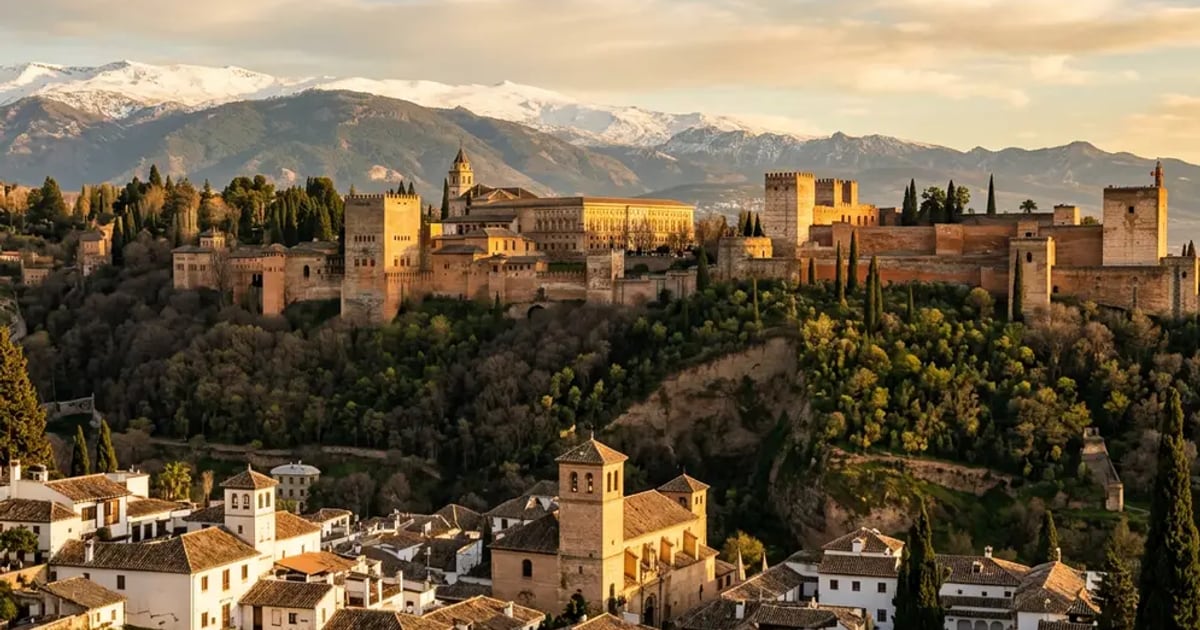
Beyond the Casa de las Chirimías the road opens into an esplanade along the river. The buildings are set back. The Darro is to your left, running between stone banks. The Alhambra fills the skyline ahead — the wall circuit, the Alcazaba towers, and the bulk of the Comares Palace at the highest point. On a clear morning in spring, with the Sierra Nevada snowline visible to the east, the view from this promenade is one of the better-composed in Andalusia.
The river's name derives from the Latin aurum — gold — reflecting its historical importance as a source of alluvial gold during Roman times. The Arabs called it Hadarro; the Christians modified it to Dauro, which became Darro. The river is small now, its flow reduced by upstream irrigation, but it has shaped the gorge that makes this walk possible: the deep cutting below the Alhambra hill that keeps the palace walls high above the city.
The promenade is fully pedestrianised from the Casa de las Chirimías eastward. Café tables appear on the esplanade in spring and summer. The walk from Plaza Nueva to the end of the Paseo takes 30 minutes at a relaxed pace; from there the path continues into the lower Sacromonte cave district.
Alhambra views from below
Most photographs of the Alhambra are taken from the Mirador de San Nicolás in the Albaicín, looking across the gorge. The view from the Paseo de los Tristes is the inverse: looking up at the walls from below, with the Comares Tower almost directly above you and the palace mass occupying the entire upper third of the view.
This angle shows the defensive purpose of the site clearly. The Alhambra was built on a ridge, but from the Albaicín it reads as a palace; from below it reads as a fortress. The walls drop sheer to the gorge. The towers are positioned to cover the approach from the city. The early-morning light (east-facing, catching the towers first) and the late-afternoon light (west-facing, warming the stone) are both good; midday glare flattens everything.
In the evening the Alhambra is illuminated from below. The promenade cafés fill up and the towers appear above the lanterns and the river noise. The combination of the lit palace, the dark gorge, and the reflected light in the Darro is the visual shorthand for "Granada at night" in most travel photography.
Cafés and bars along the route
The Carrera del Darro and Paseo stretch has cafés at intervals, mostly small terrace bars that do coffee, wine, and Granada's free tapas. The better-known spots on the Carrera del Darro itself include tea rooms on the side streets toward the Albaicín — Calle Calderería Nueva, running uphill from the Carrera, is Granada's tea-house row, with teterías serving Moroccan mint tea and pastries in tiled interiors.
On the Paseo del Padre Manjón esplanade, the outdoor terraces face the river and the Alhambra. In spring and summer the café culture here is more relaxed and less tourist-oriented than the restaurants near the cathedral. Order a glass of wine and a tapa and the bar will bring a plate. That mechanic, explained in full in the free tapas guide, works the same way here as anywhere else in Granada.
The Hammam Al Ándalus is a 5-minute walk from the start of the Carrera del Darro on Calle Santa Ana. The combination of an afternoon walk along the promenade and an evening hammam session makes for an unusually coherent half-day in this part of the city.
Walking route: Plaza Nueva to Sacromonte
1
Plaza Nueva
Starting point. The Church of Santa Ana is on your right as you enter the Carrera del Darro. The Alhambra appears above the building line almost immediately.
2
Bañuelo Arab baths (5 min)
On the right-hand side of the Carrera. 11th-century hammam with horseshoe arches. Entry ~€2.50; 15 minutes inside is enough. Skip if you have visited before.
3
Casa de Castril (10 min)
Renaissance palace with Plateresque doorway. Houses the Archaeological Museum. Worth noting the door even if you do not go in.
4
Paseo del Padre Manjón esplanade (15 min)
The road widens. Café terraces on the left. The best direct views of the Alhambra from below. This is the section to linger in.
5
Cuesta del Chapiz fork (30 min)
At the eastern end: uphill leads to the Albaicín via Cuesta del Chapiz; continuing straight takes you into lower Sacromonte. Either direction is valid depending on how much time you have.
The full walk from Plaza Nueva to the Cuesta del Chapiz fork is approximately 1.5 kilometres and takes 30–45 minutes. Add another 30 minutes for the Bañuelo, and allow time for a café stop if you are doing the esplanade properly. The route is entirely flat — no significant elevation changes between Plaza Nueva and the end of the Paseo.
Frequently asked questions
Frequently asked questions
What is the difference between the Carrera del Darro and the Paseo de los Tristes?
They are consecutive sections of the same riverside route. The Carrera del Darro is the narrow street running from Plaza Nueva to the Casa de las Chirimías — a tight, shadowed road lined with 16th-century buildings and small bridges over the Darro. The Paseo de los Tristes (officially Paseo del Padre Manjón) begins where the road widens into an esplanade at the Casa de las Chirimías, running east toward the Sacromonte caves. Most people walk both in a continuous 45–60 minute stroll.
Why is it called the Paseo de los Tristes?
The name — 'Walk of the Sad Ones' — refers to funeral processions that historically passed this way en route to the cemetery behind the Alhambra. The official name is Paseo del Padre Manjón, honouring Andrés Manjón, a 19th-century priest who founded a school for poor children in the adjacent Sacromonte neighbourhood. Both names are in common use; locals tend to use the older historic name.
Is the Paseo de los Tristes free to visit?
Entirely free and open at all times. The promenade is a public street with no entry fee or ticket. The Bañuelo Arab baths along the Carrera del Darro do have a small admission fee (around €2.50), but the exterior can be viewed without entering.
What is the best time of day to visit?
Early morning (7–9 AM) for photography: soft light, few people, and the Darro sometimes reflecting the Alhambra walls in the water. Evening (17:00–20:00) for atmosphere: the cafés fill up, the Alhambra towers go golden, and by nightfall they are illuminated against the dark. Midday in summer is the least pleasant — the stone promenade heats up quickly and the glare washes out the Alhambra views.
How does the Paseo de los Tristes connect to the Albaicín and Sacromonte?
Multiple paths climb uphill from the promenade. From the Carrera del Darro, the Cuesta del Chapiz and Cuesta de la Victoria lead into the Albaicín. At the eastern end of the Paseo, the path continues into the lower Sacromonte cave district. A walk from Plaza Nueva through the Carrera del Darro, along the Paseo, and up to the Mirador de San Nicolás via the Albaicín is one of the standard half-day circuits in Granada.