4–5 hours total
Timed Nasrid entry · One-way route
Alhambra self-guided tour: the complete route
The Nasrid Palaces timed slot is the fixed point. Build everything else around it. This guide walks you through each section in order — Alcazaba, Mexuar, Comares, Court of Lions, Generalife — with timing, what to look for in each room, and what to cut if you are running short.
Seven years resident in Granada. Specialist in Nasrid architecture, Al-Andalus history, and Andalusian walking routes.
Published
The Alhambra self-guided visit has one constraint that drives every other decision: the Nasrid Palaces timed entry slot. Everything else — which section first, how long in the Alcazaba, whether to eat before or after — is planned around that fixed point.
This guide takes you through the complete route in the order that works: Alcazaba first, then the Nasrid Palaces in walking sequence from the Mexuar through the Comares to the Lions Palace, then the Partal Gardens, then the Generalife. Total time: 4 to 5 hours at a comfortable pace, 3 hours at minimum.
The route and the timed entry constraint
The three main sections — Alcazaba, Nasrid Palaces, and Generalife — are arranged west to east across the Alhambra hill. The Alcazaba is at the far western end, closest to where you enter. The Nasrid Palaces are in the centre. The Generalife is a separate hill to the east, reached by a path through the upper gardens.
Section
Time
Entry
Alcazaba
45 minutes
Flexible — any time during opening hours
Nasrid Palaces (Mexuar → Comares → Lions)
90–120 minutes
Timed slot only — 30-minute entry window, strictly enforced
Partal Gardens
15–20 minutes
Flexible — exit route from Nasrid Palaces
Generalife
45–60 minutes
Flexible — any time during opening hours
Plan around your Nasrid slot, not around arrival time
Your Nasrid Palaces entry slot is the one time you cannot change. If your slot is 8:30 AM, go directly to the Nasrid Palaces on arrival and visit the Alcazaba afterwards. If your slot is 10:00 AM or later, visit the Alcazaba first. Walk from the main Alhambra gate to the Nasrid Palaces checkpoint takes approximately 10 minutes on a clear path; allow 20 minutes if it is busy.
Alcazaba: 45 minutes
The Alcazaba is the oldest part of the Alhambra, its military core. Construction began in the 9th century on a promontory at the western end of the hill; Muhammad I extended and fortified it after 1238. It is the section most visitors rush past to reach the palace, which is a mistake — the Alcazaba is genuinely interesting, less crowded than the Nasrid Palaces, and physically engaging in a way the palaces are not.
Torre de la Vela — the unmissable climb
The Watchtower is the highest point in the Alcazaba. The climb involves four vaulted levels of narrow stairs and opens onto a rooftop terrace with an unobstructed view: Granada's historic centre below, the Albaicín hill directly north, and the Sierra Nevada behind the city. On a clear winter morning the mountains look close enough to touch. The view alone justifies the Alcazaba visit. Allow 15 minutes for the climb and the view; more if you are photographing.
Barrio Castrense — the guards' quarter
The excavated foundations inside the fortress walls reveal the floor plan of the residential quarter where the Alhambra's elite guard lived with their families. Archaeologists have uncovered between ten and seventeen house foundations, a hammam, a cistern, and a communal kitchen. The domestic scale is quietly strange — this was a functioning neighbourhood inside a military fortress. The Jardin de los Adarves, a long 17th-century garden on the southern rampart, is one of the quieter spots on the entire hill.
Torre del Homenaje — the military keep
The 26-metre command tower at the south side of the Alcazaba. Less impressive than the Torre de la Vela but historically significant as the military nerve centre. The walls here are rammed earth reinforced with lime concrete — the same construction technique Muhammad I used when building the Alhambra from a Zirid-era fortress. The material is visible where sections have been left unrestored.
The Alcazaba has no bathroom facilities. Use the facilities near the Puerta del Vino gate before entering, or at the Charles V Palace area after the Alcazaba and before the Nasrid Palaces.
Nasrid Palaces: 90–120 minutes
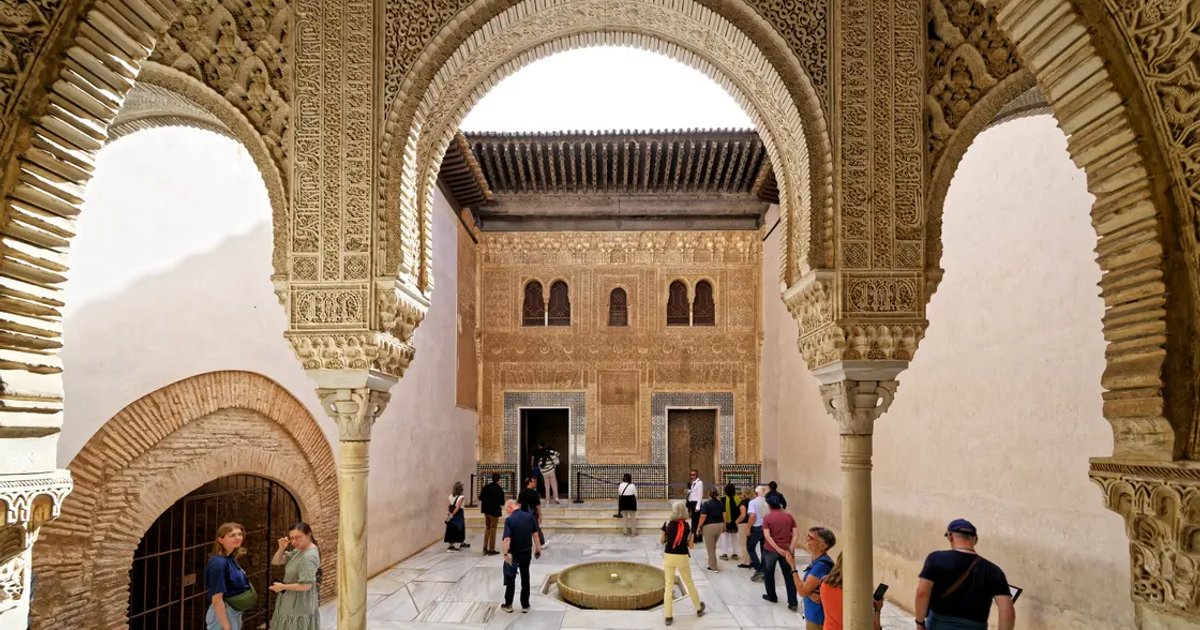
The Nasrid Palaces are three interconnected palace complexes built across two centuries of Nasrid rule. They move from the most public and administrative (the Mexuar) through the official royal residence (the Comares) to the private harem quarters (the Lions Palace). The quality and density of the decoration increases as the spaces become more private — the sultans spent their most elaborate architectural investment where only they and their closest circle would see it.
One-way route — no backtracking
The Nasrid Palaces operate one-way flow throughout. You move from the Mexuar through the Comares and into the Lions Palace without the option to return to a previous room. If you miss something, you cannot go back. Read this section before you enter so you know what to look for in each room as you pass through it.
Mexuar and the approach
The Mexuar is the first section you enter. Originally an administrative and justice hall where officials heard petitions, it was substantially modified after 1492 when the Catholic Monarchs converted part of it into a chapel. The Mexuar prayer chamber — the mihrab niche indicating the direction of Mecca — survives from the Nasrid period in the far wall. The tilework dado and the carved plasterwork above it are original; the ceiling is a later reconstruction.
The Mexuar courtyard immediately after the main hall is a small transitional space with a central fountain. Pause here before moving into the Comares section — this is one of the last uncrowded moments before the route narrows through the main ceremonial spaces.
The Mexuar receives heavy footfall as the first section of the palace. Move through it steadily and plan your time for the Comares and Lions Palace sections, which are architecturally richer and tend to be where visitors slow down most.
Palacio de Comares and the Court of Myrtles
The Comares Palace was the official royal residence, built primarily under Yusuf I (1333–1354) and Muhammad V (1354–1391). It is organised around the Patio de los Arrayanes — the Court of Myrtles — a 34-metre rectangular pool with myrtle hedges running along both sides and arching water jets above the water surface. The Comares Tower rises from the north end.
Court of Myrtles — the reflecting pool
The pool is 34 metres long and about 7 metres wide. At the southern short end, crouch to water level and the Comares Tower doubles in the water — this is the photograph everyone brings home. Afternoon light from about 3:00 PM warms the tower facade and improves the reflection quality. The myrtle hedges are clipped low and frame the view without obstructing it. The pool surface is close enough to ground level that the reflection reads clearly from standing height too, but it improves significantly from a crouched position.
Hall of the Ambassadors — the largest room in the palace
This is the throne room, the official audience chamber where the sultan received foreign diplomats and made state decisions. At 23 metres high, the cedar wood dome is the largest and most complex in the Alhambra. The dome is constructed from thousands of interlocking pieces of cedar wood in a pattern representing the seven heavens of Islam — the sultan occupied the physical centre of the cosmological order during audience. The tilework dado runs around the full perimeter. The inscriptions on the walls are poems and Qur'anic verses asserting the legitimacy of Nasrid rule. Stand in the centre and look up.
The baths of the Comares Palace are accessible from the main courtyard in a lower level — a series of vaulted rooms with star-shaped skylights that let in filtered light. They are often passed quickly; allow 5 minutes to walk through them if the one-way route permits it.
Palace of the Lions: the private quarters
The Lions Palace was built by Muhammad V in the second half of the 14th century as the private harem section of the Alhambra. It is the most elaborately decorated part of the complex — the sultans reserved their finest craftsmen for the spaces no visitor would ordinarily see. The transition from the Comares into the Lions Palace is a shift in register: the Comares is ceremonial and formal; the Lions Palace is dense, intricate, and designed to be experienced at close range.
Court of Lions — the central courtyard
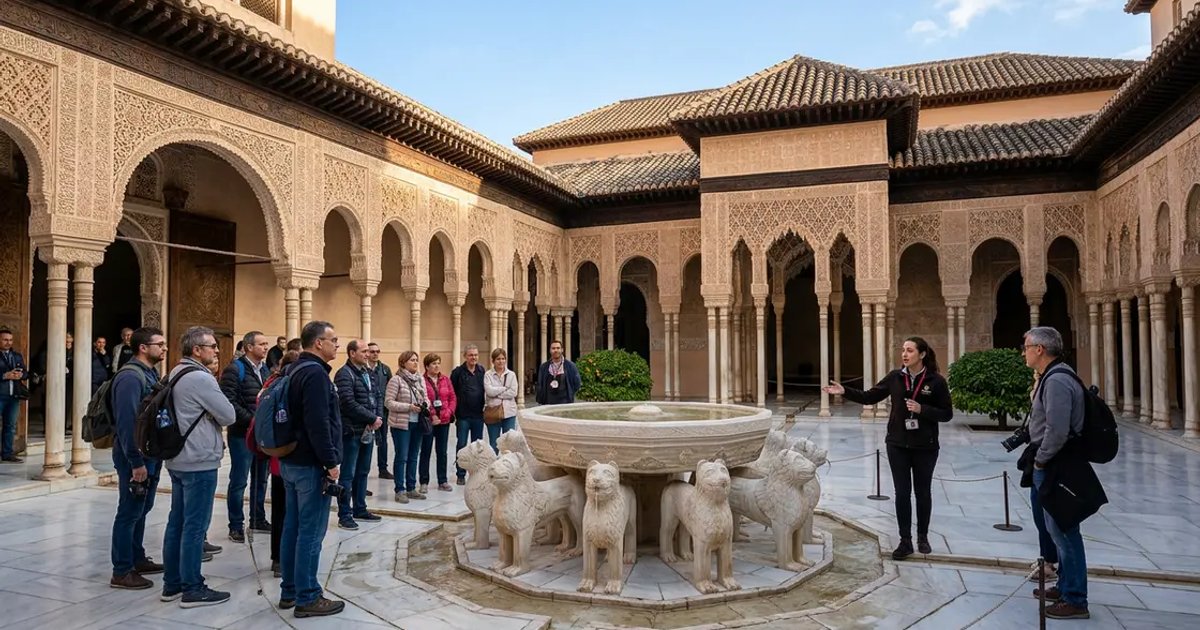
The Patio de los Leones has 124 marble columns arranged in a colonnade around the central fountain. The fountain is supported by 12 marble lions — each slightly different, carved in white marble in the 11th century, predating the palace itself by several centuries (Muhammad V incorporated an older fountain). The court was designed so that water flowed outward from the central basin through channels cut into the marble floor, distributing water to each of the four main halls. The columns form a visual forest from any angle; position yourself at one of the four pavilion openings for the clearest composition.
Hall of Two Sisters — the stalactite ceiling
The Sala de las Dos Hermanas has the most complex muqarnas stalactite ceiling in the Alhambra — approximately 5,000 individual geometric cells arranged in a honeycomb of carved plaster. Point your camera straight up and shoot wide. The hall is named for the two white marble floor slabs set into the pavement, which are identical in size. The double meaning is intentional: two sisters as floor tiles, two sisters as competing beauties in palace poetry inscribed on the walls above. Ibn Zamrak's famous poem runs around the upper friezes in Arabic cursive.
Hall of the Abencerrajes — the legendary stain
The Sala de los Abencerrajes mirrors the Hall of Two Sisters on the south side of the Court of Lions. The octagonal stalactite dome rises above an octagonal fountain basin. The story attached to this room — that Sultan Muhammad XII (Boabdil's predecessor) had the Abencerrage noble family beheaded here and that the rusty colour in the fountain basin is their blood — has been repeated for five centuries. The basin colour is almost certainly mineral staining from the water. The architectural quality of the stalactite dome is genuine.
Hall of the Kings — the leather paintings
The Sala de los Reyes at the eastern end of the Court of Lions has three vaulted alcoves whose ceilings are painted on stretched leather — an unusual technique for Nasrid architecture. The paintings show courtly scenes including what may be portraits of Nasrid rulers, an extraordinary exception to Islamic convention against figurative representation. The paintings are attributed by some scholars to Christian artists working in the Nasrid court; the attribution remains debated.
Post-palace section and Partal Gardens
Exiting the Lions Palace takes you into a transitional section where Christian-era additions from the 16th century appear alongside surviving Nasrid structures. The Rooms of Carlos V (Habitaciones de Carlos V) are a Renaissance apartment inserted into the Alhambra after 1492, used briefly by the Holy Roman Emperor. The contrast with the surrounding Nasrid architecture is abrupt and instructive.
From here the route leads into the Partal Gardens, a long terraced garden with a rectangular pool and the Torre de las Damas — the Ladies' Tower, a porticoed pavilion on the pool's north edge that is one of the earliest surviving Nasrid palace structures on the hill, dating from around 1302–1309. This section is consistently the quietest part of the entire complex: most visitors move through it quickly to reach the Generalife. Go slowly.
The Partal pool looks across to the Alhambra towers behind you and to the Albaicín hillside ahead. It is one of the most photographically underused corners of the complex. Allow 15 to 20 minutes.
Generalife: 45–60 minutes
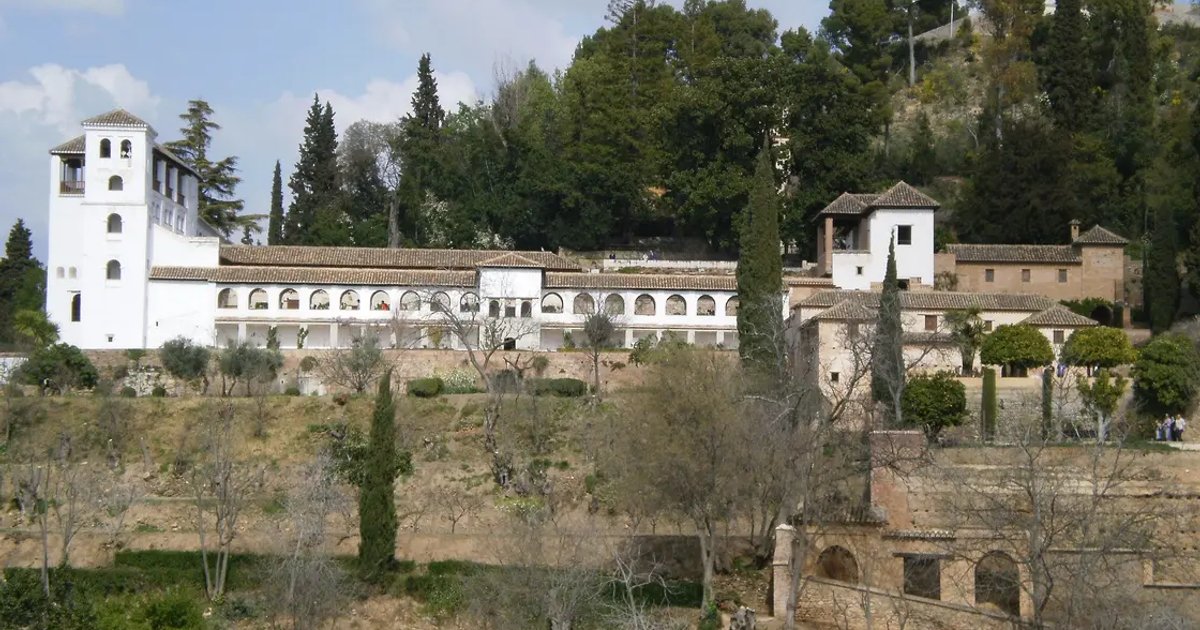
The Generalife — from the Arabic Yannat al-Arif, the Garden of the Architect — was the Nasrid sultans' summer estate on the adjacent Cerro del Sol. Construction is attributed to Muhammad III around 1302–1309. It served as a retreat from the formality of the main palace complex: cooler temperatures, open gardens, water everywhere.
Patio de la Acequia — the central water garden
The 49-metre central courtyard with the Acequia Real running along its axis is the defining image of the Generalife. The arching water jets are a 19th-century addition; the Nasrid original was a straight channel with lower spouts. The Mirador de la Acequia, the porticoed loggia at the north end, is the only surviving original opening of the Nasrid building. The carved plasterwork here is quieter than the Nasrid Palaces but more refined in proportion.
Escalera del Agua — the water stairway
The stairway connecting the lower gardens to the upper terraces has water channels built into the stone balustrades on both sides. Water flows continuously along the handrails, creating a constant sound of running water as you climb. The acoustic effect is deliberate — the Nasrid designers understood that water served multiple functions: irrigation, temperature control, and sound. The Escalera del Agua is one of the most intelligent small pieces of engineering in the complex.
Upper terraces — views back to the Alhambra
The upper ornamental gardens look directly across at the Alhambra's towers and ramparts, with the city below and the Sierra Nevada behind it. This is the angle that does not appear in most Alhambra photography — looking from the Generalife toward the palace rather than the reverse. Late afternoon light falls on the Alhambra's south face from this position.
Visit in late April or May if possible — the rose borders along the central channel bloom in this period and the garden is at its most colourful and fragrant. The summer theatre festival runs in the Generalife grounds through July and August, which affects evening access; check the schedule if you are visiting for a night visit.
What to skip if time is short
If you have less than 3 hours, or if energy is flagging mid-visit, some sections give significantly less than others. Here is an honest ranking.
Do not skip under any circumstances
Court of Myrtles — the reflecting pool is the most memorable single image in the palace complex
Hall of the Ambassadors — the 23-metre cedar dome is the architectural peak of the Nasrid period
Court of Lions — the iconic fountain and column forest justify the entire Alhambra visit
Hall of Two Sisters — the muqarnas ceiling is structurally and visually astonishing
Cut if pressed for time
Rooms of Carlos V — interesting architecturally but a detour from the Nasrid narrative
Partal Gardens upper terraces — the lower pool is essential; the upper section can be walked through quickly
Generalife Palace interior — if you have seen the main Nasrid rooms, the Generalife palace rooms are quieter but less extraordinary; the gardens are the priority
Audio guides, navigation, and practical requirements
Audio guides are available at the entrance for €4 to €6 and cover the main points in multiple languages. The official Alhambra app can also be downloaded before your visit for offline use — useful if you do not want to carry rental equipment. Both cover the Nasrid Palaces thoroughly; coverage of the Alcazaba and Generalife is adequate but briefer.
Practical requirements for the day
Photo ID: required at entry — the name on your ticket must match your passport or national ID exactly
Comfortable shoes: 3 to 6 kilometres of walking on uneven stone, worn marble, and cobblestones — flat soles with grip, not sandals
Water: minimum 2 litres per person; drinking water fountains are available throughout the complex
Sun protection: the walks between sections and the Alcazaba ramparts are fully exposed; hat and SPF necessary in summer
No tripods or flash in the Nasrid Palaces or Generalife interiors
Signage inside the complex is adequate but not comprehensive — there are direction signs to main sections but not to specific rooms within the palaces. Download the official map from the Alhambra Patronato site before your visit or collect one at the entrance kiosk. The Nasrid Palace route is one-way and clearly marked; it is the sections between the main complexes — the paths through the upper gardens between the Partal and the Generalife — where navigation occasionally requires attention.
Prefer a guided tour?
Tours are selected for quality, not commission. We earn a small fee if you book — at no extra cost to you.
A guide covers the same route with architectural context built in — worth it if you are visiting for the first time
Frequently asked questions: Alhambra self-guided tour
Frequently asked questions
What is the correct order to visit the Alhambra sections?
The practical order is: Alcazaba first, then Nasrid Palaces (at your timed entry slot), then Generalife. The Alcazaba and Generalife have no timed slots — you can visit them any time during opening hours — but your Nasrid Palaces entry slot is the fixed point that determines everything else. If your slot is early (8:30–9:00 AM), go directly to the Nasrid Palaces on arrival. If your slot is 10:00 AM or later, visit the Alcazaba first.
How strict is the Nasrid Palaces timed entry?
The 30-minute entry window is strictly enforced. If you miss your slot, you cannot enter the Nasrid Palaces that day. No refunds or rescheduling. Your ticket fixes both the date and the window. Arrive at the Nasrid Palaces checkpoint 10 to 15 minutes early — not just at the main Alhambra gate — because security queues at the Nasrid checkpoint can absorb 10 minutes by themselves.
Can I stay in the Nasrid Palaces as long as I want once inside?
Yes. The timed slot controls only your entry window. Once inside, you can stay until the palaces close for the day. Most visitors need 90 minutes to 2 hours to move through the Mexuar, Comares, and Lions Palace sections at a pace that allows you to actually look at the carving. Move faster only if you have already visited before.
What should I absolutely not miss in the Nasrid Palaces?
Four rooms are essential: the Court of Myrtles (Patio de los Arrayanes) with its 34-metre reflecting pool and the Comares Tower; the Hall of the Ambassadors, the largest room in the palace with a 23-metre cedar ceiling dome; the Court of Lions with its 124 marble columns and the famous 12-lion fountain; and the Hall of Two Sisters with the muqarnas ceiling containing approximately 5,000 geometric stalactite cells. If you are pressed for time, these four spaces alone are worth the visit.
How long does the full Alhambra visit take?
A complete visit covering all three sections — Alcazaba (45 minutes), Nasrid Palaces (90–120 minutes), Partal Gardens (15–20 minutes), and Generalife (45–60 minutes) — takes 4 to 5 hours at a comfortable pace. Three hours is the practical minimum if you want to see the major rooms without rushing. Budget more if you have specific photography goals.
Do I need an audio guide for a self-guided visit?
An audio guide (€4–€6, available at the entrance) adds context to the architectural vocabulary — what the muqarnas technique is, why the inscriptions appear where they do, what the different sections of the palace were used for. It is not required but makes the visit more coherent. The alternative is downloading a mobile app before your visit for offline use. Self-guided visits with background reading work well; walking in cold without any context is the version that produces underwhelmed visitors.
Is the Generalife included in the standard Alhambra ticket?
Yes. The general Alhambra day ticket (€22.27) covers the Alcazaba, Nasrid Palaces, and Generalife. A standalone gardens-and-Generalife ticket (€12.73) covers the Generalife without the Nasrid Palaces. For most visitors doing a complete self-guided tour, the general ticket is the right choice. For details on all ticket types, see the Alhambra tickets guide.
Reporter notebook
Insider tips
Practical observations gathered the way a local journalist would keep them: short, specific, and more useful than brochure copy.
Crowd tip
Visit the Alcazaba early and save the Generalife for last
The Alcazaba is emptiest in the first 30 minutes after opening — most visitors walk straight past it toward the Nasrid Palaces. Spend 45 minutes there at 8:30 AM while the main crowd queues for security at the Nasrid checkpoint. By the time you walk to your slot, the initial rush has cleared. Leave the Generalife for after the Nasrid Palaces — it is the section that benefits most from arriving into without time pressure.
Local custom
Read the Nasrid rooms in sequence — the architecture tells a story from public to private
The Nasrid Palaces move from most public to most private as you walk through: the Mexuar (administrative, semi-public) leads to the Comares (official royal residence, audience chambers) which leads to the Lions Palace (private harem quarters). Understanding this transition changes what you are looking at — the increasing elaborateness of the carving tracks the increasing privacy of the space. The Hall of the Ambassadors is the most public, most formal room; the Hall of Two Sisters is the most private and most decorated.
Best time
The Partal Gardens are the least-visited part of the complex
The section between the Nasrid Palaces and the Generalife — the Partal Gardens with the Torre de las Damas — is where the crowds thin to almost nothing. After the intensity of the Nasrid rooms, it is a genuinely peaceful 20 minutes: a long pool with a colonnaded pavilion and views across to the Albaicín. Most visitors walk through it in five minutes to get to the Generalife. Go slowly here.