Alhambra photography guide: where to stand and when
No tripods. No flash. You have one timed slot in the Nasrid Palaces and the light changes fast. This guide tells you exactly where to position yourself, which slot to book, and when to be at Mirador San Nicolás for the exterior shot.
Seven years resident in Granada. Specialist in Nasrid architecture, Al-Andalus history, and Andalusian walking routes.
Published
The Alhambra is the most photographed monument in Spain. That creates a specific problem: you arrive with high expectations and a timed entry window that closes in 30 minutes, and the light you wanted has already gone. Good Alhambra photography is mostly a planning problem — what to book, when to arrive, and where to stand.
Three rules govern the whole complex: no tripods, no flash, no selfie sticks. Everything else — handheld photography, smartphones, mirrorless cameras, wide lenses — is permitted for personal, non-commercial use. This guide works within those constraints.
What the rules actually are
The Patronato de la Alhambra y Generalife is consistent on three prohibited items: tripods, flash, and selfie sticks. The flash ban is a preservation rule — repeated exposure to flash degrades 14th-century stucco, painted tiles, and carved wood in ways that cannot be repaired. Staff enforce it actively in the Nasrid Palaces. The tripod ban is partly crowd management and partly the same preservation logic: a tripod leg on polished stone floors creates micro-scratches and slows movement in narrow corridors.
Commercial photography — video shoots, editorial assignments, advertising campaigns — requires a separate permit from the Patronato. If you are shooting for personal travel or a non-commercial blog, you are in the personal use category and no permit is required.
Stabilisation workarounds
Small tabletop tripods: technically in a grey area — the rule is written around full-size tripods. A gorilla pod balanced on a surface is used by some photographers without challenge. Avoid it in crowded corridors.
Image stabilisation: shoot at 1/30s or faster and rely on in-body or in-lens stabilisation. Modern cameras handle this well.
Brace against walls: the stone surfaces throughout the complex give you multiple stable points without equipment.
Court of Lions: the hardest shot to get right
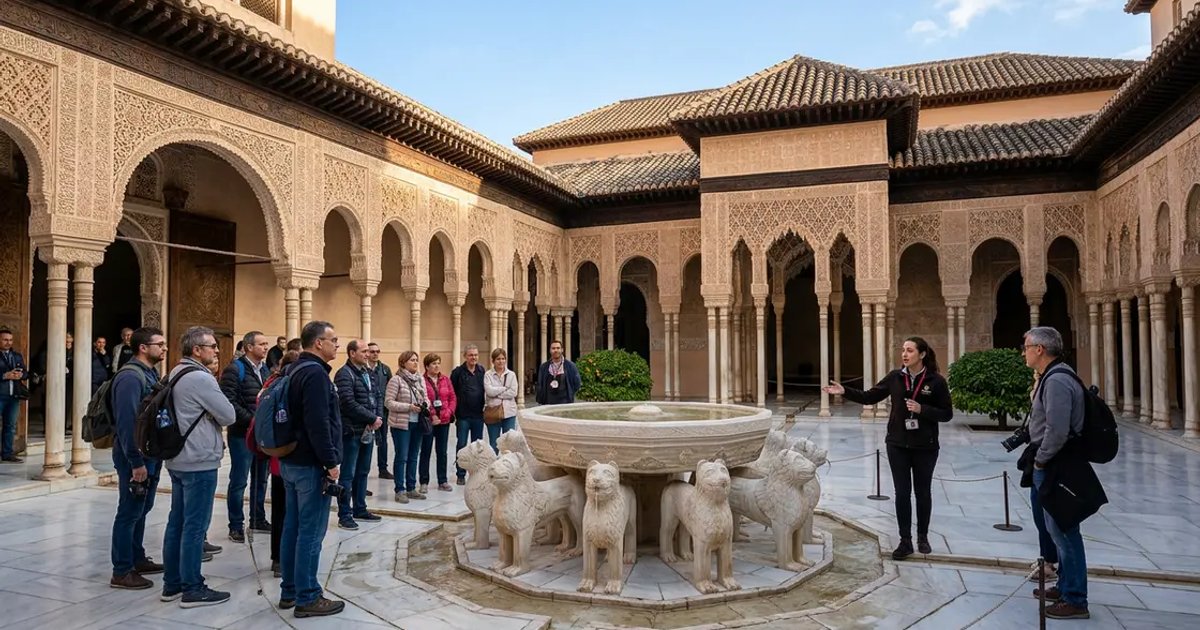
The Patio de los Leones has 124 marble columns arranged in a forest around the central fountain with its 12 marble lions. The shots most people bring home show the fountain at midday from standing height in a crowd. None of them are good. The courtyard rewards a different approach.
Position and angle
Crouch low near the fountain — a low angle emphasises the arcade rising above you and the columns receding into depth on all four sides
Use the columns as leading lines — position yourself so two or three columns frame the central fountain, creating layers of foreground, mid-ground, and background
Avoid standing height centre-courtyard shots — this is what everyone shoots and what the crowd forces on you
Light and timing
8:30 AM slot — morning sun enters at a low angle through the arcade openings, raking across the column shafts and casting long shadows on the courtyard floor
Avoid midday — the courtyard goes flat and overexposed, columns lose their shadow depth
Late afternoon (3–4 PM) warms the stone slightly but the courtyard is busiest at this time; the shadows do not match the morning quality
The Hall of Two Sisters, accessible from the Court of Lions, has a muqarnas stalactite ceiling with approximately 5,000 geometric cells. Point straight up and shoot wide. The pattern is symmetrical — centring the shot matters. Move until the central boss is in the exact centre of your frame.
The Hall of the Abencerrajes has a similar octagonal stalactite dome on the south side of the courtyard. The legend attached to it — that the Abencerrage nobles were massacred here and their blood stained the fountain basin (still rusty-coloured today) — gives the room an atmosphere that the architecture alone would not produce. Worth noting in caption or travel notes.
Court of Myrtles: the reflection technique
The Patio de los Arrayanes is a 34-metre rectangular pool flanked by myrtle hedges, with the Comares Tower rising at the north end. The tower reflects in the water almost perfectly when conditions are right. Getting those conditions requires knowing two things: where to stand, and what time to arrive.
Position: walk to the short southern end of the pool and crouch until your lens is as close to the water surface as you can get without the pool edge cutting into your frame. At this angle the entire 34-metre pool becomes a mirror, the tower doubles, and the arching fountains at each side of the pool create symmetry on both left and right. Standing height from the same end turns the reflection into a small detail at the bottom of a wide landscape shot — far less effective.
Timing: afternoon light from around 3:00 PM warms the tower's pale stone and softens the reflection. The whole building doubles in the water and the arching jets catch the light at their tips. Midday produces a grey, flat reflection with no warmth. Morning is beautiful in the rest of the palace but this courtyard faces north — the tower does not catch direct light until the afternoon.
Crowds and timing
The Court of Myrtles is the first major courtyard in the standard Nasrid route. It receives the heaviest footfall of any space in the palaces. If your timed entry slot is 10:00 AM or later, you are arriving into a courtyard that already has groups from the 8:30 and 9:00 AM slots. Build in patience — there are brief gaps between tour groups where the pool edge clears for a minute. Watch for them.
Generalife: building compositions across multiple levels
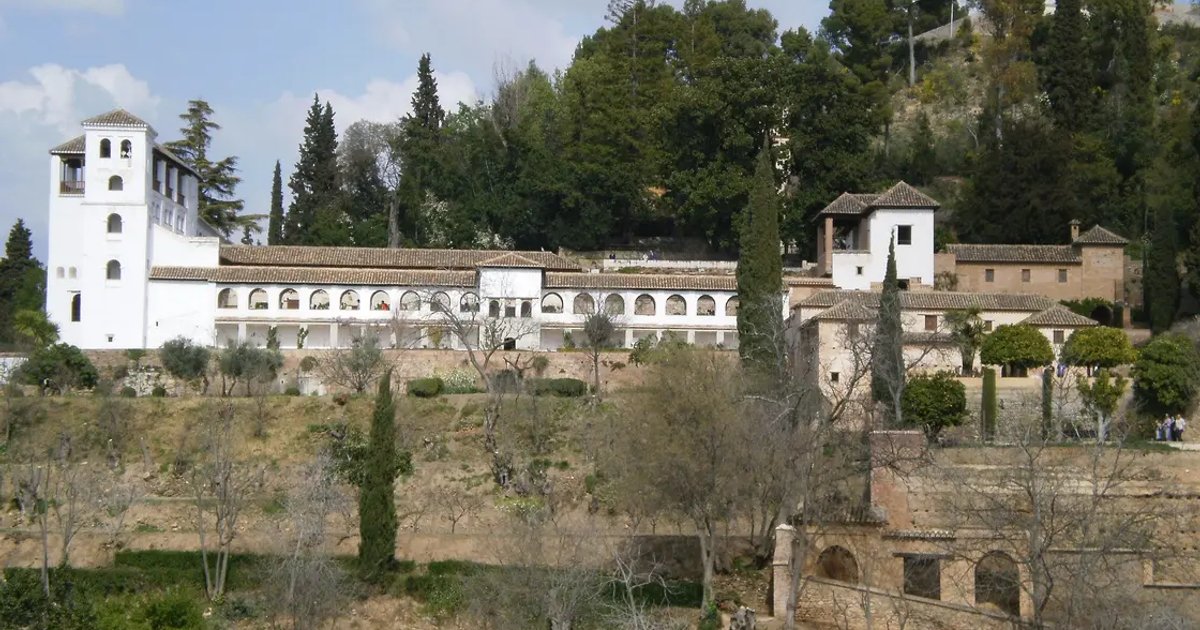
The Generalife rewards a three-stage approach: start with a long establishing shot, then work into details, then use the upper terraces for the Alhambra-in-distance framing.
Stage 1 — The Patio de la Acequia
Stand at the north pavilion end and shoot the full length of the 49-metre water channel. The arching water jets and myrtle borders create a natural corridor composition. Visit in late April or May when the roses are in bloom along the borders — the addition of colour transforms an architectural shot into a garden portrait. Soft morning light reads well here — the overcast quality of early hours suits the long canal composition better than direct midday sun, which flattens the water surface and bleaches the stone borders.
Stage 2 — Garden details
Once you have the long shot, switch to tighter work: individual roses against the stone background, the arching jets in isolation, the cypress topiary against sky. A 50–85mm focal length is useful here. The Escalera del Agua — the stairway whose stone balustrades carry a continuous flow of water — is one of the more unusual details in the complex. Shoot the water flow at 1/500s to freeze it or 1/15s to smooth it; both read well.
Stage 3 — Alhambra from the upper terraces
The upper ornamental terraces look directly across at the Alhambra towers with the old city below. Frame the shot through one of the arched openings — you get the stone arch in foreground, the Alhambra in mid-ground, and the Sierra Nevada behind it when there is snow. This is the less-photographed angle; most visitors do the Mirador San Nicolás shot but skip this one. Late afternoon light falls on the Alhambra's south face from this angle.
Golden hour and the Mirador San Nicolás shot
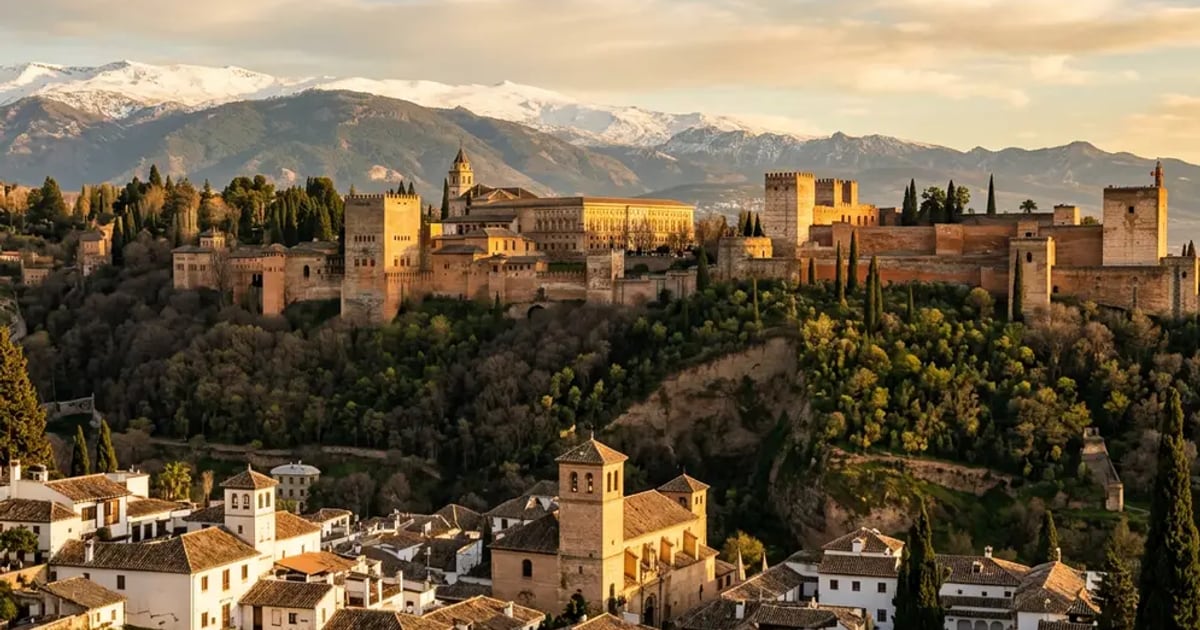
Mirador San Nicolás is the canonical exterior shot of the Alhambra — the red walls and towers against the Sierra Nevada, viewed from across the Darro valley. The viewpoint itself is in the Albaicín quarter and requires about 20 minutes' uphill walk from Plaza Nueva, or you can take the C31 bus and walk the final stretch.
Golden hour arrives at around 4:30 PM in autumn and winter, and pushes toward 8:30–9:00 PM in midsummer. The warm orange light catches the ochre of the Alhambra walls and the snow on the Sierra Nevada simultaneously. The morning version is less photographed: diffuse pre-sunrise light, mist in the valley, and almost no one at the viewpoint. Arrive 15 minutes before sunrise for the best morning shot.
What to bring for the Mirador shot
Wide-angle lens: 24mm or wider to capture the full Alhambra ridge plus the Sierra Nevada. At 35mm you lose the right edge of the mountains.
Telephoto (optional): 200–300mm equivalent for compressed shots of individual Alhambra towers against the snow.
Arrive 20 minutes early: the front rail at the viewpoint fills fast at golden hour. Late arrivals shoot over and around other people.
Check snow conditions: the Sierra Nevada snow is most visible from October to May. Summer shots lack the backdrop contrast.
A second exterior viewpoint — less crowded, better for telephoto — is from the Cerro del Sol access road east of the Generalife. You are looking west at the Alhambra rather than east as at Mirador San Nicolás, which gives you morning light on the towers instead of afternoon. Requires more navigation; check an up-to-date map before committing to the walk.
Smartphone vs dedicated camera: an honest comparison
Modern smartphones perform well enough in the Alhambra's interior spaces for most travel purposes. The key hardware difference that matters here is wide-angle capability. The Court of Lions and the Court of Myrtles both require a genuinely wide field of view — 24mm equivalent or wider — to fit the architecture in frame without backing into a wall. If your phone's main camera is 24mm equivalent and the ultra-wide is 13mm, you have what you need. If your ultra-wide introduces heavy barrel distortion that makes straight columns look curved, correct it in post.
Where smartphones are good enough
Daytime courtyard shots with adequate ambient light
Garden and exterior shots where depth of field is not critical
Social media sharing at screen resolution
Mirador San Nicolás with a wide enough main lens
Where a dedicated camera earns its weight
Low-light interiors — Hall of the Ambassadors, darker palace corridors
Print-size output — 12-inch prints or larger from interior shots
Manual exposure control for the Court of Myrtles reflection pool
The no-tripod and no-flash restrictions reduce the advantage of a dedicated camera in the lowest-light spaces. A wide-aperture prime — 24mm f/2, 35mm f/1.8 — shoots handheld in most interior conditions. Zoom lenses at f/4 to f/5.6 struggle in the darker corridor sections between the main courts.
Alhambra tours with early entry
Tours are selected for quality, not commission. We earn a small fee if you book — at no extra cost to you.
Get ahead of the crowds — guided access includes the 8:30 AM slot
Frequently asked questions about Alhambra photography
Frequently asked questions
Are tripods allowed inside the Alhambra?
Tripods are not permitted in the interior areas of the Alhambra, including the Nasrid Palaces and the Generalife. Selfie sticks and flash are also prohibited. Photography for personal, non-commercial use is permitted throughout using handheld equipment. If you need stabilisation, lean against a wall or use a small beanbag rested on a surface.
Is flash photography allowed in the Nasrid Palaces?
No. Flash photography is strictly banned inside the Nasrid Palaces. Repeated flash exposure degrades the delicate 14th-century stucco carvings and painted surfaces. Use the highest ISO your camera handles cleanly — most modern cameras and smartphones produce usable results at ISO 1600 to 3200 in the palace interiors.
When is the best time to photograph the Alhambra from outside?
The classic exterior shot is from Mirador San Nicolás in the Albaicín, looking south-east at the Alhambra with the Sierra Nevada behind it. Golden hour arrives at around 4:30 PM in autumn and winter, pushing toward 8:30–9:00 PM in midsummer. The morning version is less photographed and often better: soft diffuse light, no crowds, and the mist sometimes still sitting in the Darro valley below. Arrive 15 minutes before sunrise.
What focal length is best for the Nasrid Palaces?
A wide-angle lens in the 16–24mm range (full-frame equivalent) handles the expansive courtyards. The Court of Lions and Court of Myrtles both reward ultra-wide compositions that include ceiling and floor. A 35mm lens is useful for tighter details — individual column capitals, muqarnas stalactites, tile dadoes. A 50–85mm range works for isolating single arches or distant carved panels. Telephoto is unnecessary inside; bring it for the Sierra Nevada shot from Mirador San Nicolás.
How do I photograph the Court of Myrtles reflection pool?
Crouch as low as you can — nearly floor level — at the short end of the pool. At this angle the 34-metre pool becomes a mirror that doubles the Comares Tower, and the surface of the water fills your lower frame. Afternoon light (from around 3:00 PM) warms the tower facade and softens the reflection. Avoid midday: the water turns a flat grey and the tower goes into direct overhead light with no shadow definition on the arches.
Can I photograph the Alhambra at night?
Night visits to the Nasrid Palaces run Tuesday to Saturday from 22:00 to 23:30 (April to October) and Friday to Saturday from 20:00 to 21:30 (October to March). The spotlit stucco produces shadows that daylight visits do not. Flash is still banned; a stable grip, exposure compensation for the bright lit surfaces, and a higher ISO are the practical tools. Night garden visits to the Generalife run separately. Both require advance booking at tickets.alhambra-patronato.es.
Reporter notebook
Insider tips
Practical observations gathered the way a local journalist would keep them: short, specific, and more useful than brochure copy.
Photo spot
The floor-level shot in the Court of Myrtles: late afternoon only
Get down to floor level at the south end of the 34-metre pool around 3:30 to 4:00 PM. The Comares Tower reflection doubles in the water and the afternoon warmth removes the flat grey cast you get at midday. Bring a thin travel mat if your knees object to cold marble. The shot is well known but almost nobody makes the effort — the viewing crowd stays upright near the entrance.
Best time
Book the 8:30 AM Nasrid slot for the Court of Lions
The 8:30 AM entry slot gives you 15 to 20 minutes in the Court of Lions before the first tour group from the following slot arrives. The morning sun enters at a low angle through the arcade openings and rakes across the 124 marble columns. At 10:00 AM the same courtyard is overlit and crowded. The slot sells out fast — book the moment the three-month window opens for your travel date.
Crowd tip
Mirador San Nicolás fills fast: arrive 20 minutes early
The parapet at Mirador San Nicolás fits about 40 people comfortably at the front rail. By the time golden hour light actually touches the Alhambra walls, there are 200 people behind you. Arrive 20 minutes before your target light time and stake out your position. The east side of the viewpoint gives a slightly higher angle that clears the foreground trees. Bring a wide-angle — the full Sierra Nevada backdrop only fits at 24mm or wider.