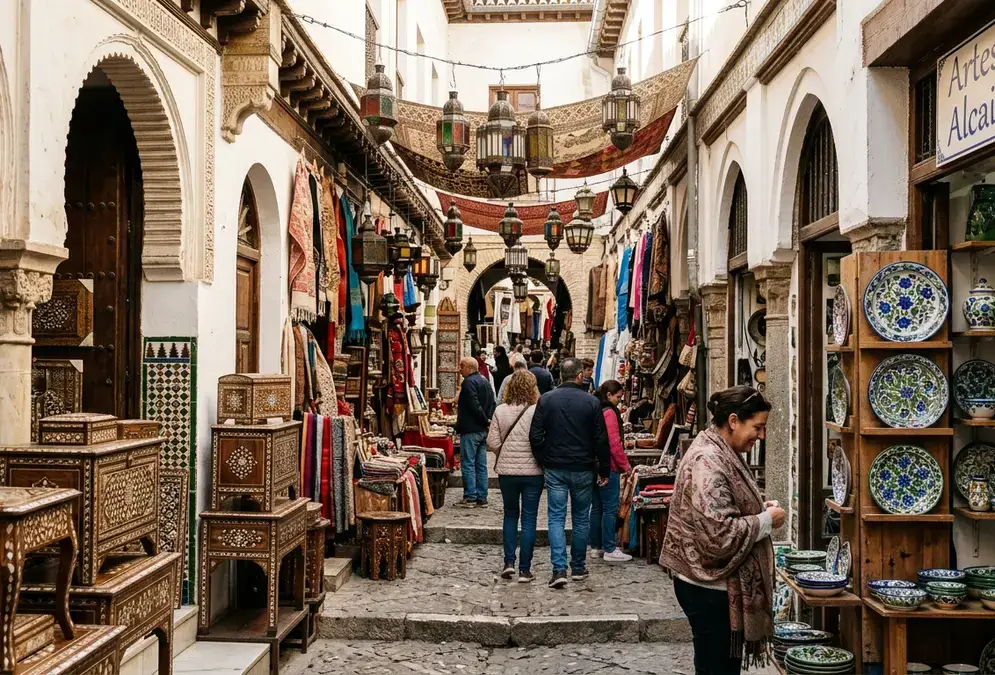
The Alcaicería: a royal monopoly in a narrow lane
The lanes of the Alcaicería sit three minutes from the Cathedral's main facade, bounded by Calle Libreros, Calle Oficios, Calle Tinte, and Calle Zacatín — that last name means *silk vendors* in Arabic and tells you exactly what traded here for two centuries. The bazaar formalised under Emir Yusuf I in the 14th century as a Nasrid royal monopoly. At its peak before 1492, around 200 shops occupied its perpendicular lanes; silk, spices, gold cloth, and fine leather changed hands under strict royal supervision and were taxed at rates well above ordinary goods. The name itself comes from the Arabic *al-Kaysar-iyya* — the place of Caesar — referencing a much older Byzantine arrangement under Emperor Justinian that gave Arab merchants exclusive silk-trade rights in the 6th century.
The building that exists today is not that market. The original Alcaicería burned in 1843 when a match workshop caught fire — a particular irony given how much the original occupants had invested in fire-proofing their lantern-lit lanes. The reconstruction that followed was smaller, cheaper, and deliberately theatrical: Neo-Moorish horseshoe arches, painted tilework, and hanging lanterns that approximate the aesthetic without any of the historical material. This is worth knowing not to dampen enthusiasm but to calibrate expectation. You are walking through a 19th-century idea of what a Moorish market looked like, built on the footprint of the real thing.
What the shops sell now reflects a different kind of continuity. **Taracea** — geometric marquetry boxes, chessboards, and trays inlaid with bone and contrasting wood veneers — has been made in Granada workshops since the Nasrid period and remains the craft most specific to the city. **Fajalauza ceramics**, blue-and-white tin-glazed pottery named after the Albaicín kiln district, trace the same lineage. The stained-glass hanging lamps called *granadinas* are genuinely local. These are what the market is for. The generic souvenir trade (fridge magnets, castanets made elsewhere) occupies the same lanes but represents a separate commerce layered on top.
Prices vary 30–40% between shops a few metres apart; walk all three lanes before buying anything. The Alcaicería crowds badly after 11:00 when the Cathedral tours end. Arriving at 10:00 gives you the lanes to yourself and vendors who are willing to talk about what they sell.
Mercado de San Agustín: where Granada actually shops
Two minutes west of the Alcaicería, at Plaza de San Agustín, is a market that most tourists walk past without entering. The building occupies a site that was the Convento de San Agustín until the 19th century; the current structure dates to the 1970s and was substantially updated more recently to add a gourmet bar section and a terrace with Cathedral views.
The Mercado de San Agustín runs Monday to Saturday, stalls open from around 09:00 to 14:00–15:00. The fish counter sources from the Costa Tropical an hour south — Granada's coast, with a microclimate warm enough for tropical fruit, produces seafood that the city has relied on for centuries. The **jamón de Trevélez** counter is worth a specific stop: Trevélez ham cures at over 1,200 metres elevation in the Sierra Nevada, a significantly different product from generic serrano, with a legal designation of origin protecting the name. Olive oil, goat cheese, seasonal vegetables, and local wines fill the rest of the produce stalls.
The standard approach for sampling before buying is to ask *¿Puedo probar?* — can I taste? — which vendors at every serious Spanish market expect and welcome. The San Agustín stall-holders are accustomed to it. The same market has a gourmet bar section operating longer hours (daily from 08:00, until midnight Sunday through Friday and 01:00 on Saturdays), where you can eat and drink at counters surrounded by what the stalls sell. This is a different use of the space from the morning shop, and draws a different crowd — office workers at lunch, food-curious visitors in the evening.
The market tells you something about how the city centre functions economically. San Agustín survives in a central location because local households — university staff, long-term residents, families with apartments in the centro — actually use it as their regular food source. The Alcaicería nearby draws tourists; San Agustín draws Granadinos. Both are five minutes from the Cathedral. That proximity and the difference in clientele is the compressed version of Granada's dual economy.
Plaza Larga: a neighbourhood square that becomes a market
Saturday mornings in the upper Albaicín, Plaza Larga — the main square of the quarter's residential core — hosts a small market that has nothing to do with tourist commerce. Around five or six stalls sell seasonal fruit and vegetables, local cheese, artisan bread, and occasionally honey or preserves. The quantity of stalls is modest; the setting is not. The Alhambra sits on the ridge directly across the valley, visible over the whitewashed walls of the houses behind the square. The café tables fill early.
The Ecomercado de Granada is a related but distinct event: an organic producers' market running twice monthly on the 1st and 3rd Saturdays, from 10:00 to 15:00, alternating between the Palacio de Congresos and an address near the bus station on Avenida Luis Miranda Dávalos. Forty organic producers sell directly to buyers; the emphasis is on agroecological farming from the Vega de Granada, the fertile flatlands surrounding the city that fed the Nasrid dynasty and still produce the lettuce, tomatoes, and peppers that appear in Granada's kitchens. The Ecomercado has no tourist infrastructure — no translations, no international payment systems — and is therefore one of the more accurate windows into what serious Granada food culture looks like outside the restaurant system.
These two Saturday markets — Plaza Larga and the Ecomercado — belong to a completely different register from the Alcaicería and San Agustín. They are neighbourhood events, not city amenities, and the distinction matters for how you approach them. Arriving at Plaza Larga at 09:00 and buying a handful of peaches from the Vega and eating them at a café table with the Alhambra above you is a particular kind of Granada morning that requires no planning and costs almost nothing.
The Zaidín and Almanjáyar flea markets: the city's working edges
Granada's two large street markets operate on its residential periphery, and both are almost entirely unknown to visitors. This is what makes them interesting.
The **Mercadillo del Zaidín** has run every Saturday in the Zaidín neighbourhood, south of the centre, since the area became Granada's largest residential district in the mid-20th century. It relocated to Calle Baden Powell in March 2023. Over 200 stalls sell fresh produce, seasonal vegetables, pickles, *chacina* (cured sausage), clothing, household goods, and plants. The market opens at 10:00 and vendors begin packing at 13:30. There are no tourists here as a baseline; the market exists to serve the neighbourhood's weekly shopping cycle. Bus lines 4 and 7 connect it to the centre in 10–15 minutes.
The Sunday market at **Almanjáyar**, a residential district north of the city centre, is larger still — one of the biggest second-hand markets in Andalusia. Stalls open at 08:00 and run to 14:00. The inventory is what every serious flea market carries: vintage clothing and denim, furniture, electrical goods, books, tools, toys, records. The logic of arriving before 10:00 applies here as elsewhere: early is when the selection is intact and vendors are most willing to talk. Cash is universal; haggling is expected. Bus lines 3, 5, and 6 cover the route from the centre in roughly 20 minutes.
For antique hunters specifically, the **Rastro de La Zubia** — 10 kilometres south of Granada in the town of La Zubia — runs Sunday mornings on Calle Chorreras, 10:00 to 14:00. Smaller than Almanjáyar, focused more specifically on vintage and collectibles rather than general second-hand goods. Bus lines 31 and 32 make the 25-minute trip from the city centre.
The flea markets matter not just as shopping destinations but as evidence that Granada is a working city with a substantial residential population that has nothing to do with the Alhambra. The half-million people who live in the greater Granada area need markets that serve them; these are those markets. Visiting them alongside the Alcaicería gives you a complete picture of how commerce actually functions across the city's economic range.
Calle Calderería Nueva: what survived the Reconquista
Running uphill from the edge of the cathedral quarter into the base of the Albaicín is Calle Calderería Nueva — known locally as Calle de las Teterías, the street of the teahouses. The street takes its official name from the copper-pot workshops that operated here when the Muslim quarter still extended this far down the hillside. The workshops are gone; what replaced them from the late 20th century onward is a dense concentration of Moroccan tea shops, craft stalls, spice merchants, and restaurants that reconstruct something of the street's pre-1492 character without being able to claim continuity with it.
This is worth being clear-eyed about. The teterías on Calderería Nueva are mostly run by Moroccan migrants who arrived in Granada from the 1980s onward, not by descendants of the Morisco communities expelled after 1492. The street is a cultural reconstruction rather than an unbroken tradition, in the same way the rebuilt Alcaicería is a reconstruction rather than the original bazaar. What it sells — Moroccan mint tea, Arab pastries, spices in open sacks, hammered brass tea sets, leather goods, hookah pipes, Berber rugs — is authentic to its current vendors' cultures, not to Granada's Nasrid period specifically.
That framing doesn't make the street less interesting; it makes it more honest. The conversation between Islamic Andalusian heritage and contemporary North African presence is a live question in Granada in ways it isn't in most Spanish cities, and Calderería Nueva is where that conversation is most visible. The tea is genuinely good. The spice stalls carry things you won't find easily in standard Spanish supermarkets. The craft objects range from mass-produced imports to handmade pieces worth buying. Navigating the difference requires the same approach as the Alcaicería: walk the whole street before committing, ask where things come from, and buy what you can verify.
Practical notes: cash, timing, and what's worth carrying home
One rule applies across all five market contexts: **carry cash**. The Alcaicería's larger shops accept cards; most craft stalls do not. San Agustín's produce vendors are cash-only as a default even where machines exist. The Zaidín, Almanjáyar, and La Zubia markets are almost entirely cash-only. Arriving without cash is not a disaster at the Alcaicería, where an ATM is a short walk away, but it closes out most of what makes the other markets worth visiting.
On what to carry home: the objects most specific to Granada are taracea woodwork (the marquetry boxes and chessboards made here since the Nasrid period), fajalauza ceramics (the blue-and-white tin-glazed pottery from the Albaicín kiln tradition), and jamón de Trevélez (vacuum-packed for travel, with the designation-of-origin label as authentication). These three are genuinely Granada-specific in ways that most souvenir-market goods are not. For the woodwork and ceramics, the proper artisan workshops in the Albaicín and on Calle Calderería Vieja sell at better prices and with clearer provenance than the Alcaicería stalls; the market is a reasonable shortcut if your time is limited.
For the full operational breakdown — opening days and times per market, bus routes, price ranges, parking — the [Granada markets activity guide](/activity/granada-markets-guide) covers each market in detail. The article you are reading is about what the markets are; the activity guide is about how to get to them.