Granada has never been a city that keeps commerce to one place. The Alcaicería near the Cathedral traces to a Nasrid royal bazaar formalised in the 14th century. The Mercado de San Agustín, a five-minute walk away, is where working Granadinos buy jamón, goat cheese, and seasonal vegetables on weekday mornings. On Saturdays, the Zaidín district runs a street market along Calle Baden Powell that has almost no tourists in it. On Sundays, the fairgrounds in Almanjáyar fill with stalls selling everything from vintage denim to second-hand appliances, one of the largest flea markets in Andalusia.
Taken together, these markets tell you more about how Granada actually functions than the Alhambra does. They are free to enter. Bring cash.
Alcaicería: the old silk market
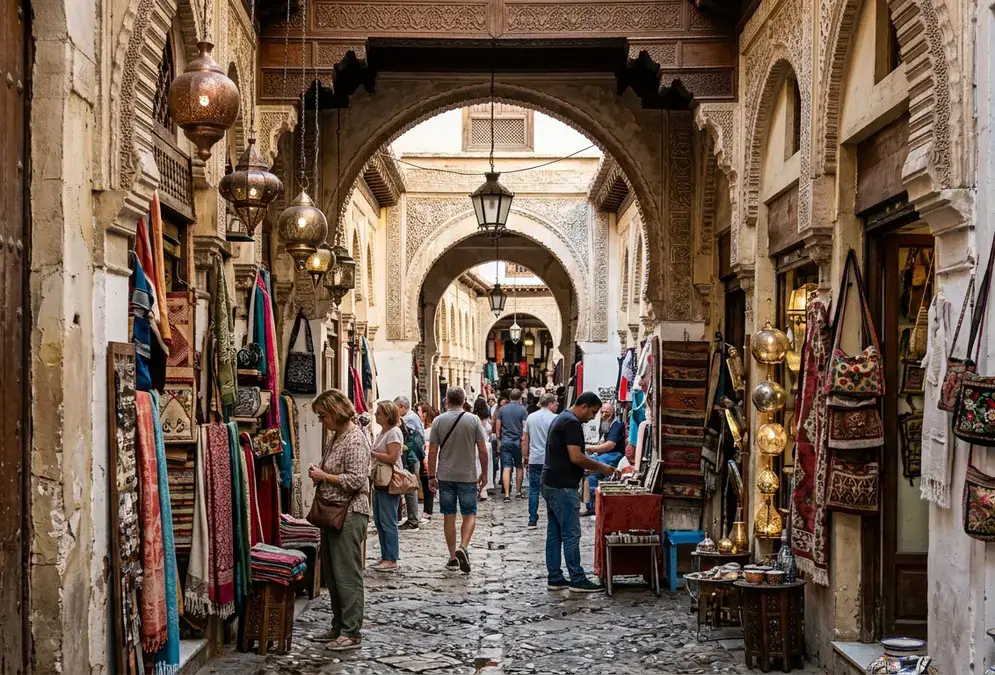
The covered lanes of the Alcaicería sit immediately beside the Cathedral, bounded by Calle Libreros, Calle Oficios, Calle Tinte, and Calle Zacatín. That last street name means silk vendors in Arabic, which tells you what traded here for two centuries. At its peak in the 15th century the market covered roughly 4,600 square metres and housed around 200 shops. It operated as a royal Nasrid monopoly, taxed at premium rates on silk, spices, gold cloth, and fine leather.
The original bazaar burned down in 1843. The current building is a 19th-century reconstruction in Neo-Moorish style: pointed horseshoe arches, painted tilework, hanging lanterns. It is a pastiche, which is worth knowing so you can enjoy it without expecting archaeological authenticity. What is genuinely old is the craft tradition. The shops sell taracea (geometric marquetry boxes and chessboards inlaid with bone and contrasting wood veneers that Granada workshops have made since the Nasrid period). Fajalauza ceramics, blue-and-white tin-glazed pottery named after the Albaicín kiln district, appear in workshops tracing back to the same era. Spices in open sacks. Leather slippers. The stained-glass hanging lamps unique to Granada, called granadinas.
Hours run roughly Monday to Saturday 10:00–21:00; Sunday 10:00–15:00, though individual shops vary. Cash is standard. Haggling is expected on craft items and anything without a marked price.
One practical note: the Alcaicería is where the tour groups go after the Cathedral. Arrive at 10:00 and you have the lanes to yourself. Arrive at 11:30 and you're sharing them with the morning's Cathedral queue.
Mercado de San Agustín
Plaza de San Agustín sits two minutes from the Cathedral, easy to walk past without noticing. The Mercado de San Agustín inside is where Granada does its actual food shopping. The produce stalls run Monday to Saturday 09:00–15:00 and close on Sundays. What you find in the morning: fresh fish and seafood, jamón de Trevélez (cured above 1,200 metres in the Sierra Nevada, a genuinely different product from the generic serrano sold elsewhere), goat cheese from local farms, olive oil, seasonal vegetables, bread.
The market has two modes. The lower-floor stalls are for buying ingredients and are most alive between 09:00 and 12:00. Saturdays are busiest, when local families do the weekly shop. The gourmet bar area operates on a different schedule: Sunday to Friday 08:00–midnight, Saturday until 01:00. At lunch (13:00–15:00) or in the early evening (19:00–21:00) you can eat at the counters directly from what the stalls sell, the kind of arrangement that makes sense once you understand how a Spanish market works.
Ask before you buy: '¿Puedo probar?' (can I taste?) is standard practice at produce stalls and most vendors expect it. The market has a terrace with views of the Cathedral and, unusually for Granada, air conditioning.
Sunday and Saturday street markets
Two markets outside the centre are worth knowing about, both because they are cheaper and because they have essentially no tourist presence.
The Mercadillo del Zaidín runs every Saturday 10:00–14:00 along Calle Baden Powell in the Zaidín residential district, south of the centre. It relocated to this street from its original pitch in March 2023. The draw is fresh seasonal produce at prices aimed at residents rather than visitors: local vegetables, pickles, chacina (cured sausages), plants. Clothing and household goods fill the rest of the stalls. Vendors begin packing down by 13:30. Bus lines 4 and 7 serve the area, 10–15 minutes from the centre.
On Sundays, the fairgrounds at Almanjáyar in the north of the city open at 08:00 and run until 14:00. This is one of Andalusia's larger second-hand markets, selling vintage clothing, furniture, electronics, books, tools, and toys. The usual Sunday flea market logic applies: arrive before 10:00 for the best selections, bring cash (nearly all vendors are cash-only), and haggle on anything you want. Parking fills by 10:00. Bus lines 3, 5, and 6 serve Almanjáyar, roughly 20 minutes from the centre.
Antique hunters have a further option: the Rastro de La Zubia, 10 km south of Granada in the town of La Zubia, runs Sundays 10:00–14:00 on Calle Chorreras. Smaller than Almanjáyar, quieter, and more focused on vintage and collectibles. Bus lines 31 and 32 make the 25-minute run from the city centre, or it is a short drive.
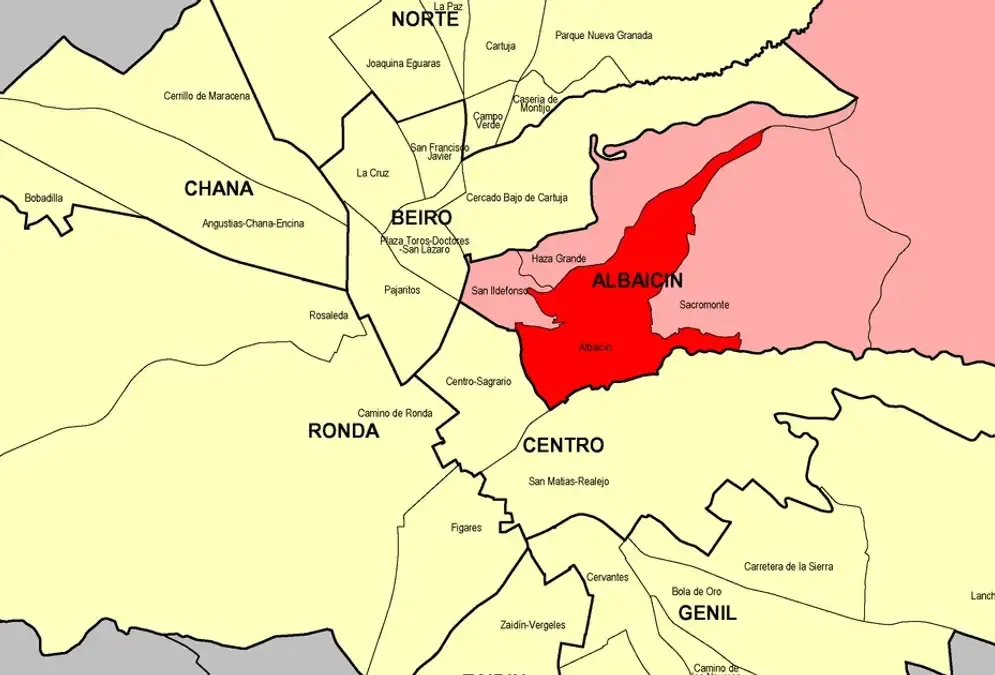
The Saturday Plaza Larga market in the Albaicín is worth mentioning separately: a compact morning market selling organic produce, artisan bread, and cheeses, with the Alhambra visible on the ridge above. It is small and finishes early, but the setting is good.
What to buy and what to skip
In the Alcaicería: taracea woodwork and fajalauza ceramics are the authentic local crafts. The same objects vary 30–40% in price between shops a few metres apart, so walk all three lanes before committing. Generic souvenirs (fridge magnets, flamenco castanets made in China) are not what the market is for. If you want serious craft work at better prices, the proper taracea and ceramic workshops are in the Albaicín and on Calle Calderería Nueva, five minutes uphill.
In San Agustín: jamón de Trevélez, local goat cheese, and small bottles of Alpujarra olive oil travel well and are genuinely specific to the region. Avoid buying fresh fish unless you're cooking that evening.
At the Sunday markets: the Almanjáyar flea market rewards patience and specific searches. If you are looking for something in particular — 1980s Spanish furniture, a specific kind of tool — this is where it might appear. As a general browse, come expecting cheap clothing and household goods; antiques are a smaller part of the inventory. For serious antique hunting, La Zubia is the better choice.
One rule across all of them: carry cash. Smaller stalls at every market, including San Agustín's produce vendors, operate cash-only. Cards are more reliably accepted at the Alcaicería's larger shops and at San Agustín's bar area, but counting on it will leave you short.