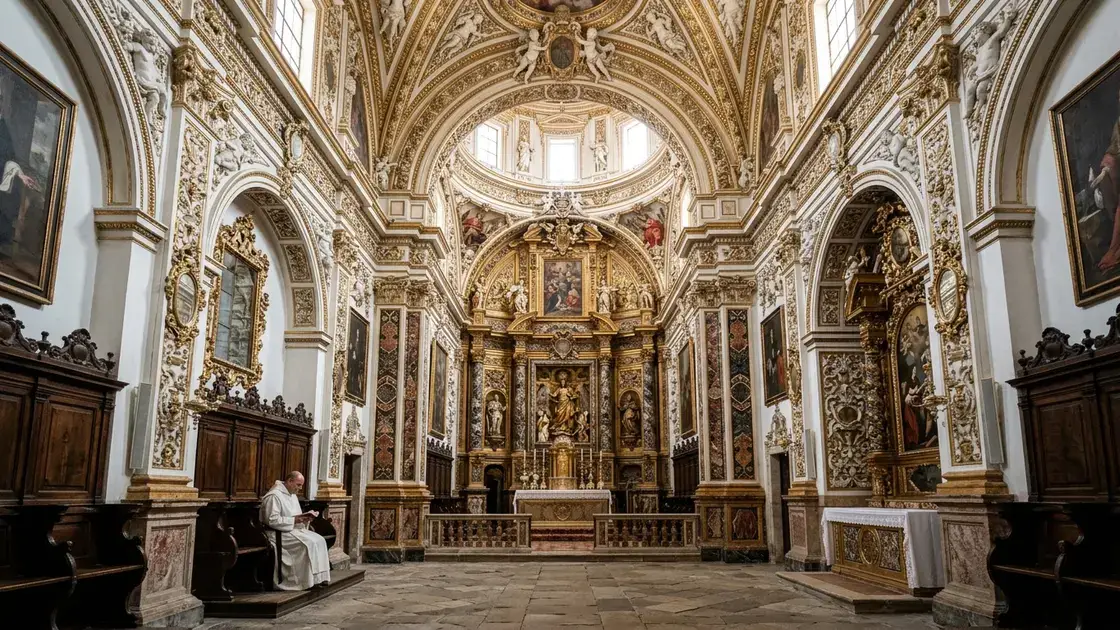
Gonzalo Fernández de Córdoba — El Gran Capitán, the general who carved out Spanish Italy with his pike squares — founded this Carthusian monastery in 1516, then promptly ran out of money. Construction dragged on for three centuries, with each generation of monks adding their own layer. The result is a building that shouldn't work architecturally but does: austere Carthusian exterior wrapped around an interior that gets progressively more extravagant as you move deeper in. The Carthusians were the strictest order in the Catholic Church. Perpetual silence, individual cells, no unnecessary contact. The monks who built this place lived like hermits. What they built in their church and sacristy is anything but austere.
The sacristy, completed between 1713 and 1747, is the reason to come. Architect Federico Hurtado Izquierdo covered every surface — walls, pilasters, ceiling — in polychrome marble inlay, carved stucco, and gilded woodwork. The altar tabernacle combines tortoiseshell, bronze, and silver into something that reads as almost abstract: a riot of geometry that somehow coheres. Art historians have compared it to the Alhambra in its commitment to total decoration, though the two buildings couldn't be more different in spirit. Where the Alhambra's Nasrid palaces use water, light, and repetition to induce calm, La Cartuja's sacristy piles material on material until it tips into ecstasy. Forty minutes in here will rewire your understanding of what Baroque can do.
In the chapter house, look for the paintings of Juan Sánchez Cotán. He arrived in Granada in 1603 — already famous in Toledo for his still-life paintings, those severe arrangements of quince, cabbage, and melon suspended on strings, rendered with an almost Dutch precision — and asked to be admitted as a lay brother. He spent the rest of his life here, painting religious works for the community. His large canvases in the chapter house show scenes of Carthusian martyrs and moments from the Passion: the same clarity of light and object that made his still-lifes extraordinary, now applied to figures. They're among the best things in Granada that most visitors never see.
Getting here takes a bit of effort. La Cartuja sits in the university district north of the city centre, a 25-minute walk from the cathedral or a short bus ride on line 8. Hours are split: morning session ends at 13:00, afternoon reopens at 16:00. Allow an hour for a proper visit. Entry is €6; Thursday afternoon admission is free if you book two weeks in advance by phone. For another angle on Granada's religious heritage beyond the Alhambra complex, the Abadía del Sacromonte guide covers the cave monastery on the opposite hillside — different order, different century, equally strange.