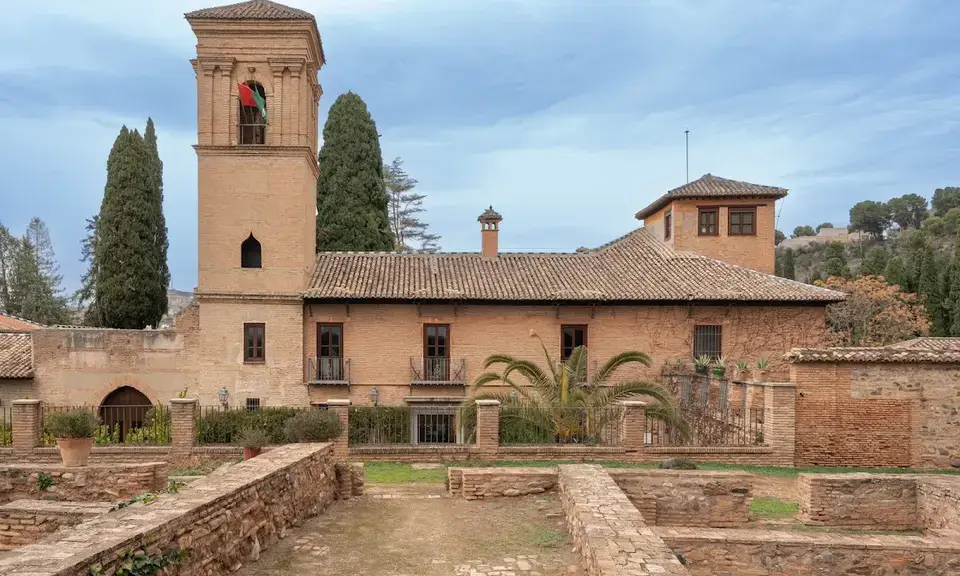
The only address that matters if the Alhambra matters
Every other hotel in Granada requires a taxi or a long uphill walk to reach the Alhambra. The Parador de Granada does not. It sits inside the walls of the UNESCO complex itself, built on the remains of a Nasrid palace and the convent of San Francisco — the same building where Ferdinand and Isabella were temporarily buried before their remains moved to the Royal Chapel in the city below.
That history is not decoration. The cloister, with its original Nasrid arches and a garden of orange trees and cypresses, is genuinely old — 14th-century stonework that has absorbed centuries of Andalusian heat. Guests who wake early enough can walk the Alhambra paths before the day-visitor crowds arrive at 8:00, when the site opens. The Generalife gardens are a five-minute stroll. You do not share those first hours with four thousand other people.
What 40 rooms means in practice
The Parador has just 40 rooms, which explains why this is the most-requested property in the entire Paradores network — all 93 of them. Standard twin and double rooms run around 230–420€ per night depending on season, with June at peak pricing. That price buys you location, not size. Rooms are comfortable rather than opulent, with exposed wooden beams, Castilian furnishings and double-glazed windows. The Superior rooms and suites look onto the gardens. If you are choosing between room types, the Superior facing the cloister is worth the step up.
Book direct at paradores.es for discounts: Golden Days rates for guests aged 55 and over, Young Persons rates for those aged 20 to 35. These are real savings, not marketing rounding. Paradores also runs seasonal promotions that are not available through OTAs like Booking.com.
The on-site museum
The hotel has its own museum — one of only three Paradors in Spain to operate one. The collection documents the building's history from its origins as a Nasrid royal precinct through its conversion to a Franciscan convent by the Catholic Monarchs in 1495. Ferdinand and Isabella were interred here temporarily; the physical evidence of that period, including carved stone elements and original frescoes, is displayed in the permanent collection. It is a serious museum, not a vanity display case for the hotel. Access is included for all guests and takes around 40 minutes to walk through properly.
Adjacent to the museum, the San Francisco chapel — still largely intact — gives a direct impression of what the 15th-century convent actually looked like before its later conversions. Few visitors to the Alhambra reach this interior.
Evenings inside the complex
After day visitors leave at closing time, the Alhambra grounds around the Parador quiet down dramatically. The cloister terrace in the evening catches the last light on the Nasrid Palaces stonework and is the right place for a drink before dinner. The restaurant serves Andalusian cuisine at Parador-standard prices — adequate, not destination dining. But eating inside these walls, with the gardens largely to yourself after dark, has an atmosphere the restaurant's food alone does not need to justify.
The Palace of Charles V, a Renaissance structure built within the Alhambra complex in 1527, is a five-minute walk from the hotel. After the public tours end, the courtyard sits empty and can be entered from the outside. In the early evening it is one of the more unexpectedly peaceful spaces in Granada.
The trade-offs
The Parador is expensive relative to what the room itself delivers. You are paying for exclusivity of address, not 500-thread-count sheets. There is no spa, no rooftop pool, no fitness room. Parking requires arriving on foot — no vehicles inside the Alhambra complex.
If your trip centres on the city, the Cathedral, the tapas bars on Calle Navas, the Albaicín neighbourhood — the Parador's isolation works against you. You will need transport or a 30-minute downhill walk each time. For visitors who plan to spend two or three days on the Alhambra and Generalife, or for anyone who has wanted to sleep inside a UNESCO World Heritage Site, no other hotel in Granada comes close.
Practically speaking
The Alhambra visit itself requires separate timed tickets booked well in advance through the official Patronato de la Alhambra website. Staying at the Parador does not include Alhambra entry. You still need to buy tickets like everyone else.
Wi-Fi is free throughout. Air conditioning works properly, which matters in a building with thick stone walls that trap heat through July and August. The quietest months, and the ones where the garden is at its best, are April, May and October. In winter the complex is genuinely deserted outside daylight hours; the snow on the Sierra Nevada is sometimes visible from the cloister garden, and the place feels entirely different from the summer version.