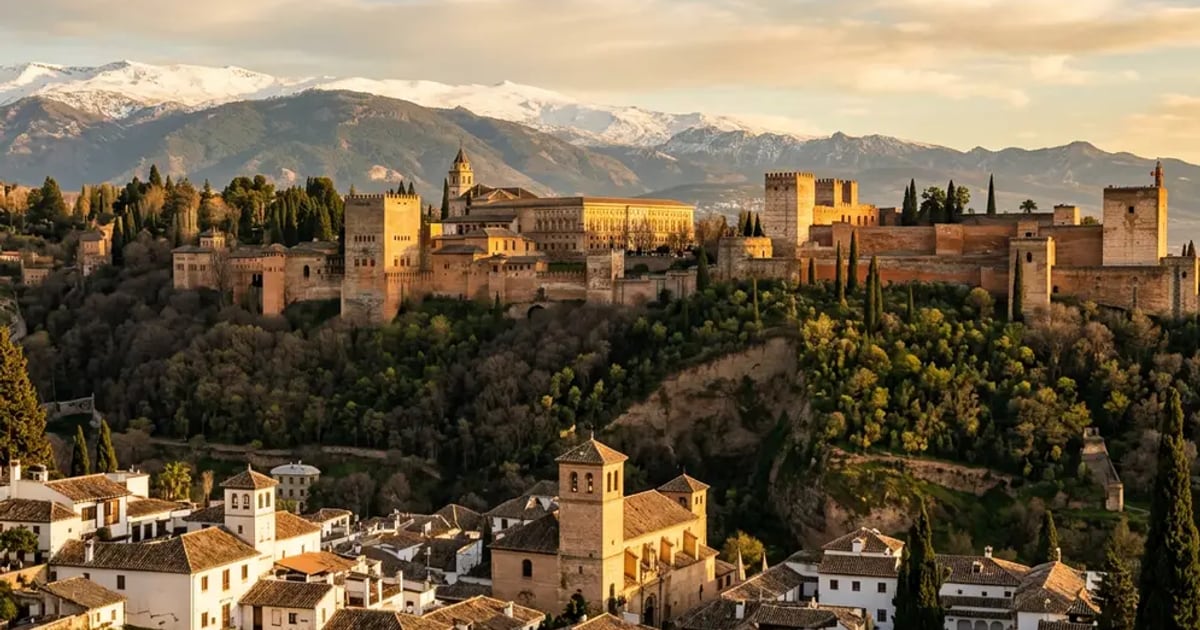
A clifftop city 150km from Granada, split by a gorge 98 metres deep. The Puente Nuevo bridge, Spain's oldest bullring, and an Arab medina that predates the Reconquista.
Seven years resident in Granada. Specialist in Nasrid architecture, Al-Andalus history, and Andalusian walking routes.
Published
Ronda sits on a tabletop plateau in the Serranía de Ronda, cleaved in two by the Guadalevín river, which over millions of years carved El Tajo — a gorge 98 metres deep and roughly 70 metres wide at the narrowest point. The Puente Nuevo bridge, completed in 1793, spans the gap. Below it, the river is a thin silver line. Above it, the whitewashed houses of La Ciudad, the old Moorish medina, hang over the edge as if someone forgot to stop building before the cliff.
From Granada, Ronda is about 150km by road. The ALSA bus takes 1 hour 40 minutes and costs roughly €14 return; by car on the A-92 and A-367 the drive is 1 hour 35 minutes. Either way you have enough daylight for the bridge, the bullring, the Arab baths, a proper lunch, and the walk down into the gorge — if you manage your time.
If you are comparing Ronda against other options, the day trips from Granada page sets out all six main destinations with travel times and what suits each type of visit. For the best months to go, the best time to visit Granada guide covers how seasonal patterns affect Andalusia more broadly.
Why Ronda makes sense as a day trip
Most of the towns in Andalusia's white village route require significant driving to reach the good bits. Ronda is the exception: the main reason to come — the gorge and the bridge — is a 10-minute walk from the bus station. You do not need a hire car to get around the old town. The historic centre is compact enough to cover on foot in half a day without backtracking.
The combination on offer is also unusually distinct. No other town in Andalusia has a 98-metre gorge running through its centre, the oldest bullring in Spain, Moorish Arab baths in reasonable condition, and a Renaissance palace converted into a museum — all within 800 metres of each other. Córdoba has more Islamic heritage; Seville has more cathedral. But for sheer geographical drama at close range, Ronda is in a category of its own.
Ronda in numbers
Distance from Granada: 150km via A-92/A-374 or A-92/A-367. Bus time: 1h40m (ALSA, approximately €7 each way). Drive time: 1h35m by car. Old town walking area: La Ciudad and El Mercadillo together, roughly 1.5km end to end. Main paid sights: Bullring (€8), Arab Baths (€3.50), Mondragón Palace (€3). The bridge and gorge viewpoints are free.
Getting there: bus vs car
By bus (ALSA)
ALSA runs two direct Granada–Ronda services daily from Granada bus station (adjacent to the train station on Av. del Sur). Journey time is 1h40m. The bus deposits you at Ronda's bus station on Avenida Concepción García Redondo, about 1km from the Puente Nuevo and a 10-minute walk along the gorge edge. Return tickets cost approximately €14.
Departures: Morning and midday (check alsa.es for current timetable)
Return: Book the return leg when you buy the outward ticket
The A-92 west from Granada is fast motorway to Antequera, then the A-374 south through the Serranía brings you into Ronda from the north. An alternative is the A-92 to Málaga then the A-357 west to Ronda, which is slightly longer but avoids mountain bends. The most scenic route is the A-367 through the Genal valley, but add 30 minutes. Park on the outskirts of La Ciudad; the old town streets are narrow and most are pedestrianised.
Drive time: 1h35m via A-92/A-374
Parking: Free parking at Alameda del Tajo or paid car parks near the bullring
Car hire in Granada: From the train station; approximately €30–50/day for a small car
Option
Travel time
Cost (return)
Flexibility
Bus (ALSA)
1h40m
~€14
Fixed schedule, 2 departures daily
Car
1h35m
€30–50 hire + fuel
Depart and return when you like
The Puente Nuevo and El Tajo gorge
The Puente Nuevo is not the oldest bridge in Ronda — that is the Puente Romano (Roman bridge) at the southern end of the gorge — but it is the most dramatic. Construction began in 1751 under Juan Martín Aldehuela and finished in 1793, after a first attempt collapsed in 1741 killing 50 workers. The completed bridge has three arches, the central one spanning 34 metres over a void of 98 metres. In the chamber inside the central arch, now accessible via a small museum, prisoners were held during the Spanish Civil War.
Standing on the bridge itself gives you little sense of the scale: the parapet is solid stone and you cannot see the drop. The gorge reveals itself from the viewpoints on either side of the bridge, and most clearly from below. The Camino de los Molinos descends into the gorge on the La Ciudad side: a steep path through olive trees that delivers you to a flat ledge with an unobstructed view of all three bridge arches from the riverbed level.
Mirador de Aldehuela
The closest formal viewpoint to the bridge, a few minutes south along the gorge edge from the Puente Nuevo. Named after the bridge's architect. Gives a side-on view of the bridge and the cliff face on the La Ciudad side. Free, no queue, better than standing on the bridge itself.
Camino de los Molinos (gorge descent)
The serious viewpoint. The trailhead is on the La Ciudad side of the bridge, just south of the Parador hotel. The descent is about 25 minutes on an uneven stone path; the ascent back up takes 30–35 minutes. At the bottom you reach the remains of the old mills (molinos) that gave the path its name, and a direct view of the Puente Nuevo's underside. Take water and wear proper footwear. Do not attempt in wet conditions.
Alameda del Tajo viewpoint
The Alameda del Tajo is a 19th-century promenade garden on the western edge of La Ciudad, running along the gorge cliff. The viewpoint at the far end gives the widest panorama: you see both cliff faces of the gorge, the bridge from a distance, and the countryside to the south opening out below. Best in the afternoon. No crowds.
The bullring and old town
The Real Maestranza de Caballería de Ronda (1785) predates all the other great bullrings of Spain. Seville's Maestranza opened in 1758 but reached its current form only in the 19th century. Madrid's Las Ventas opened in 1931. Ronda's ring, designed by Martín de Aldehuela (the same architect as the Puente Nuevo), is the original template for the Andalusian plaza de toros: a circular sand arena enclosed by two tiers of stone seating, the lower covered by a colonnade.
The museum inside covers the history of the Romero family, particularly Pedro Romero (1754–1839), who fought 5,600 bulls from this ring and codified the modern on-foot style of bullfighting. The costumes, lithographs, and matador portraits from the 18th century are well-presented. The ring itself is open to walk on between events, which is most of the year. Entry costs about €8.
The old town, La Ciudad, is the Moorish quarter that preceded the Christian reconquest in 1485. The street layout follows the original Arab medina: narrow lanes that curve and split without logic, opening occasionally onto small squares. The main axis runs from the Puente Nuevo south to the Arco de Felipe V and then to the Puente Viejo at the southern end. Allow an hour to walk it properly, or longer if you stop at the palaces.
Arab baths and Mondragón Palace
Baños Árabes (Arab baths)
Among the best-preserved Arab baths in Andalusia, built in the 13th or early 14th century on the banks of the Guadalevín river below La Ciudad. Three vaulted rooms — cold, warm, and hot — survive largely intact, with star-shaped skylights in the brick vaulting. The site is small (30 minutes is enough) but the structure is exceptionally legible compared to the more ruined baths in Granada's Albaicín. Entry €3.50. Located at the base of the gorge on the El Mercadillo side; walk down from the Puente Viejo rather than the Puente Nuevo.
Originally a Moorish palace, partially rebuilt after the Reconquest by the Catholic Monarchs as a royal residence, and converted into the town museum in the 20th century. The building itself is more interesting than many of the exhibits: the Mudéjar courtyard with its carved arcades, the horseshoe-arch doorways, and the garden terrace overlooking the gorge. The museum covers prehistoric and Roman finds from the Ronda region. Entry around €3. Allow 45 minutes.
Casa del Rey Moro gardens
A 14th-century house, partly restored, with a 14th-century mina de agua (water mine) — a staircase of 365 steps cut into the cliff face from the house down to the river, used by Christian slaves to carry water to the Moorish garrison. The staircase descends to the same level as the gorge floor, giving another view of the cliff walls from inside. Expect to queue in summer. Entry approximately €7 (includes the staircase).
Where to eat in Ronda
Ronda's food geography splits cleanly along tourist lines. The gorge-edge restaurants charge for the view; the streets of La Ciudad two blocks back from the cliff do not. The cooking is mountain Andalusian: rabo de toro (bull's tail stew), berza ronderña (stewed chard, chickpeas, and blood sausage), and game from the surrounding sierra. Skip the tourist menu and ask for the menú del día.
El Lechuguita
Calle Los Remedios, in the heart of La Ciudad. A proper tapas bar with no gorge view and no tourist menu, which is why locals eat there. The rabo de toro here is slow-cooked until the meat falls from the bone. Order the house wine by the glass — from a local Serranía bodega. Lunch from about 13:30; arrive before 14:00 or you will wait.
Menú del día in La Ciudad
Any of the smaller restaurants on Calle Armiñán (the main street of La Ciudad running parallel to the gorge) offers a three-course menú del día between 13:30 and 15:30 for €10–13. First course typically includes gazpacho or salmorejo, then a meat main (usually rabo de toro or pork ribs), dessert, and a glass of wine. The portions are Andalusian-sized; you will not need dinner.
What to avoid
The restaurants directly on the bridge parapet and on Calle Nueva (the street that leads to the Puente Nuevo viewpoint from El Mercadillo) add a significant premium for the view. The food is not markedly better and the prices are 30–40% higher than comparable restaurants in La Ciudad. Fine if the view is the priority; disappointing if you expect it to correlate with the food quality.
Best light and photography
Ronda is a difficult subject in the middle of the day. The gorge runs roughly north–south, which means the cliff faces are side-lit rather than front-lit from about 11:00 to 14:00. Morning light hits the La Ciudad side; afternoon light hits the El Mercadillo side. The Puente Nuevo reads best in afternoon, when the sun is behind most of the gorge-edge viewpoints.
Morning (before 11:00)
The east-facing walls of La Ciudad are in direct morning light. This is the time for the Mondragón Palace garden terrace and the Arab baths area. The Puente Nuevo from the bridge parapet is front-lit in the morning, which gives a clean image with the gorge visible below.
Afternoon (14:00–17:00)
The best time for the Camino de los Molinos descent. From the gorge floor, the bridge's stone arches are lit from the west, picking up texture and detail. The Alameda del Tajo gardens give a panoramic view with warm afternoon light on both cliff faces. The crowd from mid-morning has thinned by 15:30.
“Ronda is one of those places where the first view of the gorge makes you involuntarily stop walking. The photographs you've seen don't prepare you for the scale.”
— James Walker, resident correspondent
When to go
Ronda is at 750 metres altitude, which makes it significantly cooler than the coast or Granada city in summer. July and August still reach 35–38°C by midday, and the gorge viewpoints are fully exposed. The real problem in high summer is crowds: the Costa del Sol is 1 hour away, and from June through August Ronda receives heavy day-tripper traffic from Marbella, Málaga, and Puerto Banús. The bridge parapet is standing-room-only by noon.
Best months
April–May: 20–25°C, spring wildflowers in the gorge, manageable crowds, morning light on the bridge and cliff.
October: 22–25°C, low golden light, thin crowds after mid-September. The best month for photographs.
Early September: Feria de Pedro Romero (first week of September) with the Goyesca corrida — the single event most associated with Ronda.
Months to approach carefully
July–August: The bridge is packed by 11am. The old town bakes in the afternoon. Go very early (arrive before 10am) or accept the crowds.
December–February: Cool and quiet (12–15°C), no crowds, but the gorge is often in shadow by early afternoon. The Arab baths and Mondragón Palace are the better cold-weather choices.
Frequently asked questions
Frequently asked questions
Can you do Ronda as a day trip from Granada?
Yes, straightforwardly. Ronda is 150km from Granada and the journey by bus or car takes 1 hour 35–40 minutes. ALSA runs two departures daily from Granada bus station: one in the morning and one midday. A 9:00am bus arrival in Ronda gives you roughly 7 hours before the last return service. By car, leaving Granada at 7:30am puts you in Ronda by 9:15am for the best morning light on the gorge. The town is compact enough that you can see the main sights, have a proper lunch, and still make the evening return without rushing.
Is it better to go to Ronda by bus or car?
Either works, but they suit different priorities. The bus (ALSA, approximately €14 return) is cheaper, stress-free, and drops you at Ronda's bus station, a 10-minute walk from the historic centre. The limitation is schedule: only two daily departures from Granada, and the morning one leaves around 7:00–8:00am. By car (A-92 west then A-374 or A-367 south), the drive takes 1 hour 35 minutes and gives you flexibility to stop at the Tajo viewpoints and leave on your own schedule. Car hire in Granada runs €30–50 per day.
How long does it take to walk the Puente Nuevo?
The Puente Nuevo itself takes about 5 minutes to cross. The worthwhile experience is not walking across it but viewing it from below: the Camino de los Molinos trail descends into the gorge from the old town and brings you to a viewpoint directly beneath the bridge's 98-metre central arch. The descent and return takes 45–60 minutes. Go in the afternoon when the sun is behind you rather than in your eyes.
Is the Ronda bullring worth visiting?
Yes, for the building and the museum rather than any connection to active bullfighting. The Real Maestranza de Caballería de Ronda (1785) is the oldest bullring in Spain and the origin point of modern corrida technique — Pedro Romero, who fought here in the 18th century, is credited with standardising the on-foot style. The museum inside is well-curated, with 18th-century costumes, matador portraits, and the history of the Romero fighting dynasty. Entry costs approximately €8. The inner ring is open to walk on between events.
What is the best viewpoint for the Ronda gorge?
There are three distinct viewpoints, each giving a different angle. The Puente Nuevo bridge parapet is the obvious one, looking straight down 98 metres to the Guadalevín river. The Mirador de Aldehuela, a few minutes' walk south along the gorge edge, gives a side-on view of the bridge and both cliff faces. The Camino de los Molinos viewpoint (reached by descending into the gorge, 45 minutes return) is the most dramatic: you look up at the bridge from below. The Alameda del Tajo gardens on the western edge of La Ciudad provide the widest panorama, with afternoon light.
When is the best time to visit Ronda?
Spring (April–May) and autumn (September–October) are the most comfortable. Summer in Ronda sits at 35–38°C in July and August, and the gorge viewpoints have no shade. The crowds peak in summer; by mid-morning in August the bridge parapet is shoulder to shoulder. October is particularly good: temperatures drop to 22–25°C, the light is low and golden in the afternoon, and the town is noticeably quieter. May brings the Feria de Pedro Romero in early September — worth coinciding with if your dates are flexible. See the best time to visit Granada guide for how seasonal patterns affect both the city and day-trip options.
Reporter notebook
Insider tips
Practical observations gathered the way a local journalist would keep them: short, specific, and more useful than brochure copy.
Crowd tip
Arrive before 11am — the bridge fills up fast
Tour coaches from the Costa del Sol start arriving in Ronda between 10:30am and 11:00am, and the Puente Nuevo parapet becomes genuinely congested by noon. If you arrive by 9:30am you will have the bridge to yourself for at least an hour. The same window applies to the Mondragón Palace courtyard, which is enclosed and narrow. The afternoon crowd thins again after 15:30, once the day-trippers from Marbella and Málaga head back.
Photo spot
The Camino de los Molinos for the real Puente Nuevo shot
Every photograph on every postcard of Ronda shows the Puente Nuevo from below — and that view requires descending into the gorge via the Camino de los Molinos, a steep path that starts just south of the bridge on the La Ciudad side. The descent takes about 25 minutes; the viewpoint is a flat ledge directly beneath the 18th-century arch. Afternoon light (14:00–16:00 in summer, 13:00–15:00 in spring) hits the bridge face-on. The path is marked but not maintained: wear shoes with grip.
Money tip
Lunch in La Ciudad is cheaper than anything near the bridge
The restaurants with Puente Nuevo views on the gorge edge add at least 30% to their prices. The old medina (La Ciudad) two streets back from the gorge edge has no views and much better value: a three-course menú del día costs €10–13 in the side streets around the Mondragón Palace. El Lechuguita on Calle Los Remedios is the spot locals mention unprompted. Same quality of food, no tourist premium, 5 minutes from the bridge on foot.